
XLR Male to RCA Female Adapter Cable
4.8Editor score
Nickel-plated metal shell
Rivet-secured connector joint
Two adapters included
This RCA to XLR Adapter guide compares 10 options for connector compatibility, signal type, shielding, build quality, channel needs, setup ease, and durability.
An RCA to XLR adapter bridges the gap between consumer-style RCA connections and professional XLR equipment, allowing mixers, microphones, amplifiers, receivers, DJ controllers, and studio interfaces to work together. The right adapter depends on connector gender, balanced or unbalanced signal handling, channel configuration, shielding, and the construction needed to withstand regular plugging and repositioning.
This guide compares ten adapters and cables by examining their connector combinations, conductor or contact design, shielding, cable format, channel support, intended applications, customer ratings, and included quantities. It covers compact couplers, short signal-conversion cables, color-coded pairs, a stereo Y-cable, and higher-end audiophile models so readers can compare more than just plug shape.
Each selection highlights a different practical use: connecting XLR outputs to RCA inputs, adapting RCA cables to XLR inputs, or splitting a three-pin XLR connection into separate right and left channels. Ratings and product details reflect the supplied listings, while availability, promotions, and market conditions can change after publication.
4.8Editor score

4.6Editor score

4.8Editor score
The comparison below organizes all ten products by their exact connector configuration, signal approach, construction, and practical role. It makes clear whether an adapter is a passive coupler, a short conversion cable, a stereo splitter, or a premium audiophile connection.
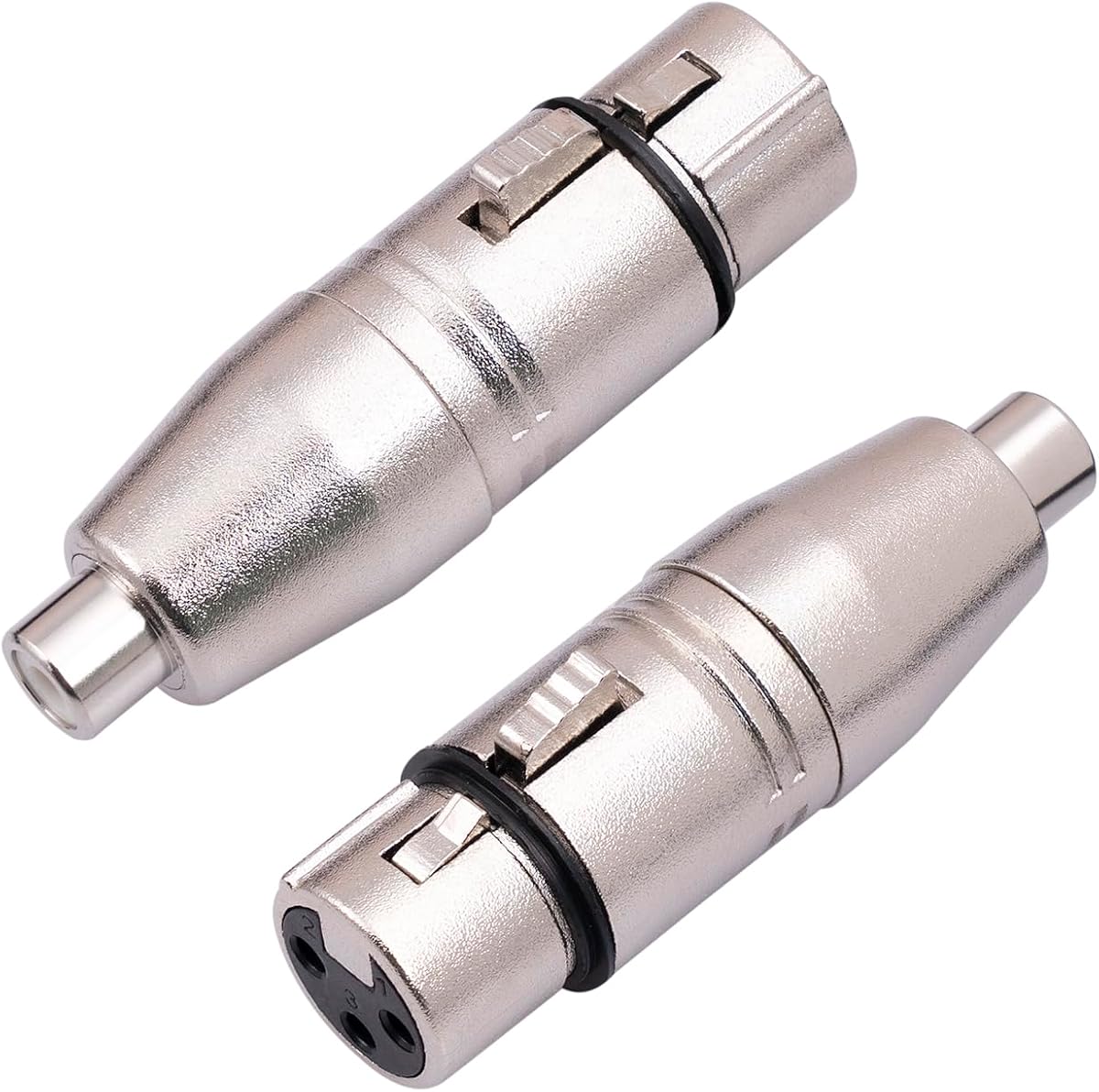


This compact two-pack converts an XLR male connection into an RCA female connection, making it a practical bridge between professional equipment and RCA-based audio devices. Its 4.8 rating is the highest among the products in this guide, while the nickel-plated metal shell and riveted connector joint suggest a design intended for repeated use rather than a disposable loose coupler.
We may earn a commission when you buy through this link, at no additional cost to you.
The most useful feature is the unusually clear adapter configuration. An XLR male plug fits into a female XLR output, while the RCA female end accepts a standard male RCA cable. That arrangement works particularly well for sending an XLR output into an amplifier, powered speaker, interface, or other RCA input without requiring a custom-made cable.
The trade-off is that this is a connector adapter rather than a full signal-conversion cable. It does not independently transform a balanced source into a stereo pair, and the supplied description does not identify any active electronics. It also does not color-code the RCA channels, so users should verify that they are working with a single relevant channel rather than assuming it handles left and right stereo automatically.
This is a strong general recommendation for anyone seeking a simple, well-rated, two-pack solution. It is particularly useful for mixers, audio players, power amplifiers, and microphones that expose the required XLR and RCA interfaces. The included quantity also makes it easier to keep one adapter in a mixer bag and another near an amplifier.
The riveted shell connection avoids loose screw hardware that can work loose during transport. Its all-metal exterior also makes it better suited to mobile rigs, rehearsal rooms, and home studios than a lightweight plastic coupler.
Two matching adapters support common stereo or multi-device arrangements, although users should confirm channel requirements before assuming the pair handles stereo conversion automatically.
We may earn a commission when you buy through this link, at no additional cost to you.
This adapter is designed for a different direction of travel than most of the other products: it combines an XLR female connector with an RCA female connector. That makes it useful when the RCA cable is already present and the XLR-equipped device has a male output that needs a female XLR input.
We may earn a commission when you buy through this link, at no additional cost to you.
Its 4.6 rating reflects a favorable customer response, and the construction details support regular use. The full metal shell resists physical wear, the electroplated exterior is intended to resist fading and corrosion, and the copper-nickel contacts are described as providing reliable connectivity.
Unlike a direct RCA-to-XLR cable, this unit requires a separate RCA male-to-male or RCA male-to-female cable depending on the equipment in use. The extra connection can be inconvenient in a tight rack, and the pair should not be mistaken for a stereo Y-adapter. Both are important limitations to understand before buying.
The recommendation is strongest for people building modular audio chains around mixers, recorders, and amplifiers. It is a useful gender-changing solution for anyone who wants to preserve existing RCA cables and add an XLR interface without replacing the entire cable run.
The female RCA end accepts standard RCA cables, making this a convenient option when a useful RCA lead is already installed and only the XLR interface needs adapting.
The electroplated full-metal shell combines a durable exterior with a stable connector joint. It remains important to keep the unused adapter stored somewhere it cannot be bent or crushed.
We may earn a commission when you buy through this link, at no additional cost to you.
This two-pack of eight-inch cables directly converts a three-pin XLR male connection to an RCA male plug, with the listing explicitly describing balanced-to-unbalanced signal conversion. That makes it one of the clearest options for readers who need an actual cable rather than a passive connector coupler.
We may earn a commission when you buy through this link, at no additional cost to you.
The cable uses 4N oxygen-free copper conductors with 20 AWG shielded twisted-pair construction. A high-density braid and aluminum-foil layer provide shielding against EMI and RFI, while 24K gold-plated contacts support reliable contact. A flexible PVC jacket and rubber strain relief add protection at likely stress points.
Its short length is the main limitation. Eight inches works well for equipment mounted close together, but it may not reach between a mixer and a rack unit positioned farther apart. Each cable also provides one RCA connection, so stereo requires the correct two or more source connections and the appropriate channel wiring.
This is a strong recommendation for nearby mixers, recorders, interfaces, and amplifiers where a compact shielded conversion cable is more convenient than a separate adapter and RCA lead. The explicit balanced-to-unbalanced description, shielding, strain relief, and two-pack format make it particularly useful for practical home-studio or live-sound hookups.
Unlike a simple coupler with ambiguous wiring, this listing expressly identifies balanced XLR input being converted to an unbalanced RCA signal. Users should still verify channel and pin requirements with their equipment.
The combination of copper braid and aluminum-foil shielding is intended to reduce electromagnetic and radio-frequency interference, which can be valuable near dimmers, computers, power transformers, and other noisy sources.
We may earn a commission when you buy through this link, at no additional cost to you.
This two-pack combines XLR male and RCA female connectors in a zinc-alloy body with 24K gold-plated contacts. Its 4.7 rating places it among the strongest-rated options, and the red-and-white color coding gives it a practical advantage when identifying stereo channels.
We may earn a commission when you buy through this link, at no additional cost to you.
The listing emphasizes minimal resistance, rapid signal transfer, and preservation of detail and dynamic range. It also describes oxygen-free copper conductors, a nickel-locked mechanism, and shielding within the solid body. Those features are appealing for users who want a more substantial connector than a loose plastic gender changer.
The important limitation is that the listing presents the product as an adapter and does not explicitly describe balanced-to-unbalanced conversion. It should therefore be evaluated as a connector bridge rather than assumed to solve every wiring or channel problem. Separate RCA cables are also required because the RCA end is female.
This is a compelling choice for home studios, DJ setups, amplifiers, and stereo connections where channel identification matters. The two-pack is especially useful when a mixer or interface has XLR outputs that need to travel to separate red and white RCA inputs without guessing which connector belongs to each side.
Red and white markings reduce the chance of reversing left and right channels. The color system is especially helpful in dim entertainment spaces, crowded racks, and temporary event setups.
Gold-plated contacts, a zinc alloy shell, and a nickel locking mechanism are intended to improve contact stability and resist interference. These attributes do not make the adapter appropriate for every wiring configuration, so connector and channel checks remain essential.
We may earn a commission when you buy through this link, at no additional cost to you.
This four-pack provides XLR male to RCA female adapters with five-micron 24K gold-plated contacts and zinc alloy shells. Its larger quantity makes it the most complete multi-adapter set in the list, while the 4.3 rating is still positive but lower than the ratings of most alternatives.
We may earn a commission when you buy through this link, at no additional cost to you.
The adapters are supplied in classic red and white to help distinguish left and right channels. Their solid bodies are described as resistant to wear, providing a tight, gap-free connection and shielding against external electromagnetic interference. The construction is appropriate for repeated integration between professional and home audio equipment.
Four adapters do not automatically create a four-channel converter. They provide four connector bridges, and the user must determine how many outputs, inputs, and signal channels the source and destination require. The listing also uses converter language without giving the same explicit pin-level detail provided by the WJSTN cable.
The set is most useful for a multi-zone home audio system, a compact DJ or rehearsal setup, or users who want spare adapters in several locations. It is a sensible choice when convenience and inventory matter more than maintaining the smallest possible collection of individual accessories.
The four included adapters make it convenient to link several pieces of equipment or keep matching spares nearby. They remain passive connection accessories rather than a complete multi-channel signal processor.
The five-micron plating and zinc alloy housing combine corrosion-resistant contact surfaces with physical protection. That balance suits home theaters, rehearsal spaces, and mobile audio carts.
We may earn a commission when you buy through this link, at no additional cost to you.
This two-pack is a straightforward option for bridging XLR male outputs and RCA female cable connections. It offers five-micron gold-plated contacts, a zinc alloy shell, and red-and-white channel identification, making it closely aligned with the needs of a conventional stereo link.
We may earn a commission when you buy through this link, at no additional cost to you.
The 4.3 rating is solid but sits at the lower end of this comparison. The product description highlights fast signal transfer, minimal signal loss, interference shielding, and a secure fit. It also lists compatibility with receivers, amplifiers, speakers, DJ gear, and mixers connected to interfaces.
As with the similar four-pack, the exact pin-level conversion is not described. Consequently, users should not assume that every XLR output will behave identically when reduced to RCA. The product also requires existing RCA leads because the incorporated connector is female.
This is a good fit for a home stereo or theater that already uses red and white RCA wiring and needs to connect it to XLR-equipped source gear. It may be less compelling for users seeking documented balanced conversion, detailed channel wiring, or a fully shielded cable run.
The red and white adapters support straightforward left and right identification. This makes the pair convenient when connecting an XLR-equipped device to a conventional two-channel RCA input.
A gap-free fit and shielded zinc alloy body help protect the connection from movement and external interference. Proper strain relief on any connected RCA lead will further improve longevity.
We may earn a commission when you buy through this link, at no additional cost to you.
This Cardas Audio pair is the premium-focused option in the guide, with a 4.8 rating and a construction brief centered on high-end contact materials. It combines a female RCA connector with a male XLR connector, providing the orientation needed to attach an XLR-equipped destination to an existing RCA cable.
We may earn a commission when you buy through this link, at no additional cost to you.
Its contacts use rhodium over silver, while the body is made from non-magnetic eutectic brass. The listing specifically credits the construction with efficient shielding that rejects RF and clock signal interference. Tight connections and a secure lock add confidence for stationary high-fidelity systems.
These strengths come with trade-offs. The adapters are the most expensive option in the comparison, their metal construction may be unnecessary for casual listening, and they still require separate RCA cables. They also do not advertise active electronic conversion, so their suitability depends on the source and destination signal format.
The recommendation is aimed at discerning users who already own a high-quality RCA cable and want a more refined XLR interface. For an audiophile system, the premium plating, shielding, and secure mechanical connection are more relevant than simply matching a plug to a socket.
Rhodium over silver is intended to provide enhanced connectivity while the non-magnetic brass body reduces the risk of unwanted magnetic influence. These choices suit users who prioritize signal integrity.
The efficient shielding is presented as a defense against RF and clock-related interference. In a carefully arranged system, this can support cleaner communication between source components and an XLR-equipped audio device.
We may earn a commission when you buy through this link, at no additional cost to you.
This is the list's dedicated Y-cable, using one three-pin XLR male connector at one end and two phono RCA plugs at the other. Its 4.7 rating and 1.5-meter length make it useful when a single XLR-equipped source needs to reach a stereo pair of RCA inputs.
We may earn a commission when you buy through this link, at no additional cost to you.
The cable includes high-density shielding and aluminum-foil shielding intended to reduce EMI and RFI interference. A flexible PVC jacket, nickel-plated contacts, and rubber strain relief support dependable use. The listed applications include mixed consoles, microphones, tape recorders, amplifier line outputs, DJ controllers, home theater equipment, and professional audio gear.
Its key limitation is that splitting an XLR into two RCA plugs does not universally mean the XLR contains discrete left and right channels. Users need to verify whether the XLR source carries stereo, two mono signals, or a single balanced signal. The listing is therefore better understood as a connection-format tool than a guaranteed universal converter.
The recommendation is best for a user with a verified stereo XLR output or for a temporary connection around a mixer, recorder, amplifier, or home-theater installation. Its extra length provides more routing freedom than the short eight-inch and six-inch cable options.
The dual-RCA end provides separate red and white connections from one XLR plug. That makes setup quicker when the source has already been confirmed to carry left and right audio.
At 1.5 meters, the cable can bridge more distance than a compact adapter or short patch cable. Routing it away from power cables and securely supporting both ends will help preserve connection quality.
We may earn a commission when you buy through this link, at no additional cost to you.
This two-pack offers 4.92-foot RCA male to XLR male cables for users who want a complete lead rather than a separate adapter and RCA cable. Its 4.7 rating, 4N oxygen-free copper conductors, advanced shielding, and heavy-duty jacket make it one of the more elaborately constructed options in the comparison.
We may earn a commission when you buy through this link, at no additional cost to you.
The shielding combines a high-density tinned copper braid, double-layer PVC shielding, and ferrite cores to address EMI and RFI interference. The connectors use five-micron 24K gold plating over pure copper cores, while the nylon braid resists wear, pulling, and repeated bending. The two-cable pack can support parallel or spare connections.
The male-to-male orientation is the decisive compatibility detail. It cannot connect directly to female RCA outputs or female XLR inputs without another appropriate cable or adapter. The product copy also includes strong longevity and performance claims, but those statements should not be interpreted as independently verified laboratory findings.
This is a good recommendation for a permanent or semi-permanent hi-fi arrangement where cable length, flexible routing, and a braided exterior matter. It is less suitable as a compact travel adapter or as a solution requiring female connectors on either end.
Tinned copper braid, PVC shielding, and ferrite cores provide several forms of interference protection. The layered approach is useful in homes where audio components sit near computers, gaming systems, or power converters.
The 4.92-foot length offers practical reach around a cabinet or entertainment center, while the nylon braid helps tolerate repeated handling. Coiling the cable loosely and avoiding sharp bends will support long-term use.
We may earn a commission when you buy through this link, at no additional cost to you.
This six-inch two-pack uses an RCA male connector and a three-pin XLR female connector. Its 4.5 rating is credible, but the strongest feature is transparency: the listing explains the unbalanced format and identifies how XLR pin two relates to the RCA positive pole and how pins one and three relate to the negative poles.
We may earn a commission when you buy through this link, at no additional cost to you.
This explicit wiring information helps distinguish the product from adapters that simply reveal connector genders. It is designed to connect XLR microphones and components with RCA circuits, including AV receivers, DVD or VCD equipment, equalizers, compressors, interleavers, and digital decoders.
The six-inch length is excellent for equipment positioned close together but may be too short for a room-sized installation. Because the product is unbalanced only, users seeking a fully balanced XLR pathway should choose another solution. The two RCA male plugs also need to fit the destination's connector type.
The recommendation is strongest for compact setups where a short, understandable cable is more useful than elaborate construction. Users who want precise knowledge of the pin relationships can benefit from the supplied specification, while those needing balanced signal support should look elsewhere.
The documented relationship between XLR pins two, one, and three makes it easier to understand the unbalanced conversion before installation. It also helps users recognize when an equipment mismatch exists.
At six inches, the cable works well when a receiver, amplifier, recorder, or small mixer sits near the destination input. Longer runs are possible but may require a different cable length.
We may earn a commission when you buy through this link, at no additional cost to you.
Connector gender is only the starting point. A useful RCA to XLR adapter must also match the intended signal direction, channel layout, equipment connectors, signal format, and physical environment, so the following factors help narrow the options before purchase.
Start by writing down the gender of the connector on each device and the direction the signal will travel. An XLR male to RCA female adapter accepts a male XLR output and then requires an RCA male cable at the opposite end. An XLR female to RCA male cable instead plugs into a female XLR input while presenting a male RCA connection to the source. A female-to-female coupler often supports existing RCA leads, whereas a male-to-male lead is the simplest solution when both devices have male output connectors.
Choose the connector orientation that completes the path with the fewest extra pieces. Gender mistakes are common because XLR is frequently identified only by shape rather than by male or female contacts.
RCA connections are generally associated with unbalanced consumer audio, while professional XLR interfaces may carry balanced mono signals. A direct adapter can change the connector but cannot magically make an unbalanced destination accept a fully balanced signal. Some listed cables explicitly perform a balanced-to-unbalanced conversion, while others describe only physical connectivity. Check the documentation of both the source and destination before choosing a passive adapter.
For critical studio work, confirm whether either device already provides an unbalanced XLR-compatible output. If not, a converter or interface designed for the required signal path may be more appropriate than a simple cable.
One XLR connector may carry one mono channel, two separate conductors in a balanced configuration, or a stereo pair with pin one acting as a shared ground. An XLR-to-dual-RCA cable therefore does not guarantee that left and right channels will appear on the red and white plugs. Read the product's pin details and verify the source's channel arrangement. Compact one-to-one adapters work best when each XLR connection already represents the relevant mono channel.
Users should avoid assuming that a two-pack automatically performs stereo conversion. The correct arrangement depends on the number of XLR outputs, the number of RCA inputs, and whether the devices use shared or isolated returns.
Shielding can reduce electromagnetic and radio-frequency interference, particularly near computers, stage lights, dimmers, power transformers, and poorly isolated power supplies. Stronger options use braided conductor shielding, aluminum-foil layers, ferrite cores, or a solid metal body intended to limit interference. For short, quiet desktop connections, a well-made basic adapter may be sufficient. For a permanent home-theater or studio chain, shielding and stable contacts deserve more attention.
Look for a defined shielding description rather than vague claims of premium sound. Shielding is only one part of a clean installation, so cable routing and connector compatibility still matter.
Contact plating can improve corrosion resistance and maintain a consistent electrical connection over time. Common options in this guide include gold-plated contacts, copper-nickel plating, nickel-plated connectors, and rhodium over silver. Gold and rhodium are especially common on premium or audiophile products, while plated nickel and copper-nickel provide durable alternatives. The connector shell should also be rigid enough to resist movement and easy to grip without damaging the attached cable.
Prioritize secure contact and sound mechanical construction over decorative plating alone. A well-designed body, proper strain relief, and a secure locking mechanism can contribute more to daily reliability than connector decoration.
Adapter-style products eliminate cable clutter and work well when devices are close together. Short six- or eight-inch leads provide enough movement for a desktop or rack connection without creating excess cable loops. Longer RCA-to-XLR cables are more useful when equipment sits across a cabinet, around a room, or in a larger installation. A Y-cable may also be necessary when one XLR source must feed two RCA destinations.
Choose the shortest length that permits easy routing without strain. Excessively long cables can create clutter, tangles, and unwanted strain, while an overly short lead may force a sharp bend at the connector.
For mobile use, a compact metal adapter can be easier to carry than a full cable, and a two-pack allows one unit to remain with each device. For permanent installations, a cable with a nylon braid or flexible PVC jacket may offer better strain relief and easier routing. A 1.5-meter Y-cable is more useful in a fixed setup but takes more space in a bag. Think about where the connector will live, how often it will be removed, and whether it may be dropped or crushed.
A protective case or small cable pouch is useful for loose metal adapters. For installed cables, secure the connection at both ends and avoid leaving unsupported plugs hanging from equipment.
Premium materials, multiple adapters, and color coding are useful only when they solve a practical issue. A simple nickel-plated coupler may be ideal for a one-off connection, while a premium matched pair may be justified in a carefully assembled audiophile system. A color-coded set helps with stereo routing, and a two-pack provides spares. A longer cable reduces the need for separate components, but added length can complicate placement.
Set a budget and identify the most important requirement before shopping. The most feature-rich adapter is not automatically the best choice if its connector orientation or signal format does not fit the system.
Begin by identifying the source output, destination input, and required channel. Power off the equipment when practical, inspect both sockets, and make sure the adapter's male and female ends match the correct sides. Connect the XLR end first, then secure the RCA cable with a light pull check. If the connection feeds an amplifier or passive speakers, turn the amplifier off before changing cables.
Route the cable and adapter away from power cords, dimmer controls, and other interference sources. For a stereo connection, verify red and white channel assignments at both ends rather than relying solely on color. If there is hum, a missing channel, or unexpected distortion, disconnect the setup and check connector compatibility, pin wiring, grounding arrangements, and source balance before changing equipment.
To care for the adapter, hold the metal connector body rather than pulling on an attached cable. Store loose pieces in a pouch or compartment where they cannot be bent. Inspect the contacts for dirt, oxidation, bent pins, or loose joints, and keep the connection free of moisture. Long cables should be loosely coiled, while unused adapters should remain protected from impact.
It depends on the adapter's wiring and the direction of the signal. Some dedicated XLR-to-RCA cables explicitly provide a balanced-to-unbalanced conversion, while passive connector couplers simply change the physical connection. Check the pin arrangement and the documentation for both the source and destination before assuming compatibility.
The difference is the gender of the connectors and therefore the direction of the cable path. An XLR male to RCA female adapter plugs into a female XLR output and accepts a male RCA cable. An XLR female to RCA male cable plugs into a female XLR input and connects to a source with a male RCA output.
No. The result depends on what the XLR source carries and how its pins are wired. A dual-RCA Y-cable is useful when the source already provides separate stereo channels, but it may not split a single balanced or mono signal correctly. Check the device manual or test the channels before relying on the output.
Gold plating is useful because it is corrosion-resistant and supports dependable contact, but it is only one part of adapter quality. Connector fit, secure locking, internal wiring, shielding, strain relief, and correct channel configuration can matter more. A well-made plated-nickel adapter may be perfectly suitable for a basic home audio connection.
Most compact adapters included in this guide have at least one female RCA end, so they require a separate RCA cable to reach the destination. Products with male RCA ends are complete leads for compatible equipment. Always check both connector genders before choosing a model for your setup.
Start by checking that all cables are fully seated, that the source and destination are compatible, and that the channel wiring matches the manufacturer's guidance. Keep the signal cable away from power cables and poorly isolated power adapters. A hum that persists may indicate a grounding or signal-format issue rather than an adapter fault.
Only when the electrical requirements match. A microphone usually needs a microphone-level input, while many RCA destinations accept line-level audio. Connecting the plugs correctly does not guarantee compatible signal strength, and a powered microphone may need additional gain or a suitable preamplifier.
A short six- or eight-inch cable is convenient when devices are adjacent, while a longer lead provides more routing freedom around a desk or cabinet. Choose the shortest length that avoids tension and allows connectors to sit straight. For a permanent installation, secure both ends and provide strain relief to protect the plugs.
The XLR Male to RCA Female two-pack stands out as the best overall option because it combines a 4.8 rating, durable metal construction, and a broadly useful connector configuration. The short XLR-to-RCA cable earns the Editor's Choice position for its documented balanced-to-unbalanced conversion, shielded oxygen-free copper conductors, and short-cable convenience, while Cardas provides the premium path for listeners who value refined contacts, shielding, and secure locking connections.
Before choosing, prioritize the connector direction, signal format, and channel layout over decorative features. Use a female-to-female coupler when existing RCA leads need adaptation, a dual-RCA cable only when the XLR source is confirmed to carry the required channels, and a complete male-to-male cable when both devices present male connectors. Match the construction to the environment and the importance of long-term reliability.
Finally, confirm the current product details, included quantity, connector orientation, and manufacturer documentation at the time of purchase. Listings can change, promotions may come and go, and equipment revisions can alter compatibility. Checking those details before ordering helps ensure that the selected adapter genuinely fits the intended audio path.