
Elitech CLD-100
4.3Editor score
Six-second preheating period
Six sensitivity settings
Eight-inch flexible probe
Audible and visual alarms
Our 10 Best Refrigerant Leak Detector picks compare sensor type, sensitivity, displays, probes, alerts, power, and refrigerant support for HVAC and automotive
A refrigerant leak detector helps technicians find escaping refrigerant in air-conditioning and refrigeration systems before a small problem becomes a major service issue. The right instrument balances sensitivity, response speed, probe flexibility, readable displays, useful alarms, and compatibility with the refrigerants found in today’s HVAC equipment.
We compared the ten models using the information supplied for each product, including sensor technology, stated leak sensitivity, refrigerant coverage, probe design, display functions, alert options, power requirements, and field-service features. The list covers traditional heated-diode and semiconductor tools, rechargeable models, infrared units, and practical entry-level detectors.
Each review explains who benefits most from the design and where its limitations may matter. Ratings reflect the supplied customer feedback, while technical details describe manufacturer claims rather than independent test results. Availability and pricing can change, so confirm the current listing and specifications before buying.
4.3Editor score

4.8Editor score

4.4Editor score
The table below compares all ten detectors by sensor platform, sensitivity, probe style, display, alerts, power, and refrigerant compatibility so technicians can identify the most appropriate tool for a particular system or job.




The Tadeto Rechargeable Refrigerant Leak Detector combines an accessible layout with a 4.8 supplied rating, the highest among the ten products considered. Its compact body, digital display, 11-inch gooseneck probe, and combined audible, light, and LCD alerts make it a strong general-purpose option for residential HVAC, automotive air conditioning, and commercial refrigeration work.
We may earn a commission when you buy through this link, at no additional cost to you.
The sensing system is intended for halogen refrigerants, including R22, R134a, R410a, R404a, R1234yf, and other common CFC, HCFC, and HFO refrigerants. Real-time readings and a bar graph can help the operator observe how concentration changes while approaching a suspected leak. A non-slip handle supports longer inspections, while the bendable probe can reach around coils, hoses, valves, and service ports.
Rechargeable Type-C power removes the routine expense and interruption associated with disposable batteries. The package includes the detector, a user manual, a charging cable, and a carry bag, making it reasonably complete for field use. The main trade-offs are practical rather than fundamental: users must allow roughly 30 seconds for warm-up and automatic calibration, and the manufacturer specifically recommends moving steadily and uniformly rather than sweeping too quickly or pausing.
This is our leading recommendation for users who want a modern, rechargeable detector with a clear digital interface and flexible probe. It is especially useful for technicians who work across mixed refrigerant systems and need audio, visual, and displayed feedback. For a buyer who values simple controls, long battery life between charges, and comprehensive field accessories, it offers a balanced package without an unusually complex feature set.
The high-definition display provides real-time detection readings and a visual bar graph, helping operators judge whether the probe is moving closer to or farther from a leak. Audible and light alerts add useful feedback in noisy workshops, dark basements, and other environments where sound alone may be easy to miss.
A universal Type-C charging port and included cable simplify recharging between calls. The supplied carry bag makes storage easier, while the flexible 11-inch probe and ergonomic handle support detailed work around obstructions without requiring a rigid probe to enter the same space.
We may earn a commission when you buy through this link, at no additional cost to you.
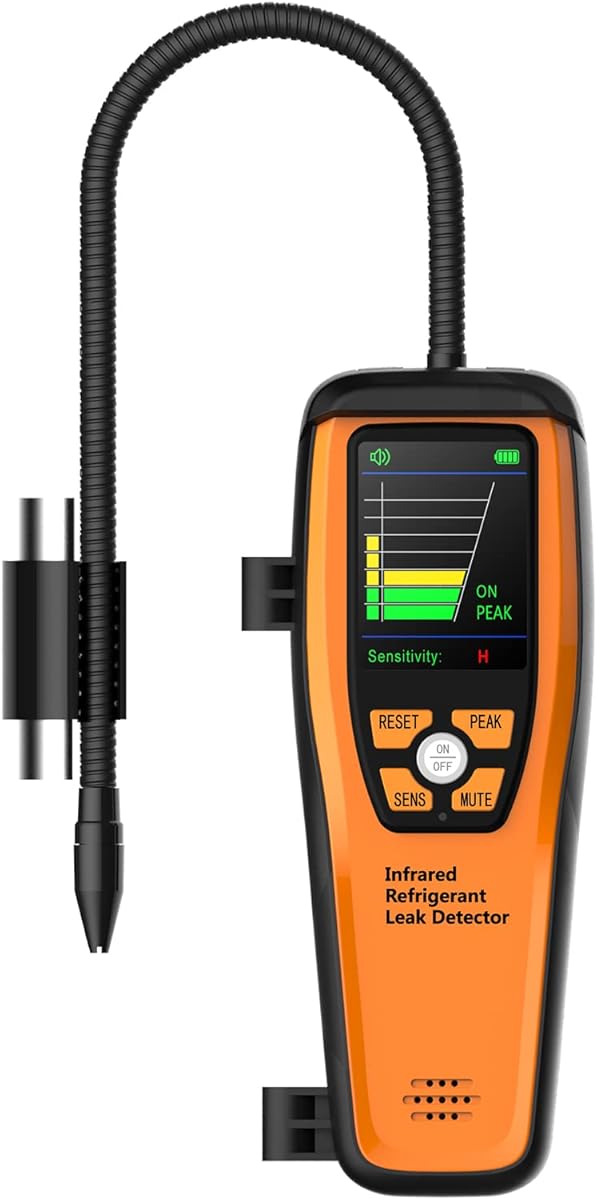
The Elitech ILD-200 stands apart in this group through its infrared detection technology, which the manufacturer describes as offering strong interference resistance, fast response, accuracy, and long service life. It carries a 4.4 supplied rating and is positioned for professional HVAC, automotive, and refrigerant leak-search applications where a technician wants a directional indication of the strongest leak point.
We may earn a commission when you buy through this link, at no additional cost to you.
Sensitivity can be adjusted among High, Medium, and Low settings, with a stated maximum sensitivity of 0.14 ounces per year. The detector supports halogenated gases across CFC, HFC, HCFC, HC, HFO, and mixed-refrigerant categories. Named examples include R11, R22, R404a, R410a, R600a, and R1234yf, as well as blends such as AZ-50, HP62, and MP39.
Its 2.8-inch screen uses a peak display to indicate the orientation of a leak point, which may be more informative than a simple alarm that only announces the presence of gas. The screen also supports quieter operation by giving the user visual information instead of relying entirely on sound. US-based research and service support are additional points in its favor for professional buyers.
The ILD-200 is best suited to technicians who value infrared technology, broad refrigerant support, and a peak-reading display. Its three-level adjustment scheme is simpler than the multi-position controls offered by some competitors, so users who want fine-grained sensitivity selection may prefer another model. Even so, it is a compelling professional choice with a 10-year stated infrared sensor life.
The peak display is intended to show the orientation of the detected leak, helping an operator focus the probe on the strongest concentration. This is useful in cabinets, mechanical rooms, and vehicle interiors where several components sit close together.
Support for common refrigerants, legacy refrigerants, HFO gases, and multiple blends allows one instrument to cover a wide service portfolio. That versatility is valuable for technicians moving between older residential systems, newer automotive applications, and commercial equipment.
We may earn a commission when you buy through this link, at no additional cost to you.
The Rechargeable Refrigerant Leak Detector with Japanese Sensor offers one of the most sophisticated visual interfaces in the group. Its 4.7 supplied rating, full-color TFT screen, real-time PPM readings, funnel view, and trend graph make it particularly attractive to technicians who prefer quantitative information while moving through a system.
We may earn a commission when you buy through this link, at no additional cost to you.
The high-precision Japanese semiconductor sensor offers three selectable sensitivity levels, with sensitivity stated as high as 3 grams per year, or 0.1 ounces per year. A quick mute function can silence the buzzer while leaving visual or vibration alerts active. Sound, indicator-light, and vibration alarms may each be enabled or disabled independently, allowing the user to adapt the detector to garages, basements, occupied rooms, and busy service areas.
Its 2,000mAh rechargeable lithium battery is stated to support up to eight hours of continuous use. A battery-status display and low-battery warning help prevent an interrupted job, and USB-C charging keeps the charging process familiar. The rugged handheld housing and 14.5-inch flexible gooseneck provide reach around condensers, evaporators, coils, pipes, and service ports.
Compatibility includes R134a, R410A, R407C, R404A, R22, R123, R32, R502, R503, and R1234YF, along with HFC, HCFC, CFC, PFC, HFO, R717, and some mixed halogen refrigerants. This model is best for users who want detailed data, multiple notification choices, and a rechargeable field tool. Those wanting the simplest controls and screen may find its feature set more involved than necessary.
The funnel view offers an immediate visual representation of leak intensity, while the trend graph helps show how the reading changes over time. Either view can make it easier to decide whether the probe is approaching a leak or moving away from it.
Sound, light, and vibration alerts can be enabled independently. This flexibility makes the detector useful in quiet indoor environments as well as noisy workshops, while quick mute provides another option when audible notifications are not useful.
We may earn a commission when you buy through this link, at no additional cost to you.
The Elitech CLD-100 is a straightforward, affordable entry into professional-style leak detection. It uses an updated version of the WJL-60000 with an updated analogue circuit and corona sensor, delivering fast triggering for R11, R22, R134A, R404a, R410A, and other halogenated refrigerants. Its supplied rating is 4.3.
We may earn a commission when you buy through this link, at no additional cost to you.
A six-second preheating period and instantaneous claimed response help minimize downtime at the beginning of a job. Six adjustable sensitivity levels give users more control than a simple high-low selector, while the stated maximum sensitivity of 0.21 ounces per year suits routine self-checks and professional troubleshooting. The flexible probe is about 8.26 inches long, allowing access to awkward spaces behind coils and around fittings.
Audible and visual leakage indicators make the operating state clear, and dual-colour battery indicators provide a visual power check. It runs on four AAA batteries, which are not included. That limitation should be considered when planning a service call, although disposable batteries can make it easy to keep spare power on hand.
The CLD-100 is a sensible choice for budget-conscious technicians, automotive users, and homeowners who want more adjustment than a basic two-level detector. It lacks the large displays, rechargeable operation, and advanced data views found in higher-ranked models, but its quick startup and broad refrigerant support provide a useful core feature set.
A six-second warm-up is shorter than the startup periods listed for several alternatives. Six sensitivity settings let users balance detection capability against ambient conditions and the size of the leak being investigated.
Audible and visual alarms make results easier to recognize, while the dual-colour battery indicator helps avoid an unexpected shutdown. The flexible 8.26-inch probe provides useful access without the bulk of a much longer gooseneck.
We may earn a commission when you buy through this link, at no additional cost to you.
The Elitech ILD-100H combines a heated diode sensor with a TFT screen and a stated response within one second. It has a 4.4 supplied rating and targets technicians who want fast halogenated-gas detection across a broad range of residential, commercial, and automotive refrigerants.
We may earn a commission when you buy through this link, at no additional cost to you.
Sensitivity is adjustable among High, Medium, and Low levels, with a maximum stated sensitivity of 0.1 ounces per year. The detector is listed for CFC, HFC, HCFC, HC, HFO, and mixed refrigerants, including R11, R22, R404a, R410a, R600a, and R1234yf. Blends named in the product information include AZ-50, HP62, and MP39.
The TFT display is intended to present sensitivity, leakage alerts, battery level, and other operating information more clearly than a basic indicator-light detector. Two front buttons allow direct sensitivity adjustment and buzzer muting, reducing menu navigation during a service call. The manufacturer also provides continuous service support and a one-year warranty for the gas leak detector.
This detector is a strong middle-tier option for professionals who value quick response, a heated-diode sensor, and a detailed screen. It is less elaborate than models with rechargeable batteries, numerical concentration views, trend graphs, or independently configurable alarm modes. Even so, the ILD-100H focuses on core detection performance and readable controls without excessive complexity.
The heated diode platform is described as producing accurate results for halogenated refrigerants, while the stated one-second response supports rapid scanning. This makes the detector appealing for technicians moving around service valves, coils, and service ports.
A TFT screen consolidates sensitivity, alarms, battery information, and other status details. Direct front buttons for sensitivity and buzzer control keep operation efficient when the user is wearing gloves or handling equipment.
We may earn a commission when you buy through this link, at no additional cost to you.
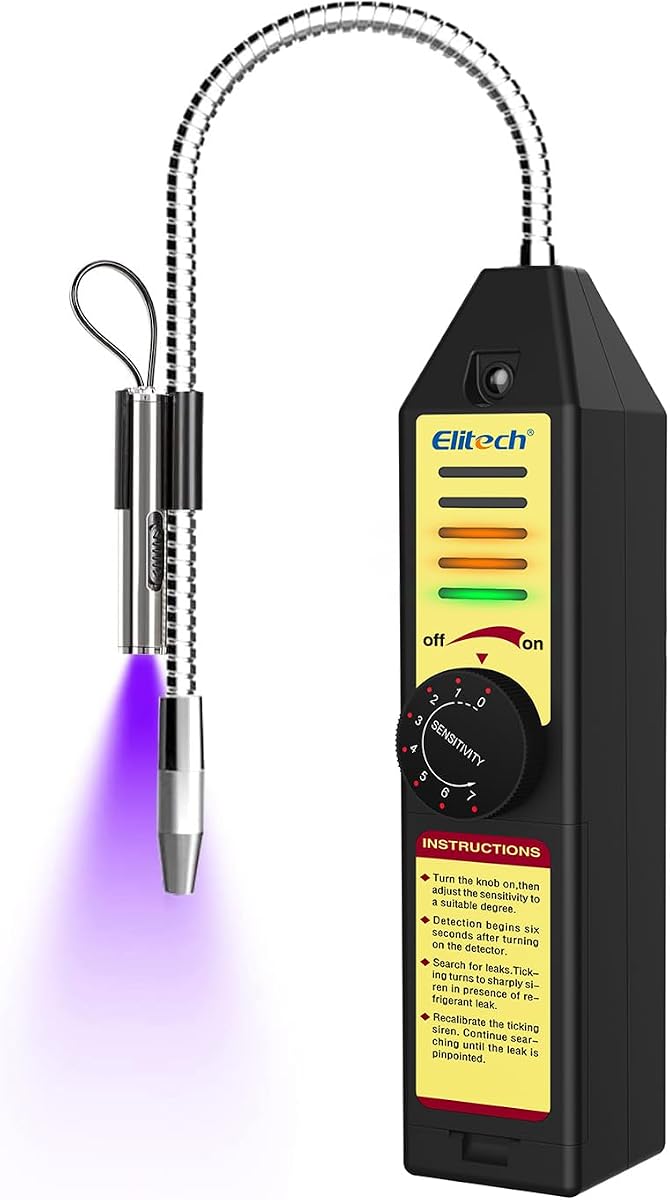
The Elitech WJL-6000S is a compact, uncomplicated detector for users who prefer direct manual control. It has a 4.2 supplied rating and supports common refrigerants including R22, R134A, R404A, R410A, and R1234YF, along with HFCs, CFCs, HCFCs, and blends.
We may earn a commission when you buy through this link, at no additional cost to you.
Its main distinguishing feature is a rotary control with seven selectable sensitivity levels. The stated maximum sensitivity is 0.21 ounces per year, which the product information describes as sufficient for self-checking automotive air conditioning and other air-conditioning systems. Multiple settings make it possible to move from a broad initial search toward a more sensitive pass near a suspected component.
The electronic detector responds within three seconds after a six-second warm-up, reducing setup time. Audible and visual leakage indicators communicate the result, and dual battery indicators help monitor power. Its 7.9-inch flexible probe can reach difficult areas, although it is shorter than the 11-inch and 14.5-inch probes offered by some rechargeable competitors.
The WJL-6000S is a useful option for basic residential service, automotive checks, and technicians who want a simple knob-based detector without complex menus. It does not offer the TFT data screens, rechargeable batteries, vibration alerts, or numerical readings found in more advanced tools. Its appeal lies in quick setup, straightforward operation, and granular sensitivity selection.
Seven settings give users more control than the three-level arrangement of many premium detectors. The simple knob is easy to understand and can be adjusted without navigating an onscreen menu.
A six-second warm-up and three-second response help keep routine inspections moving. The handheld body, flexible probe, audible alarm, and visual indicator cover the essential functions of a basic refrigerant sniffer.
We may earn a commission when you buy through this link, at no additional cost to you.
The ALD-200 is one of the most versatile instruments in the roundup, with stated support for A1, A2L, and A3 refrigerants as well as hydrogen-nitrogen tracer gas. Its 4.4 supplied rating and rechargeable construction position it for HVAC professionals, maintenance teams, and advanced DIY users working on heat pumps, air conditioners, refrigeration units, and automotive air-conditioning systems.
We may earn a commission when you buy through this link, at no additional cost to you.
The upgraded heated diode sensor is stated to detect R410A, R32, R454B, R290, R600, and other gases. Maximum sensitivity is listed as 0.14 ounces per year. Compatibility information extends across CFC, HCFC, HFC, HFO, PFC, hydrocarbon, and blend categories, including R134a, R404A, R407C, R1234yf, R1234ze, R1233zd, and several blends.
A 2.8-inch TFT color display shows concentration levels, while the audible alarm frequency increases as leak intensity rises. Peak Mode captures the maximum reading, and Reset recalibrates the sensor to help minimize false alarms. An impact-resistant, oil-resistant housing and rechargeable battery stated to support a full service day add field-oriented value.
The ALD-200 is best for users who service newer refrigerant systems or need one tool for several refrigerant classes and tracer gas. Its detailed feature set is more than a basic homeowner requires, and claims about precision should be evaluated against the manufacturer’s documentation. Even so, its compatibility, rechargeable design, and useful display features make it a compelling professional choice.
Coverage of A1, A2L, and A3 refrigerants is especially relevant as service portfolios expand. Stated tracer-gas support also extends the instrument beyond basic R22, R410A, and R134A applications.
Peak Mode retains the maximum observed leakage reading, which can help a technician return to a strong signal. Reset provides a way to recalibrate the sensor and reduce the chance that background conditions will be mistaken for a new leak.
We may earn a commission when you buy through this link, at no additional cost to you.
The POROMETISTO HLD01 is a rechargeable halogen detector built around a clear numerical LCD and flexible testing arrangements. It carries a 4.5 supplied rating and offers two sensitivity controls, two calibration modes, triple alerts, two types of LED lighting, and USB-C charging in one compact package.
We may earn a commission when you buy through this link, at no additional cost to you.
Its screen provides a direct color-coded interpretation of concentration: red indicates a warning above 85 ppm, yellow identifies the 16–85 ppm caution range, and green represents a safe reading from 0–16 ppm. This visual system is easier to interpret at a glance than a basic audible alarm. The stated measurement range is 16 to 200 ppm, and one-button switching between high and low sensitivity supports different inspection conditions.
An extended hose provides flexible positioning, while a white auxiliary LED improves visibility in dark environments. A purple LED is included for auxiliary leak-point detection. Both automatic and manual calibration are available, allowing the operator to account for different surroundings. The package includes the HLD01, user manual, packing box, USB Type-C cable, and cloth bag.
The detector supports CFC, HCFC, HFC, and HFO refrigerants, including R11, R22, R32, R134a, R404a, R410a, R1234yf, R449a, R452b, R454a, and R455a. It is a strong option for users who prioritize a rechargeable body, numerical display, and illumination features. Buyers working with refrigerant concentrations outside the stated range should verify suitability before relying on the numerical reading.
Red, yellow, and green concentration bands make the instrument’s status immediately understandable. Numerical values add useful context, particularly when comparing readings from different points in the same system.
White and purple LEDs support work in dark spaces, while automatic and manual calibration offer flexibility across environments. These features can make a methodical probe pass more practical and reduce reliance on the sound alone.
We may earn a commission when you buy through this link, at no additional cost to you.
The GL77A offers a relatively simple way to locate halogen leaks in HVAC, refrigeration, and automotive air-conditioning systems. Its supplied rating of 3.8 is the lowest in this list, so buyers should weigh that feedback against the useful UV light, backlit display, included batteries, and straightforward controls.
We may earn a commission when you buy through this link, at no additional cost to you.
The detector uses a semiconductor sensor with a stated maximum sensitivity of 0.49 ounces per year, or 14 grams per year. It supports R134a, R1234yf, R410a, R22, R404a, R407c, R454b, R32, and other halogenated refrigerants. The product information notes that the manual lists only common models due to space limitations, while claiming broader halogen capability.
A 30-second automatic warmup prepares the sensor before use. The manufacturer recommends a probe distance of no more than 0.25 inches and a movement speed of no more than 3 inches per second, emphasizing slow, close scanning for reliable results. A UV light function provides additional visual leak visualization, while a high-brightness LCD displays concentration, battery status, and alarm information.
The GL77A includes two AAA batteries, a user manual, reset calibration, automatic power-off, and a temperature-unit switch. It is a reasonable pick for homeowners, maintenance staff, and budget-conscious buyers who appreciate illumination and an easy button layout. Its single sensitivity level and lower supplied rating make it less attractive for specialists who require multiple settings and more advanced readouts.
The stated maximum probe distance of 0.25 inches encourages a close, controlled pass around suspected components. The recommended movement limit also helps reduce the chance of moving past a weak signal before the display and alarm register it.
The UV function can assist with leak visualization, and the backlit LCD helps users read concentration, battery, and alarm information in poor lighting. Included AAA batteries improve the convenience of the package for immediate use.
We may earn a commission when you buy through this link, at no additional cost to you.
The Inficon Model 705-202-G1 is a premium traditional service detector built around a proven heated diode sensor. It has a 4.4 supplied rating, detects CFC, HCFC, HFC, and HFO refrigerants, and is A2L certified, making it especially relevant to technicians handling flammable refrigerants classified in that safety group.
We may earn a commission when you buy through this link, at no additional cost to you.
The stated maximum sensitivity is 0.25 ounces per year, or 7 grams per year. Automatic background adjustment, or zeroing, allows the instrument to establish a clean baseline before searching. The detector is also described as resistant to false alarms caused by soap solutions, an important practical consideration on systems that technicians may have prepared with a leak solution.
The sensor life is stated as 100 hours, and the unit runs on two D-cell alkaline batteries. A rugged carrying case is included, and the detector is made in the United States. US technician support is available by email and phone, which may be valuable for organizations that want assistance with setup, operation, or troubleshooting.
This model is best for professional service buyers who value a recognized detector platform, A2L certification, and dependable heated-diode technology. The specified 100-hour sensor life and disposable battery power make it less convenient than rechargeable models for high-volume daily use. Its rugged construction and support package make it a strong choice for technicians who value traditional service equipment over advanced displays.
A2L certification makes this model relevant for work involving flammable refrigerants such as R32 and R454B. Technicians should still follow all equipment-handling, ignition-control, and workplace safety requirements when servicing those systems.
The proven heated diode platform is designed for dependable halogenated-refrigerant detection. Automatic zeroing and resistance to soap-solution false alarms make the instrument practical for real service environments where background contamination is possible.
We may earn a commission when you buy through this link, at no additional cost to you.
The most useful detector is one that combines appropriate sensitivity with the refrigerant compatibility, probe access, and alert features required for a specific service environment. Review the following factors before choosing a model.
Sensor technology is the central distinction among these tools. Heated-diode detectors, including the Elitech ILD-100H, ALD-200, and Inficon Model 705-202-G1, are established choices for halogenated-refrigerant leak searches. The Tadeto and GL77A use sensing systems or semiconductor technologies, while the Elitech ILD-200 uses infrared detection. The POROMETISTO HLD01 provides numerical halogen readings, and the rechargeable Japanese-sensor model uses a semiconductor platform. Choose based on refrigerant family, required sensitivity, and the controls your technicians already understand.
A detector must respond to the refrigerant used in the system being inspected. Most products list R22, R134a, R410a, R404a, and R1234yf, but newer blends such as R454B, R32, R454a, R455a, and R457a may matter for heat-pump or newer service work. The ALD-200 also lists A3 refrigerants such as R290 and R600, while the Inficon model carries A2L certification. Check both the refrigerant and its safety class. A broad list is useful, but the detector must also meet the local and manufacturer-specific requirements for the application.
Smaller stated leak rates indicate greater potential sensitivity, but the figures are not directly interchangeable because manufacturers may use different test conditions. Sensitivity settings still matter because a very sensitive setting can react to background conditions, while a lower setting may help during an initial broad search. The Elitech CLD-100 offers six settings, the WJL-6000S offers seven, and several heated-diode models use three levels. The GL77A has one stated level. Choose a control scheme that supports the sort of leak search you perform and allows you to move from general scanning to focused inspection.
Probe design determines whether the sensor can reach coils, service valves, bends, hoses, and cramped cabinet spaces. Flexible probes range from about 7.9 inches on the WJL-6000S to 14.5 inches on the rechargeable Japanese-sensor detector. The Tadeto offers 11 inches, the CLD-100 approximately 8.26 inches, and the POROMETISTO uses an extended hose. Longer probes can improve access, but they also require steadier movement and more storage space. Consider the dimensions of your typical equipment and whether the probe can reach the leak point without forcing or bending it sharply.
Display quality affects how quickly an operator can interpret a reading. A basic audible and visual alarm is sufficient for many routine searches, while numerical PPM readings, peak memory, concentration trends, and color-coded bars can make diagnosis more precise. The Japanese-sensor model offers funnel and trend views, the ALD-200 includes Peak Mode, and the POROMETISTO uses a three-color scale. If you often work in noisy or dark locations, vibration alerts, mute controls, white lighting, or UV illumination may be more useful than additional graphics.
Power affects both convenience and field readiness. Rechargeable models eliminate routine battery replacement and are well suited to technicians working many calls per day. The Tadeto, Japanese-sensor model, ALD-200, and POROMETISTO use USB-C charging. The GL77A includes two AAA batteries, the CLD-100 requires four AAA batteries that are not included, the WJL-6000S uses a battery-based design, and the Inficon model uses two D-cell batteries. Check runtime claims, charging cable inclusion, carry cases, and whether your operation prefers a dedicated charged unit or readily available disposable cells.
Proper warm-up and calibration establish a reliable baseline before the probe enters an equipment cabinet. The Tadeto requires approximately 30 seconds for warm-up and automatic calibration. The POROMETISTO provides both automatic and manual calibration, and the ALD-200 includes a Reset function. The Inficon automatically adjusts its background, while the Inficon product information also notes resistance to false alarms from soap solutions. A detector that is used too soon, moved too quickly, or calibrated in a contaminated area can produce misleading results. Always follow the unit’s startup procedure and use controlled probe movement.
Portability includes more than size. Consider weight, grip, storage case, probe storage, display visibility, battery access, and the availability of technician support. The Tadeto and Inficon include carry cases, while the POROMETISTO includes a cloth bag. Elitech models list US-based technician support, and the Inficon also provides email and phone support. A one-year warranty is stated for the Elitech ILD-100H, while the POROMETISTO offers a one-year replacement service for product-quality issues. For a business, these support terms may be as important as the detector’s headline features.
Begin by confirming that the detector supports the refrigerant in the target system. Inspect the probe for damage, clean the sensor area according to the manual, install or charge the batteries, and power the unit in a clean environment. Allow the full warm-up period specified for that model. Several units also perform automatic background calibration, so keep the probe away from the equipment until the display and controls indicate that initialization is complete.
Begin the search with a broader, lower-sensitivity setting when the unit offers multiple levels. Move the probe slowly and uniformly near likely leak points such as service valves, fittings, coil connections, brazed joints, and refrigerant lines. Pause briefly only when the display suggests a stronger reading. If the alarm activates, use peak mode or the numerical reading, if available, to identify the strongest response, then approach the suspected source from several directions to confirm its position.
After the inspection, switch the detector off and remove disposable batteries if the manual recommends it. Clean the flexible probe gently, avoid immersing the sensor or display, and store the unit in its case away from excessive heat, moisture, oil, and physical impact. Recharge rechargeable models regularly and follow any sensor-life or replacement guidance supplied by the manufacturer. If readings become erratic, recalibrate the detector in clean air and consult its support resources before continuing service work.
The best type depends on the refrigerants and equipment you service. Heated-diode models are established tools for many halogenated refrigerants, while semiconductor and infrared options may suit particular sensitivity, display, or interference requirements. Confirm compatibility with the exact refrigerant codes you encounter before buying.
No detector should be assumed to find every leak under every condition. Performance depends on sensor type, calibration, background contamination, probe distance, movement speed, access, and leak size. A controlled scan and cross-checking suspected points remain important even when a unit has a high stated sensitivity.
Follow the instructions for the exact model. Warm-up periods in this roundup range from about six seconds for the Elitech CLD-100 and WJL-6000S to approximately 30 seconds for the Tadeto and GL77A. Using the detector before stabilization can increase the risk of inaccurate readings or missed signals.
There is no single winner for every situation. Heated-diode detectors are widely used with halogenated refrigerants, while semiconductor detectors can provide sensitivity, portability, and lower-cost operation. The more important comparison is whether the unit supports the refrigerant, can access the leak point, and is operated in the recommended manner.
A sensitivity figure expresses the smallest annual leak rate the manufacturer states the detector can identify under specified test conditions. It provides a useful comparison clue, but manufacturers may use different procedures. Actual results also depend on refrigerant, environment, calibration, probe technique, and access.
Several models in the roundup list R32, R454B, or both. The ALD-200 supports A1, A2L, and A3 refrigerant classes, and the Inficon Model 705-202-G1 is stated to be A2L certified. Check the exact model listing and local safety requirements before using any detector around flammable refrigerants.
You should follow the model’s startup and calibration instructions, which often include warming up in clean air and allowing automatic background adjustment. Some units also offer manual calibration, peak mode, or reset functions. If the display remains erratic, repeat the process in a clean environment before relying on the reading.
An electronic detector and soap test can serve different purposes. Electronic units can help locate and quantify small leaks in accessible areas, while soap bubbles can visibly confirm a suspected joint. Some products, including the Inficon model, are specifically described as resistant to false alarms from soap solutions, but complementary verification can still be valuable.
The Tadeto Rechargeable Refrigerant Leak Detector is the strongest all-around recommendation in this group, combining a 4.8 supplied rating, a digital display, an 11-inch flexible probe, multiple alerts, and Type-C charging. The Elitech CLD-100 is a practical budget choice with quick startup and six sensitivity levels, while the Inficon Model 705-202-G1 stands out for A2L certification, automatic background adjustment, and a rugged professional package.
For technicians who want a more detailed screen and flexible alerts, the rechargeable Japanese-sensor model provides funnel views, trend graphs, and three independently controlled alarm modes. The ALD-200 is notable for broad A1, A2L, and A3 coverage, while the Elitech ILD-200 offers infrared technology and directional peak information. Prioritize exact refrigerant compatibility, reliable access, appropriate sensitivity, and a power method that suits your workload.
Before ordering, verify the current manufacturer specifications, package contents, warranty terms, and availability on the product listing. Customer ratings and technical claims can change over time, and service requirements also evolve as newer refrigerant blends become more common. Checking the current listing ensures that the selected detector still matches the equipment and refrigerants you actually service.
