
25-Value Precision Metal Film Kit
4.7Editor score
One-percent metal film tolerance
One-thousand total components
Transparent labeled storage case
Compare 10 resistor assortment kits by value range, tolerance, wattage, component count, storage design, and suitability for electronics projects and repairs.
A resistor assortment kit gives electronics builders a convenient way to keep common resistance values organized and ready for prototyping, repair, and education. A useful kit balances a broad selection with appropriate tolerance, wattage, lead quality, and storage that makes individual components easy to identify and retrieve.
The ten products in this guide were compared using the specifications provided for each kit, including resistance range, number of values, total components, tolerance, power rating, construction, and organization. The list covers compact general-purpose assortments as well as extensive precision sets and compartmentalized collections.
Each review explains the standout characteristics of the kit and the situations in which its configuration makes the most sense. Ratings reflect the supplied customer feedback, while product characteristics come from the listed descriptions. Availability and seller information can change, so readers should verify current listing details before ordering.
4.7Editor score

4.7Editor score

4.7Editor score
This side-by-side comparison highlights the major differences in resistance coverage, tolerance, power rating, component quantity, and storage design, making it easier to identify the kit that matches a particular project or repair bench.



The BOJACK 1000-piece kit is a well-rounded selection for electronics learners, hobbyists, and repairers who want useful resistance values without purchasing numerous separate packs. Its 4.7 rating reflects favorable customer feedback, and the combination of 25 values, 1,000 components, and a 1Ω-to-1MΩ range covers a substantial part of ordinary low-power circuit work.
We may earn a commission when you buy through this link, at no additional cost to you.
Its most useful trait is the balance between breadth and manageability. The listed values include 10Ω, 22Ω, 47Ω, 100Ω, 220Ω, 330Ω, 470Ω, 1KΩ, 2.2KΩ, 4.7KΩ, 10KΩ, 22KΩ, 47KΩ, 100KΩ, and 1MΩ, alongside additional values that make the assortment more versatile. Each resistor is a 1/4-watt carbon film component with a stated ±5% tolerance.
The tradeoff is that five-percent tolerance is less exact than the one-percent tolerance offered by several metal film kits. That difference may matter in precision measurement, tightly calibrated analog circuits, or replacement work where the original component's exact value is important. It is less consequential for LED circuits, pull-up and pull-down networks, general voltage-divider experiments, and many introductory breadboard projects.
This is a particularly accessible option for a new electronics bench because it provides plenty of components and covers a familiar E-series range. The stated thicker metal pins and RoHS certification add practical and compliance details. For general DIY projects, the BOJACK kit is a strong all-around recommendation, while builders needing tighter tolerance can use the same resistance range as a guide when comparing the metal film alternatives.
The assortment includes many values encountered in breadboard demonstrations, LED projects, transistor biasing experiments, and general circuit modification. This makes it easier to assemble a prototype without pausing to order one resistance value at a time.
A 1/4-watt rating is a familiar choice for general low-power electronics and matches the power demands of many hobby circuits. Users should still calculate expected dissipation when substituting a resistor in a position that carries substantial current.
We may earn a commission when you buy through this link, at no additional cost to you.
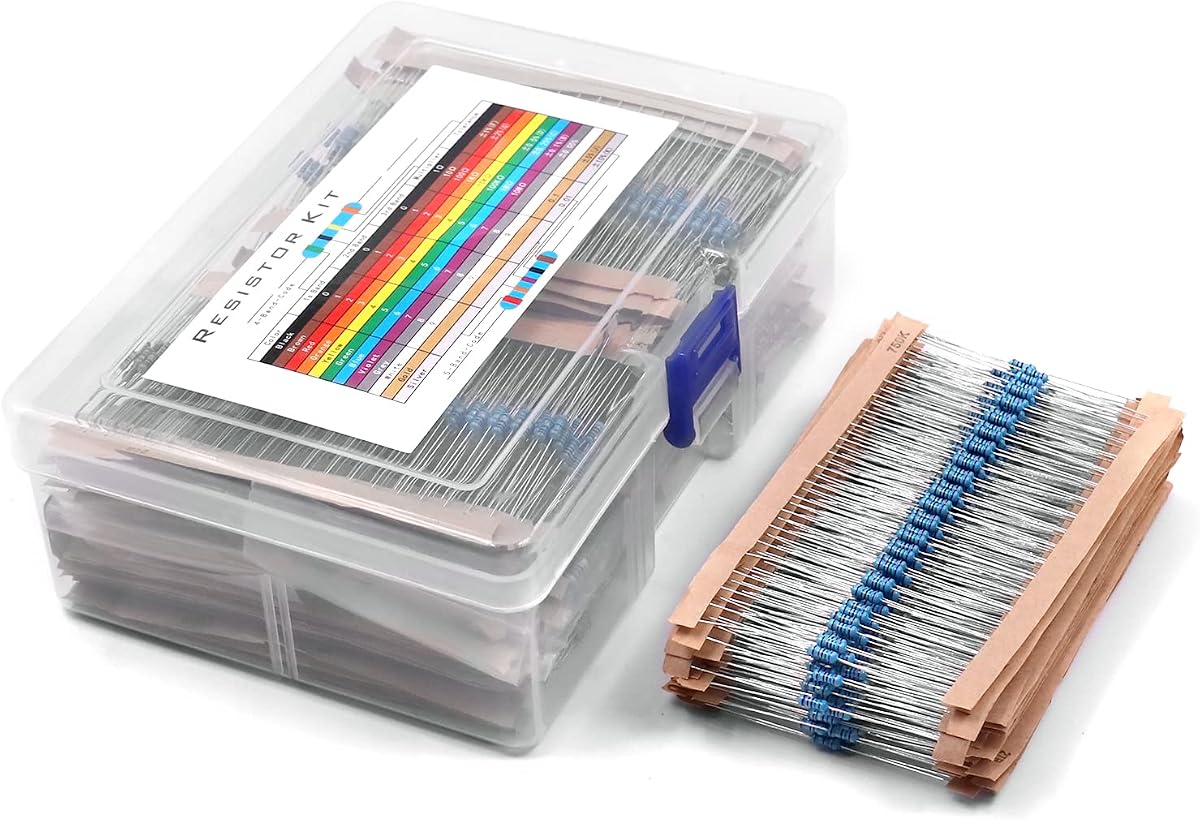
This 1,000-piece metal film assortment combines a familiar 25-value range with ±1% tolerance and a clear organization system. The 4.7 rating and stated machine testing support its position as a practical precision-oriented starter kit, while the 1Ω-to-1MΩ span covers many common prototyping and repair requirements.
We may earn a commission when you buy through this link, at no additional cost to you.
Every listed value has 40 pieces, creating a consistent quantity across the case rather than concentrating nearly everything in a few popular positions. The resistance list includes 1Ω, 4.7Ω, 10Ω, 22Ω, 47Ω, 100Ω, 220Ω, 330Ω, 470Ω, 680Ω, 1KΩ, 2.2KΩ, 3.3KΩ, 4.7KΩ, 10KΩ, 22KΩ, 33KΩ, 47KΩ, 68KΩ, 100KΩ, 220KΩ, 330KΩ, 470KΩ, 680KΩ, and 1MΩ.
Two workbench features deserve particular attention. Printed value strips are designed to eliminate repeated color-band decoding, while the transparent case includes a printed value chart and color-band reference. Full-length rigid tinned leads are also stated to seat firmly in breadboard sockets, which is useful for maintaining reliable contact during iterative experiments.
The primary limitation is its relatively narrow value count compared with the larger precision kits in the list. It also stops at 1MΩ, so projects requiring 2MΩ, 4.7MΩ, 5.6MΩ, or 10MΩ values would need another source. Even so, it is a compelling option for a new workbench, a student assembling a core component collection, or a hobbyist who values clear identification and tighter tolerance over maximum breadth.
Printed value strips reduce the chance of selecting the wrong component when several closely related values are present. The case reference adds a second identification aid, which can be especially helpful for beginners still learning color codes.
Forty pieces of every listed resistance value provide a predictable inventory. This balanced distribution is useful for repeated builds, classroom exercises, and repairs involving several similar circuits.
We may earn a commission when you buy through this link, at no additional cost to you.
The BOJACK 50-value assortment is an attractive upgrade for builders who want precision-oriented components and substantially broader resistance coverage than a standard starter set. It has a 4.7 rating, includes 1,350 resistors, and spans 0Ω through 5.6MΩ with a stated ±1% tolerance and 1/4-watt metal film construction.
We may earn a commission when you buy through this link, at no additional cost to you.
The range is one of its defining strengths. It includes 0Ω jumpers, low values such as 1Ω, 2.2Ω, and 4.7Ω, conventional E-series values, and high resistance options including 1MΩ, 2MΩ, 4.7MΩ, and 5.6MΩ. That coverage makes the kit relevant to communication equipment, musical instrument projects, breadboard prototypes, and general repair work.
Quantity is distributed with practical use in mind. The description states that 100Ω, 220Ω, 1KΩ, and 10KΩ include 50 pieces each, while less frequently used values receive 25 pieces. A color-code guide is included to assist identification. Thicker metal pins are highlighted as a feature intended to support secure connections and stable performance on a project bench.
The main trade-off is physical scale. A fifty-value, 1,350-piece assortment occupies more space than a compact kit, and less common values have fewer units than the popular values. Nevertheless, this configuration offers a notably strong balance of range, precision, and quantity. It is especially appropriate for a serious hobbyist, an electronics instructor, or a technician who would rather have several resistance families available than repeatedly supplement a smaller collection.
Fifty values allow a builder to move between low-ohm current paths, conventional signal resistances, and high-value biasing or pull-up networks. The range is broad enough to reduce the need for a separate general-purpose kit.
The larger quantities assigned to 100Ω, 220Ω, 1KΩ, and 10KΩ reflect their frequent use. This is helpful for classroom exercises and repeated prototype revisions that consume common components quickly.
We may earn a commission when you buy through this link, at no additional cost to you.
This EEEEE kit stands out for its physical organization and its 1/2-watt power rating. It contains 600 resistors distributed among 30 values, with each value assigned to an individual compartment. The supplied rating of 4.8 is the highest among the ten products, indicating particularly favorable customer feedback.
We may earn a commission when you buy through this link, at no additional cost to you.
Three sets of ten values cover the 1Ω-to-1MΩ range. The first includes 1Ω, 2.2Ω, 3.3Ω, 4.7Ω, 10Ω, 22Ω, 47Ω, 68Ω, 100Ω, and 150Ω. The second covers 220Ω through 6.8KΩ, while the third contains 10KΩ, 15KΩ, 22KΩ, 33KΩ, 47KΩ, 68KΩ, 100KΩ, 220KΩ, 470KΩ, and 1MΩ.
Every compartment has its own plastic cover that closes with a positive snap. This design keeps values separated, reduces mix-ups, and allows a user to retrieve one group without disturbing the others. The one-percent metal film specification also makes this more suitable for precision-sensitive work than a standard five-percent assortment.
There are 600 components rather than 1,000 or more, and 30 values are still fewer than the 50-value BOJACK kit. However, for a workbench where organization, clear access, and a 1/2-watt rating are priorities, this is a persuasive package. The half-watt rating gives additional power-handling headroom compared with quarter-watt kits, while the compartmented case keeps a mixed inventory orderly.
Individual lidded compartments make it possible to keep a project focused on one resistance family without dumping the entire kit onto the bench. The design is useful for teaching, repair work, and anyone who values fast visual identification.
The 1/2-watt specification distinguishes this kit from common quarter-watt assortments. It can be a sensible alternative when a circuit's calculated resistor dissipation approaches the limits of a smaller-rated component.
We may earn a commission when you buy through this link, at no additional cost to you.
The MelkTemn 130-value kit is built for users who want a broad library of resistance values rather than a small general-purpose collection. It contains 2,600 resistors, with 20 pieces for each of 130 specifications, and has a 4.6 customer rating. The stated range extends from 1Ω to 3MΩ.
We may earn a commission when you buy through this link, at no additional cost to you.
Its range includes standard values across the common E12 and E24-style sequences, along with additional intermediate values. That makes it useful for precise electronic circuits, electronics and electrical communication equipment, musical instrument applications, and DIY projects. The description specifically identifies solderless plug-in breadboards as a suitable use.
The kit is described as 1/4-watt metal film with ±1% tolerance and thicker metal pins. The listed performance characteristics include high stability, low noise, a low temperature coefficient, precision behavior, and a long working life. A five-band color code guide is included to help users identify values, and RoHS certification is stated.
The obvious trade-off is physical bulk. A 2,600-piece collection with 130 separate values requires more room and may be more than a beginner needs. In return, it substantially reduces the chance of encountering an uncommon required value. It is most compelling for experienced makers, educators running repeated electronics exercises, and service-oriented hobbyists who want deep stock across many resistance families.
Twenty pieces across 130 values provide meaningful stock for intermediate and less frequently used resistances. This is particularly helpful when a schematic calls for a value that is not prominent in a basic starter assortment.
The stated low-noise, low-temperature-coefficient characteristics align well with precision-oriented prototyping. Those qualities can be valuable in signal, timing, and measurement-related experiments where component variation influences circuit behavior.
We may earn a commission when you buy through this link, at no additional cost to you.
This BOJACK assortment provides 1,000 resistors in 25 familiar values and raises the power rating to 1/2 watt. The 4.7 rating indicates solid customer feedback, and the 1Ω-to-1MΩ range closely mirrors the popular quarter-watt version while offering a different rating for applications that dissipate more heat.
We may earn a commission when you buy through this link, at no additional cost to you.
The value set includes 1Ω, 2.2Ω, 3.3Ω, 4.7Ω, 10Ω, 22Ω, 47Ω, 68Ω, 100Ω, 150Ω, 220Ω, 330Ω, 470Ω, 1KΩ, 1.5KΩ, 2KΩ, 2.2KΩ, 4.7KΩ, 5.6KΩ, 10KΩ, 15KΩ, 22KΩ, 47KΩ, 100KΩ, and 1MΩ. This selection covers many low- to medium-resistance applications and standard upper-range values used in hobby circuits.
As a carbon film kit with a stated ±5% tolerance, it is better suited to general-purpose work than precision calibration. The half-watt rating provides more thermal headroom than a quarter-watt resistor, although actual safety depends on the voltage, current, and physical environment. The thicker metal pins are intended to improve connection stability on breadboards and project boards.
This is a sensible selection for someone who wants the familiar range and quantity of a standard carbon assortment but may also work with LED lighting, power-control exercises, or circuits that run warmer. It lacks the one-percent tolerance and broader value selection of the precision alternatives, so the main decision is whether greater power handling outweighs tighter accuracy for the intended projects.
A 1/2-watt rating can be preferable when the calculated heat output of a resistor position is higher than a quarter-watt part can comfortably accommodate. The rating should be checked against circuit conditions rather than selected by habit.
The included values closely match common E-series choices, making the kit easy to integrate with standard schematics and instructional circuits. Its familiar range also simplifies replacement of previously used hobby components.
We may earn a commission when you buy through this link, at no additional cost to you.
The EEEEE 20-value kit offers a compact alternative for projects concentrated in the 100Ω-to-1MΩ range. It contains 300 resistors, provides 20 individual compartments, and has a 4.8 customer rating. Its 1/2-watt carbon construction gives it more power-rating headroom than a typical quarter-watt hobby assortment.
We may earn a commission when you buy through this link, at no additional cost to you.
The first group of values runs from 100Ω to 3.3KΩ and includes 100Ω, 150Ω, 220Ω, 330Ω, 470Ω, 680Ω, 1KΩ, 1.5KΩ, 2.2KΩ, and 3.3KΩ. The second group continues with 4.7KΩ, 6.8KΩ, 10KΩ, 15KΩ, 22KΩ, 33KΩ, 47KΩ, 68KΩ, 100KΩ, and 1MΩ.
The supplied description highlights the ability of carbon construction to absorb short bursts of energy and notes its non-inductive nature. Those characteristics make the set potentially relevant to surge-protection, pulse, and high-frequency-related work. Each compartment has a positive-snap plastic cover, preserving separation and reducing the likelihood of mixing values.
This is not the most inclusive kit: it omits values below 100Ω, includes only ten pieces of each resistance, and has five-percent tolerance. Even so, it offers a focused, easy-to-store selection for LED projects, general current limiting, pull-up networks, and high-resistance circuits. Its favorable rating and combination of compartmentation, compact size, and half-watt rating make it worth considering for a secondary bench collection.
Starting at 100Ω and extending to 1MΩ concentrates the kit around medium- and high-resistance circuits. It is a sensible fit for users who do not regularly need sub-100Ω jumpers or very low resistance values.
The listed short-burst energy absorption makes these resistors relevant to surge-protection and pulse-circuit contexts. Component suitability still depends on the specific pulse energy, duration, and operating conditions.
We may earn a commission when you buy through this link, at no additional cost to you.
This 35-value kit is designed around a practical compromise between range and quantity. It contains 1,000 metal film resistors, has a 4.6 customer rating, and covers 1Ω through 1MΩ. Its ±1% tolerance and 1/4-watt rating align it with conventional precision-oriented electronics work.
We may earn a commission when you buy through this link, at no additional cost to you.
Unlike assortments that distribute most components evenly, this one places additional inventory in popular values. The description specifies 80 pieces each of 10KΩ and 1KΩ, 50 pieces each of 4.7KΩ and 2.2KΩ, and 40 pieces each of 220Ω and 330Ω. That emphasis reflects how often these resistances appear in introductory circuits, voltage dividers, LED arrangements, and Arduino-style projects.
Storage is handled through a compact case intended to make the collection easier to store, transport, and access. A five-band color code guide is included as a reference for identification. The listed applications include Arduino projects, breadboards, PCB prototyping, circuit repair, STEM education, and general DIY electronics.
The main compromise is the uneven distribution of components. A builder needing many units of a less common value may find the count lower than expected. The kit also tops out at 1MΩ and does not reach the multi-megaohm values offered by the 50-, 130-, and 156-value kits. For common hobby work, however, the emphasis on frequently used values can be more practical than a large assortment with twenty pieces of every specification.
Larger quantities of 1KΩ, 10KΩ, 2.2KΩ, 4.7KΩ, 220Ω, and 330Ω reduce the likelihood of running short during repeated builds. This is especially useful in classroom settings where many students may use the same circuit values.
The compact case supports storage and transport between a workbench, classroom, or maker space. Keeping all values together also helps builders maintain a tidier bench and quickly return loose components after a project.
We may earn a commission when you buy through this link, at no additional cost to you.
The Minidodoca kit is the broadest assortment in this group by value count, offering 156 specifications with 20 resistors in each. That produces 3,120 components and extends the resistance range from 1Ω to 10MΩ. Its 4.6 rating and listed precision construction make it a strong option for an extensive component library.
We may earn a commission when you buy through this link, at no additional cost to you.
Every value has a consistent allocation, which simplifies inventory planning when a particular resistance may be needed across multiple prototypes. The five-band color code guide helps identify components, while the 1/4-watt metal film specification is paired with ±1% tolerance and thicker metal pins for more stable, secure connections.
The described applications include precise electronic circuits, electronics and electrical communication equipment, musical instrument work, general DIY projects, and solderless plug-in breadboards. The kit also states high stability, low noise, a low temperature coefficient, precision characteristics, and a long working life. RoHS compliance is included in the listed feature set.
Its scale is the defining trade-off. At 3,120 pieces and 156 values, this is not a compact first kit and may include many values a particular hobbyist will never use. It is better suited to a dedicated electronics workspace, a lab-style collection, or an experienced builder who values having nearly every intermediate resistance at hand. For that user, the exceptional breadth can eliminate repeated gaps in the parts inventory.
A 156-value selection includes dense sequences of intermediate resistances that shorter kits omit. This makes it useful for experiments that require particular E-series values beyond the most popular twenty or thirty choices.
Twenty pieces per value create a predictable stock level throughout the kit. This uniform approach is valuable for maintenance work, repeated educational builds, and any project likely to consume several copies of multiple values.
We may earn a commission when you buy through this link, at no additional cost to you.
This EEEEE assortment combines 28 resistance values, 280 total components, and 1/2-watt carbon construction. Its 4.6 customer rating reflects generally favorable feedback, while the individual-compartment design makes it a practical option for builders who want sorted access without an enormous number of pieces.
We may earn a commission when you buy through this link, at no additional cost to you.
The values span 2.2Ω to 1MΩ. They include 2.2Ω, 10Ω, 22Ω, 47Ω, 100Ω, 120Ω, and 150Ω in the first column; 220Ω, 330Ω, 470Ω, 680Ω, 1KΩ, 1.5KΩ, and 2.2KΩ in the second; 3.3KΩ, 4.7KΩ, 6.8KΩ, 10KΩ, 15KΩ, 20KΩ, and 22KΩ in the third; and 33KΩ, 47KΩ, 68KΩ, 100KΩ, 220KΩ, 470KΩ, and 1MΩ in the fourth.
The product description highlights short-burst energy absorption and non-inductive construction. These claimed characteristics suit the set to pulse circuits, surge protection, and high-frequency applications where inductive reactance would be undesirable. The 1/2-watt rating provides more thermal capacity than quarter-watt alternatives, although each application should still be evaluated independently.
The limitation is quantity. Ten pieces per value is enough for occasional repairs and many small projects, but it offers less spare stock for classroom use or repeated builds. The stated five-percent tolerance also makes it less appropriate for precision measurements. Even so, the combination of 28 values, separate storage, and a broad resistance span makes this a focused and tidy kit for general electronics work.
Twenty-eight individual compartments organize a wide mix of low- and high-resistance values without requiring a bulk pile. The structured layout is useful for maintaining consistency across multiple builds or repairs.
The listed non-inductive construction can benefit pulse, surge, and high-frequency circuits. These characteristics make the kit more versatile than its general-purpose carbon classification might initially suggest.
We may earn a commission when you buy through this link, at no additional cost to you.
The most useful kit is not necessarily the one with the most values. Resistance range, tolerance, power rating, component quantity, and storage design should be matched to the kinds of circuits you expect to build, the precision required, and the amount of bench space available.
Begin by comparing the exact resistance values, not just the advertised range. A kit may span 1Ω to 1MΩ while including only a handful of intermediate values, while another may provide dozens of closely spaced choices. General LED and voltage-divider projects often rely on conventional values such as 100Ω, 220Ω, 1KΩ, 10KΩ, 47KΩ, and 100KΩ. More specialized circuits may call for values such as 4.7KΩ, 6.8KΩ, 33KΩ, 470KΩ, or 2MΩ. The 130-value and 156-value kits offer the deepest libraries, whereas the 20-value and 25-value kits are more compact.
Tolerance describes how far an individual resistor may differ from its marked value. Kits with ±1% tolerance are generally more appropriate when circuit behavior depends on a fairly accurate resistance, while ±5% carbon film sets remain suitable for many ordinary current-limiting, biasing, and pull-up applications. The distinction matters most in timing, reference-voltage, signal-conditioning, and precision divider work. It is less critical in simple LED demonstrations where the exact operating point is not critical. Among the products here, the metal film kits specify ±1%, while several carbon configurations specify ±5%.
The wattage rating indicates how much heat a resistor can handle under its specified conditions. A 1/4-watt component is standard for many low-power hobby circuits, while a 1/2-watt rating offers additional headroom for positions that dissipate more energy. The correct choice depends on circuit voltage, current, resistor value, enclosure temperature, and the duration of the load. A higher rating does not automatically improve accuracy or make every circuit safe. It simply provides more thermal capacity. Three kits in this comparison use 1/2-watt parts, while the remaining selections are primarily 1/4 watt.
Total quantity indicates how often a kit can support repeated builds, but the distribution matters as much as the headline count. Some kits distribute twenty or forty pieces across every value, while others place additional stock in commonly used resistances. A 1,000-piece collection with only ten pieces of an uncommon value may be less useful than a smaller kit with deeper quantities where needed. Classroom exercises and repeated prototype revisions benefit from high counts of popular values, whereas occasional repairs require fewer spare components.
Resistors are small, numerous, and easy to mix, so storage is a practical rather than cosmetic consideration. Individual compartments are helpful when multiple values are in use, while a single case with printed identification strips or a chart can make a more compact assortment easier to manage. A color-code reference remains useful even with printed labels because it helps builders verify markings or identify loose components. The EEEEE sets emphasize lidded compartments, whereas the 25-value metal film kit combines a transparent organizer with a printed value chart and reference.
Metal film resistors are commonly chosen for low noise, stability, and tighter tolerance, while carbon film sets provide a familiar general-purpose alternative. The lead design also affects the user experience. The listed thicker metal pins, rigid tinned leads, and full-length bodies are intended to seat reliably in breadboards and maintain secure connections. Solderless work is easier when the leads are straight and long enough for the socket spacing. A kit with shorter or less consistent leads may still perform correctly after soldering, but it can be less convenient for repeated breadboard changes.
A large 3,120-piece, 156-value assortment is valuable in a dedicated lab or advanced maker workspace but can overwhelm a small desk or a first-time buyer. A compact 280- or 300-piece set may be more appropriate for a traveler, classroom demonstration, or focused repair collection. Larger kits are advantageous when uncommon values are likely to be required. Think about how often you prototype, how many people will share the inventory, and whether you need to transport components between work areas.
RoHS certification and the presence of a color-code guide add confidence that the kit is intended for organized electronics work. Documentation is not a substitute for checking the individual markings, but it can make the assortment easier to manage. Five-band or color-code references are especially valuable for beginners and for verifying resistors that leave their labeled compartments. Projects that require formal component traceability may also benefit from purchasing consistently documented stock rather than loose inventory.
Before using a resistor, confirm its marked value, tolerance, and wattage against the circuit design. For a new project, select the required resistance and power rating first, then calculate the expected current and resistor dissipation. This check helps prevent an incorrect value or an undersized wattage rating from causing unexpected circuit behavior.
Sort components by value before inserting them into a breadboard or soldering them into a circuit. The clear cases, individual compartments, printed strips, and color-code guides included with several kits make identification easier. Keep the storage system closed when parts are not in use, and avoid placing loose resistors on surfaces where they can roll into gaps or mix with screws and other small components.
Handle resistors by their leads rather than squeezing the resistor body, and insert straight, clean leads into breadboard sockets. Keep the circuit disconnected while changing components, and inspect each part for damaged insulation, bent leads, or discoloration. After a project is complete, return resistors to their assigned compartments and check the circuit schematic again before reusing the parts in a different design.
Metal film kits are generally the better choice for precision, stability, and low-noise applications because the products in this comparison specify ±1% tolerance. Carbon film kits are well suited to routine hobby work, LED current limiting, and general pull-up or biasing circuits, with several options using ±5% tolerance. The appropriate choice ultimately depends on the circuit's accuracy requirements and expected power dissipation.
A 1/4-watt rating is suitable for many low-power breadboard and hobby circuits. It can be exceeded when a resistor carries enough current for the calculated dissipation to approach its rating, especially in lighting, power regulation, or pulse applications. For those positions, a 1/2-watt kit may be more appropriate after checking the circuit's voltage and current.
A very large assortment is not automatically the easiest option for a beginner because it requires more storage and may include many values that are initially irrelevant. A compact kit with common values, a clear organizer, and a color-code reference can be more manageable for first projects. The 156-value Minidodoca kit makes more sense for an established workbench, a lab, or a builder who frequently needs less common values.
Begin with the LED's forward voltage and the circuit's supply voltage, then calculate the desired current. The resistance is the difference between supply voltage and forward voltage divided by the intended current, with the result adjusted to a standard available value. The resistor's power dissipation must also remain within its rating, so current-limiting circuits commonly use quarter-watt components.
Tolerance controls how closely the actual resistance matches the marked value, while wattage controls how much heat the component can dissipate. A resistor can have excellent tolerance but an insufficient power rating, or a high power rating while still having wide resistance tolerance. Both specifications should therefore be checked separately when selecting a component for a circuit.
A guide is useful for beginners and for verifying a marking that is difficult to read, particularly on small resistor bodies. Several kits also provide printed value strips, individual labels, or compartmental storage, which can be faster than decoding colors every time. Even with those features, retaining the guide helps confirm values and makes the kit easier for another person to use.
Not necessarily. Total component count matters less than the number available for each frequently used value. A smaller kit with extra 1KΩ, 10KΩ, 220Ω, and 330Ω resistors may be more useful for repeated classroom exercises than a larger kit with uniform but limited quantities. Compare the full value list and distribution before deciding.
Return each component to the compartment or section where it belongs and use the included color-code chart or printed identification system to verify it. Keeping resistors in a closed case prevents mixing, contamination, and loss. If a lead is bent or the body is damaged, set the part aside rather than returning it to general inventory.
The BOJACK 25-value carbon film kit offers the most balanced general-purpose configuration, combining 1,000 components, familiar values, and a quarter-watt rating. The 25-value metal film kit adds ±1% tolerance and especially clear identification, while the BOJACK 50-value precision kit serves as the stronger premium choice for broad precision-oriented coverage.
The right kit for other needs may differ. A compartmentalized EEEEE set is attractive when organization and a half-watt rating matter most, while the 130-value and 156-value collections are better for extensive inventories and uncommon values. Prioritize exact resistance coverage, acceptable tolerance, adequate power rating, and a quantity distribution that reflects the values used most often in your projects.
Current seller details, availability, and component configurations can change, so buyers should check the latest listing and package details before ordering. Comparing the current resistance list against a few upcoming schematics is one of the most reliable ways to avoid discovering a missing value only after the kit arrives.