
128GB Micro SD Memory Card for Tapo Cameras
4.3Editor score
Explicit Tapo camera compatibility
Class 10 UHS-1 speed
U3 and V30 ratings
Full-size adapter included
Discover the best SD card for Tapo Camera options, comparing endurance, capacity, speed ratings, compatibility, and features for reliable recording and
An SD card for a Tapo camera must do more than fit the slot. It needs to sustain continuous recording, preserve footage without dropped files, and provide enough capacity for the retention period you need. Endurance, speed class, supported capacity, and camera compatibility matter more than headline transfer speed for most security-camera setups.
We compared ten microSD options using their stated capacities, speed classes, recording features, environmental protections, adapters, and stated device compatibility. The list includes cards explicitly marketed for Tapo cameras, high-endurance surveillance cards, general-purpose microSD cards, and dual-card packs for users who need separate media for multiple devices.
Each pick highlights a different balance of capacity, endurance, value, and convenience. The explicitly Tapo-compatible option is a natural starting point, while high-endurance cards may suit users who record longer or more continuously. Product availability and pricing change frequently, so confirm the current camera requirements and card details before ordering.
4.3Editor score

4.7Editor score

4.7Editor score
The comparison below places all ten cards side by side, emphasizing the factors that affect Tapo camera use: capacity, endurance, video speed class, physical protections, and stated compatibility.




The SANDISK 128GB High Endurance is the most balanced overall choice in this guide because it combines a surveillance-oriented design with ample capacity and appropriate video speed classes. Its 4.7 rating reflects strong customer satisfaction, while the U3, V30, and C10 markings make it better aligned with continuous recording than cards marketed mainly for quick file transfers.
We may earn a commission when you buy through this link, at no additional cost to you.
Its defining feature is the high-endurance design, which is intended for dash cams and home monitoring systems. SanDisk states that the card can record for up to 10,000 hours, although that figure is based on Full HD recording and actual footage time will be lower at higher resolutions. The 128GB capacity gives a Tapo camera a useful buffer for clips, while the included adapter makes it easier to move footage into a computer.
The card is also described as temperature proof, water proof, shock proof, humidity proof, and magnet proof. Those qualities matter in indoor installations and for cameras exposed to ordinary household temperature changes, although outdoor users should still protect the camera and card from direct weather exposure unless their equipment is specifically weather resistant. The main limitation is that advertised endurance totals depend on resolution, bitrate, motion, and recording behavior.
This is a strong recommendation for anyone who wants a purpose-built surveillance card without moving to the maximum-capacity model. Check your Tapo camera's supported capacity and formatting requirements before use, and format the card through the camera when possible. For continuous home monitoring, this card offers the best overall mix of endurance, capacity, and established video specifications.
The SANDISK 128GB High Endurance deserves the Editor's Choice badge because its specifications directly address the stresses of unattended recording without adding unnecessary functions. It is a dependable starting point for users who want clear evidence that the card was designed for security and dash-camera workloads.
A high-endurance controller and flash configuration are especially relevant when a camera records around the clock or writes footage repeatedly. This card's surveillance positioning gives it a clearer purpose in a Tapo setup than a general-purpose card optimized primarily for phone applications and file transfers.
The combination of 128GB, C10, U3, and V30 provides ample room for Full HD and 4K workflows while satisfying common video recording requirements. The included full-size adapter also adds convenience when reviewing recordings on a computer.
We may earn a commission when you buy through this link, at no additional cost to you.
The Amazon Basics 128GB microSDXC card offers an appealing mix of speed, capacity, and physical durability for users who also want the card for phones, tablets, or laptops. Its 4.7 rating places it among the strongest-reviewed options here, and the stated A2, U3, and V30 specifications give it more than enough speed for typical camera recording tasks.
We may earn a commission when you buy through this link, at no additional cost to you.
Amazon Basics advertises read speeds of up to 100MB/s under laboratory conditions, along with support for high-bitrate video, burst photography, RAW files, and time-lapse sequences. For a Tapo camera, those advanced photography functions are less relevant than the V30 guarantee and stable writing performance. The card is also described as optimized for 4K UHD and Full HD recording, with usable capacity of at least 116GB after formatting.
Its environmental specifications are reassuring for cameras in varied indoor locations. It is shock resistant, IPX6 water resistant, resistant to X-rays and magnetic fields, and rated for temperatures from minus 10°C to 80°C. Unlike a dedicated high-endurance card, however, its product information does not make the same continuous-surveillance claim, so buyers should not assume identical write endurance.
Choose this card if you want one dependable microSD for a Tapo camera and other compatible devices. Verify that the camera accepts 128GB cards and check its maximum supported capacity if you may upgrade later. It is especially attractive for users who value fast reading and broad everyday compatibility over a surveillance-specific endurance claim.
The card's principal strength is flexibility. It delivers the speed classes expected by modern microSD devices, enough capacity for regular recording, and a full-size adapter for convenient transfers. That makes it a well-rounded option when the same card may rotate between a camera and another compatible device.
The advertised read speed makes this card useful for moving clips from an adapter to a computer and for broader use with compatible Android devices. Its A2 rating also improves application responsiveness on supported hardware, although camera recording remains the primary consideration here.
Shock, water, temperature, X-ray, and magnetic-field resistance make the card practical for travel, indoor cameras, and compatible dash-cam use. These protections support reliability, but they do not replace the need for a suitable camera housing and a correctly formatted card.
We may earn a commission when you buy through this link, at no additional cost to you.
The SANDISK 128GB Ultra microSD is primarily a general-purpose performance card, and its standout attraction is a stated read speed of up to 195MB/s when paired with a compatible reader. It carries a 4.7 rating and offers 128GB of capacity, making it a strong option for users who frequently offload security-camera clips to a computer or phone.
We may earn a commission when you buy through this link, at no additional cost to you.
Its speed classes are V10, U1, C10, and A1. Those ratings indicate stable Full HD recording and faster app performance on compatible Android devices, but the card is not the strongest choice in the list for high-bitrate 4K writing. The very high headline number concerns reading rather than sustained write speed, so it should not be interpreted as proof that the card is ideal for every continuous-recording scenario.
The card supports a broad range of devices, including Android phones and tablets, digital cameras, and laptops. SanDisk also points to the QuickFlow microSD UHS-I USB-A reader for achieving its stated read speed and to the Memory Zone desktop or Android application for organizing and transferring media. These features are useful when the card serves as a shared media and backup device.
For a Tapo camera, select this option if Full HD recording, high read speed, and storage capacity are your priorities. If your camera records in 4K at a demanding bitrate or runs continuously, a V30 high-endurance card may be a better match. Confirm your camera's supported resolution, capacity, and card format before installing it.
The Ultra card is best understood as a fast, flexible companion for security footage and general storage rather than a dedicated surveillance card. It makes sense for users who value quick imports and device versatility, while the High Endurance picks remain more purpose-focused for cameras.
A compatible USB-A reader is important for reaching the advertised read performance. Fast imports are especially helpful when the card contains many short recordings, because they reduce the time spent copying clips before they can be reviewed or backed up.
The same card can serve compatible smartphones, tablets, digital cameras, and laptops, making it convenient for users who want one storage medium for several purposes. A1 performance can also benefit supported Android workflows beyond basic video capture.
We may earn a commission when you buy through this link, at no additional cost to you.
This 128GB card is the most straightforward match for the search keyword because it is specifically marketed for Tapo cameras and a long list of named Tapo models. Its 4.3 rating is lower than that of the leading general and endurance cards, but the explicit compatibility focus can outweigh a small difference in aggregate customer feedback.
We may earn a commission when you buy through this link, at no additional cost to you.
It uses Class 10, UHS-1, U3, and V30 specifications, providing a solid video-recording baseline. The listed compatibility includes the Tapo C100, C200, C310, C210, C220, C420, C500, C325, C510W, TC60, TC70, TC65, D230S1, and C420S1. Users should still confirm the exact model and firmware requirements of their camera before purchase.
A full-size SD adapter is included, which is helpful for viewing videos on a computer. The product information also states that the card carries a lifetime warranty. Its selling proposition is straightforward: 128GB of storage with speed classes suitable for video and a stated compatibility list aimed directly at Tapo Wi-Fi indoor and outdoor cameras.
The absence of a detailed endurance claim means it may be less compelling for demanding around-the-clock deployments than the SanDisk High Endurance cards. Nevertheless, it is a practical option when the priority is a card whose listing directly addresses Tapo use. Format it in the camera before relying on it for important recordings.
This card earns the Best Budget designation among the highlighted options because it combines targeted compatibility with a 128GB capacity and appropriate speed ratings. For buyers who do not want to navigate uncertain compatibility lists, the direct Tapo positioning is a meaningful advantage.
The broad list of supported Tapo models gives buyers more confidence than a vague reference to security cameras. It covers several indoor, outdoor, and pan-tilt styles, although exact model and firmware checks remain essential before formatting or recording.
U3 and V30 provide a clearer indication of sustained video suitability than a basic Class 10 card alone. The included adapter also makes it easier to transfer captured clips to a computer for review after removing the card.
We may earn a commission when you buy through this link, at no additional cost to you.
The SANDISK 256GB Ultra microSD is the capacity-focused general-purpose option in this roundup. Its 256GB capacity can retain substantially more footage than a 32GB or 64GB card, while its 4.7 rating indicates strong customer reception. It also offers up to 150MB/s read speed when used with a compatible reader.
We may earn a commission when you buy through this link, at no additional cost to you.
The card carries an A1 rating for application performance and is described as suitable for Full HD video recording, phones, tablets, Chromebooks, and Windows laptops. Those traits make it a flexible choice for a Tapo installation where the owner also wants to use the card for file storage. Its 256GB capacity may be overkill for motion-event recording, but it is useful when footage retention is the main goal.
The included adapter and compatibility with the SanDisk MobileMate USB 3.0 microSD reader make transferring recordings straightforward. SanDisk also supports file organization through the Memory Zone app and backs the card with a 10-year limited warranty. As with all high-capacity microSD cards, users should confirm that the camera supports 256GB and can format the card correctly.
Compared with the dedicated 256GB High Endurance card, this Ultra model is not explicitly designed around continuous surveillance workloads. It may be better for cameras that record primarily on motion or for users who value capacity and cross-device flexibility. For constant recording, the endurance-focused card offers a more directly relevant construction.
Choose the Ultra 256GB when storage space and fast imports matter most. Its combination of capacity, A1 performance, strong rating, and warranty makes it a solid all-round option, provided your Tapo model supports the capacity and card format you select.
The extra capacity relative to 64GB and 128GB options can reduce the frequency with which recordings must be downloaded or deleted. That is particularly helpful in an event-heavy location where the camera captures frequent motion clips.
The supplied adapter, compatible USB reader, and Memory Zone app support a practical workflow for moving files and organizing recordings. The A1 class is also useful when the card is moved to a compatible phone or tablet.
We may earn a commission when you buy through this link, at no additional cost to you.
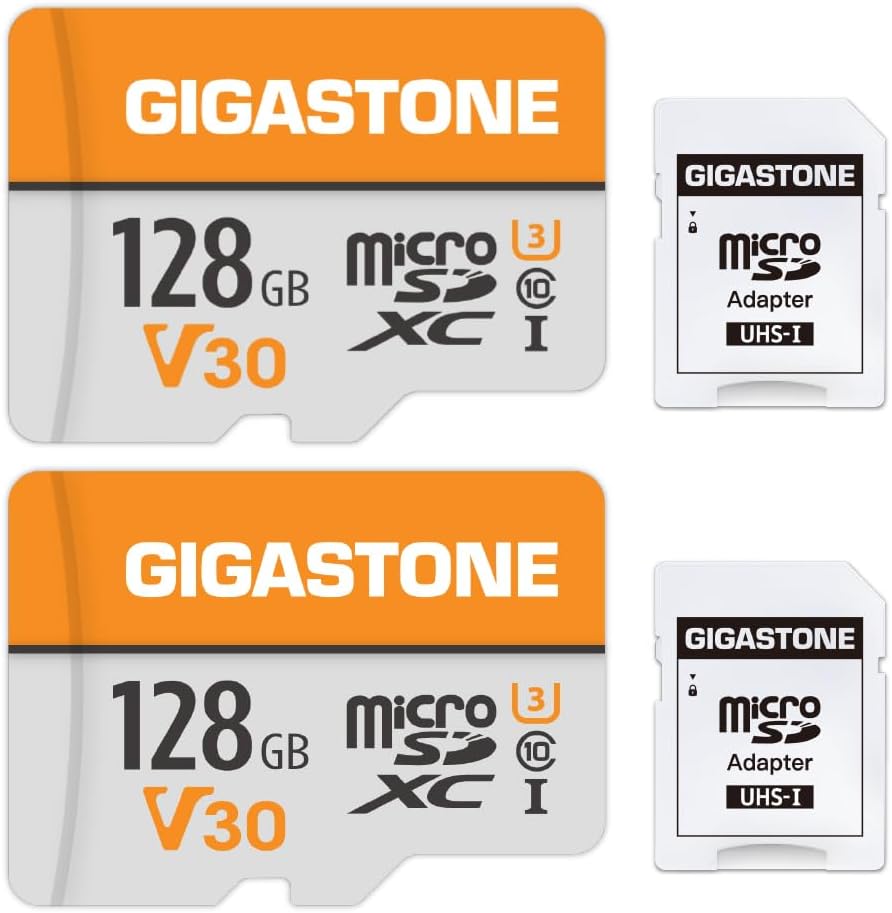
The GIGASTONE 128GB two-pack is especially practical for homes or businesses operating more than one camera. It provides two 128GB cards, and the stated 4.6 rating indicates solid customer satisfaction. Its A1, V30, UHS-I, and Class 10 specifications are appropriate for video-heavy devices, including many security cameras, dash cams, and drones.
We may earn a commission when you buy through this link, at no additional cost to you.
Stated read and write speeds reach 95MB/s and 40MB/s respectively, and the listing specifically identifies 4K Ultra HD recording and display. The package also includes two full-size SD adapters, so each card can be inserted into a larger device for transfer or review. That level of packaging makes the set convenient for separate Tapo cameras or for keeping a spare card ready.
The important compatibility note is formatting. These cards are natively formatted as exFAT, while older security cameras, dash cams, and some Android phones may require FAT32. Users should check the camera manual and format the cards through compatible device settings before inserting them into a Tapo camera. The card is also described as waterproof, shockproof, temperature-proof, and X-ray-proof.
Gigastone provides a five-year limited warranty. The main trade-off is that A1 and V30 do not automatically guarantee the same long-term write endurance as cards expressly built for surveillance. However, the pair configuration and strong environmental specifications make this a convenient choice for users who want separate media for multiple devices.
This two-pack is a strong option when you need one card per camera or want an immediate backup. Verify formatting requirements and the maximum capacity supported by each Tapo model, then initialize every card in the camera that will use it.
Using a different card for each camera simplifies file management and prevents one device from filling the storage available to another. Two adapters make it easier to retrieve and transfer footage from both cards.
The exFAT default may be accepted by newer devices but not by older cameras. Checking the Tapo model's manual and formatting the card through the camera reduces the risk of recognition errors or interrupted recording.
We may earn a commission when you buy through this link, at no additional cost to you.
The SANDISK 256GB High Endurance is the most premium-focused card here, combining a large 256GB capacity with a design specifically intended for dash cams and home monitoring. Its 4.7 rating supports its reputation for reliability, while the U3 and V30 classes indicate that it is equipped for demanding video recording rather than merely file storage.
We may earn a commission when you buy through this link, at no additional cost to you.
SanDisk states that this model can record for up to 20,000 hours, though actual footage time is lower and depends on resolution, bitrate, and recording behavior. The card supports Full HD and 4K recording on compatible devices. At 256GB, it offers twice the nominal capacity of the 128GB High Endurance card while preserving the same surveillance-focused feature set.
Physical protections include temperature, water, shock, humidity, and magnet resistance for the card itself. That makes it a sensible option for indoor security cameras and compatible outdoor setups where the card may be exposed to environmental changes. The included adapter provides a straightforward path to moving recordings to a computer.
The trade-off is cost and a possible capacity mismatch. Some cameras, particularly older models, may not recognize 256GB cards, so the user must verify the supported maximum before buying. Even where capacity is accepted, an endurance card is most valuable when recording is frequent or continuous rather than occasional and event-driven.
This is the best premium choice for a high-recording camera that explicitly supports 256GB. It delivers the largest capacity among the top three highlighted picks, a strong video-speed foundation, and a construction designed around surveillance workloads. For occasional recordings, a smaller or more explicitly Tapo-targeted card may be more economical.
A 256GB card can extend the interval between manual downloads or deletions while keeping the same high-endurance construction. This is especially useful for cameras that create frequent event clips or record on a continuous schedule.
The high-endurance design is more relevant than raw transfer speed for repeated writes and long recording sessions. Its physical protections add another layer of suitability for security-camera locations and mobile use.
We may earn a commission when you buy through this link, at no additional cost to you.
The TF162 128GB two-pack provides a flexible alternative for people who want two cards without moving to a dedicated high-endurance product. Its 4.5 rating reflects moderate but positive customer feedback. Each card has 128GB of nominal capacity, and the listing describes compatibility with cameras, surveillance equipment, car recorders, phones, computers, and game consoles.
We may earn a commission when you buy through this link, at no additional cost to you.
The cards use UHS-I, C10, and A1 specifications, with stated read speeds of up to 80MB/s. That is adequate for many Full HD recording situations, and the A1 class supports faster application performance on compatible Android devices. Unlike several more specialized options in this guide, the listing does not state a V30 rating, so buyers prioritizing high-bitrate 4K should verify the camera's requirements carefully.
Each card is accompanied by an adapter, allowing either microSD card to be used in a full-size SD slot. The dual-pack format is convenient for separating camera footage from other files or assigning one card to each of two cameras. Its broad compatibility also makes the set useful for tablets, mobile phones, car audio systems, and compatible consoles.
The main uncertainties are the lack of a stated endurance rating and more limited environmental information than the SanDisk and Gigastone products. Continuous recording should be tested after setup, and important footage should be checked to ensure the camera recognizes and writes to the card without interruption.
Choose this set for value-oriented buyers who want two 128GB cards and broad device support. It is most convincing for moderate-resolution recording and secondary devices, while a V30 high-endurance card is the safer choice for demanding continuous surveillance use.
The package arrangement is simple and useful: one card can stay in a Tapo camera while the other remains available as a spare or serves another compatible device. Separate adapters reduce friction when transferring files.
UHS-I, C10, and A1 classes make the cards usable across common phones, tablets, computers, and cameras. The stated transfer speed is adequate for routine file movement but should not replace checking a camera's supported video classes.
We may earn a commission when you buy through this link, at no additional cost to you.
The 64GB Micro SDXC card is a compact-capacity option for users who do not need a large archive on the camera. It has a 4.6 rating and a stated read speed of up to 90MB/s. Its U1 and A1 classes, together with Full HD readiness, make it appropriate for many everyday Tapo recording configurations.
We may earn a commission when you buy through this link, at no additional cost to you.
The listing specifically states stable 1080p recording for phones, dash cams, and security cameras without frame drops. That makes it a sensible match for a Tapo camera configured for Full HD and a shorter on-device retention period. The card is also described as resistant to temperature, shock, water, and X-rays, adding durability for mobile and indoor use.
A1 performance benefits application launches and random operations on compatible Android devices, while the included adapter helps with transfers to a computer. Actual usable capacity is higher than 58GB because operating systems and formatting methods report space differently from the decimal capacity used on the label.
The 64GB limit is the central trade-off. It fills more quickly than 128GB or 256GB options, making regular downloading and card rotation important. The U1 speed class also does not offer the same explicit high-bitrate video guarantee as V30, so 4K camera configurations require closer compatibility checking.
This card is best for a single camera with lighter recording needs or for a buyer who wants to maintain a simple, inexpensive backup routine. Confirm that the Tapo model supports the card, format it in the camera, and check recorded clips before relying on it for critical monitoring.
A 64GB card can be a practical match for a camera that records primarily on motion or where footage is reviewed and removed regularly. It reduces storage demands without moving to a less common high-capacity configuration.
U1, A1, and the included adapter support phones, tablets, dash cams, action cameras, and laptops. The stated 90MB/s read speed helps when copying clips to a computer, although actual results vary by interface and device.
We may earn a commission when you buy through this link, at no additional cost to you.
The TOPESEL 32GB two-pack is the most basic option in the guide, offering two small-capacity cards with a 4.5 rating. It is most appropriate for users with modest recording needs, older or simpler compatible cameras, and a preference for FAT32 formatting. The shared adapter can hold either microSD card when a full-size SD slot is required.
We may earn a commission when you buy through this link, at no additional cost to you.
The cards provide a stated read speed of up to 80MB/s and write speed of up to 20MB/s. Their Class 10 and UHS-I markings suit everyday file storage, but the listing warns that they may not suit high-speed write scenarios. That limitation deserves attention when a Tapo camera is configured for high-resolution or high-bitrate continuous recording.
Each 32GB card generally appears as approximately 28.8GB of usable space. FAT32 is the default format, which can improve compatibility with older cameras, although some newer devices may require reformatting or may not recognize the card at all. The compatibility notice specifically warns against assuming that every camera supports the card and mentions recognition errors, formatting messages, interrupted recording, and failed high-speed continuous shooting as possible symptoms.
For a Tapo camera, this option is best limited to lightweight use where capacity can be managed easily and the camera's supported card specifications have been confirmed. The dual pack allows a hot-swap workflow in which one card is being reviewed while the other remains in use, provided the camera's card requirements allow it.
The TOPESEL set offers a simple fallback for basic recording and backup needs. It is not the strongest choice for constant surveillance, but its two-card format and familiar FAT32 setup can be useful where capacity and basic compatibility outweigh demanding write performance.
FAT32 is useful for many older cameras and accessories, but it also comes with a 32GB capacity ceiling. Newer devices may reject it or require a different format, making manual verification essential.
The package contains two microSD cards and one shared adapter, not two separate adapters. Rotating between cards can simplify downloads and archiving, provided the camera performs a fresh format check on each card.
We may earn a commission when you buy through this link, at no additional cost to you.
Choosing a microSD card for a Tapo camera is easiest when capacity, recording workload, speed class, and device support are considered together. The most important requirement is a card that your exact camera model accepts and can format.
Start with the manual or support documentation for the exact Tapo camera model. Some cameras impose maximum capacity limits, require a particular file system, or list approved speed classes. A card can perform well in a phone yet still fail to be recognized by a camera, so model-level verification should come before any purchase. The explicitly Tapo-targeted card in this guide names a wide range of compatible cameras, while the other products offer more general compatibility claims.
Check compatibility first, then confirm the physical microSD format and formatting behavior. It is also wise to test the card in the camera before relying on it for important footage.
Capacity determines how long recordings remain on the card before being overwritten or manually removed. A 32GB card suits limited or occasional recording, 64GB works for lower-volume use, and 128GB or 256GB provides more room for motion events and longer retention. Larger cards are convenient, but they offer no benefit if the camera does not recognize the capacity. Storage consumption also depends on resolution, frame rate, bitrate, motion frequency, and whether the camera records continuously.
Choose the smallest capacity that comfortably covers your retention and backup routine. A larger card is usually better for continuous recording, while a smaller card may be easier to manage for a lightly used camera.
The Video Speed Class guarantees a minimum sustained write rate under specified recording conditions. V10 supports up to 10MB/s, while V30 guarantees 30MB/s. Cards labeled U3 also meet the higher UHS performance class, but the V30 marking is the more direct indicator for video recording. A card without V30 may work for Full HD on some cameras, yet it is less reassuring for 4K, high-bitrate, or continuous recording.
For a Tapo camera, match or exceed the camera's recommended video class. High advertised read speeds are useful for transferring files but do not replace an appropriate sustained-write rating.
A general-purpose card is often sufficient for a camera that records mainly when it detects motion. A high-endurance card is more appropriate for continuous schedules, busy scenes, and cameras that repeatedly write short clips. Endurance involves the card's controller, flash quality, and workload support rather than just a headline transfer speed. The two SanDisk High Endurance cards in this guide are expressly positioned for dash cams and home monitoring, making them the clearest choices for demanding recording routines.
Use a surveillance-focused card when recording is intensive or uninterrupted. For occasional event clips, a compatible general-purpose card with an appropriate speed class may be sufficient.
FAT32, exFAT, and the file systems used by other devices can affect whether a card is recognized. Many cameras format a supported card themselves, but older devices may require FAT32 while some newer products are designed around exFAT. The Gigastone cards are natively exFAT and may need reformatting for older cameras. The TOPESEL cards default to FAT32, which may help older equipment but can be rejected by newer devices. Formatting erases the card, so do it before adding important files.
Use the camera's formatting function whenever possible. If it offers a file-system choice, follow the manual rather than assuming a format used by a phone will work.
Security cameras may operate in warm rooms, vehicles, entryways, or outdoor locations where temperature changes, moisture, and accidental impacts are possible. Water, shock, temperature, X-ray, and magnetic-field resistance can improve the card's suitability, but these claims do not make the camera housing weatherproof. A card that is described as waterproof may still be installed in a location where condensation or water can enter the camera body.
Prioritize cards with useful environmental protections, and pair them with a properly sealed camera enclosure. Physical card durability cannot compensate for an inadequately protected camera.
A full-size SD adapter makes it easier to move recordings into a computer or another device with a standard SD slot. Adapters are passive and do not improve speed, so a capable USB reader is still important for fast transfers. Some multi-card packs include one adapter for each card, while the TOPESEL set includes one shared adapter. If you use the card in several devices, a second adapter can reduce inconvenience.
Check what is included before buying. An adapter is convenient, but it should be treated as a transfer accessory rather than a substitute for a properly formatted card.
Begin by checking your Tapo camera's maximum supported capacity, required speed class, and file-system instructions. Insert the card into the camera and use the camera's storage or microSD management menu to format it. Formatting in the camera establishes the correct partition structure and reduces the risk of unrecognized media, interrupted clips, and errors during recording.
After formatting, make a short test recording and verify its date, resolution, playback, and replay in the Tapo app. Confirm that the camera can save new events without overwriting the test immediately. If the card is not recognized, remove it, check the insertion direction, and repeat the camera's formatting process rather than repeatedly inserting and ejecting it.
To protect recorded evidence, download important clips regularly and maintain a separate backup. Handle the card by its edges, keep it dry, and avoid removing it while the camera is actively recording. Replace or reformat cards that show recording errors, corrupted clips, or unusual write warnings, and do not rely on a single card as the only copy of critical footage.
Most compatible Tapo cameras use a microSD card, but the supported capacity, maximum file size, speed class, and file system can vary by model. Check the camera manual and its on-screen storage settings before buying a card. The 128GB Tapo-specific card in this guide lists compatibility with numerous C-, TC-, and D-series models, but your exact model should still be confirmed.
A 256GB card can be suitable if your exact Tapo camera supports that capacity and can format it correctly. More capacity extends the time before footage must be downloaded or overwritten. The SANDISK 256GB High Endurance is a strong choice for intensive recording, while the 256GB Ultra model is better suited to users who also value fast transfers and general device compatibility.
A high-endurance card is most helpful when the camera records continuously, the scene generates frequent motion clips, or the card will remain in service for long periods. A general-purpose card may be adequate for occasional event recording. High-endurance cards are designed for repeated writes, so they provide a clearer margin for demanding surveillance workloads.
Formatting in the Tapo camera is generally preferable because it creates the file system and settings expected by that device. If the camera cannot format the card, consult its manual for the required file system and capacity limits. Formatting on a computer should be a fallback, and the card should be safely removed afterward before inserting it into the camera.
The card may exceed the camera's capacity limit, use an unsupported format, have been formatted incorrectly, or suffer from a connection or card fault. Confirm the supported maximum capacity, reinsert the card with the contacts aligned, and format it through the camera. Testing a known-compatible card can help determine whether the problem is the card or the camera.
V30 is a strong minimum target for modern continuous or high-resolution recording because it guarantees a 30MB/s sustained write rate. Some Full HD cameras may work with lower-class cards, but higher-resolution recording creates greater demands. If the camera recommends V30 or U3, choosing a card that meets or exceeds that requirement reduces the risk of dropped frames and recording interruptions.
Clear or download footage as often as your recording volume requires, usually before the card becomes full. The best interval depends on resolution, bitrate, motion frequency, capacity, and whether the camera records continuously. Downloading important clips regularly also prevents a full card and reduces the risk of losing evidence when new footage overwrites older files.
A card may physically fit and may be supported by several models, but using the same card in multiple cameras can make file management harder and increase the workload on that single card. Separate cards are generally easier to maintain, especially in multi-camera systems. If one card is moved between cameras, reformat it in each camera and confirm that the model supports its capacity.
The SANDISK 128GB High Endurance is the strongest all-around recommendation because it combines a surveillance-focused design, 128GB capacity, and U3 and V30 video classes. The explicitly Tapo-compatible 128GB card is the best fit for buyers who prioritize a clear compatibility list, while the SANDISK 256GB High Endurance is the premium choice for compatible cameras that need more storage and heavier recording workloads.
Prioritize exact model compatibility, appropriate sustained write performance, and a capacity that suits the retention schedule. A V30 high-endurance card is a sensible default for continuous recording, whereas a lower-capacity general-purpose card can serve a lightly used camera. Users operating multiple cameras should consider a two-card pack and keep separate media for easier maintenance and archiving.
Before purchasing, verify the camera's current requirements, supported maximum capacity, and recommended format. Product details and prices can change, so check the latest listing and camera documentation at the time of purchase. Whichever card you choose, format it in the camera, test a recording, and maintain a separate backup of important footage.