
GL.iNet GL-SFT1200 Opal Travel Router
4.2Editor score
Compact dual-band Wi-Fi
Pre-installed OpenVPN and WireGuard
Three Gigabit Ethernet ports
Our Site to Site Vpn Router guide compares 10 options for VPN performance, wired and wireless connectivity, port speed, security, portability, and ease of use.
A site-to-site VPN router can connect entire networks through an encrypted tunnel rather than protecting only one device at a time. The strongest choices combine capable VPN clients or servers, multi-gigabit Ethernet, flexible routing, and useful OpenWrt-based controls. The right router depends on whether you need a permanent office gateway, a compact travel system, or a wireless home network with VPN protection.
This guide compares ten routers for the factors that most directly affect a site-to-site setup: VPN protocol support, throughput, wired and wireless capabilities, port configuration, security features, multi-WAN options, and administration. It includes travel routers, gaming routers, dedicated wired security gateways, and a home-oriented Wi-Fi 7 model. Product ratings reflect the supplied marketplace feedback, while practical suitability is assessed from the published specifications.
Each review explains the product's strongest use case, important limitations, and the kind of network it is best suited to manage. Some products explicitly support site-to-site tunnels, while others are better understood as client-side or remote-access VPN platforms. Availability and pricing can change over time, so readers should verify current product details and service requirements before purchasing.
4.2Editor score

4.5Editor score

4.4Editor score
The comparison below highlights each router's primary network type, VPN approach, wired connectivity, and most important flexibility. It shows why the list spans portable client routers, dedicated security gateways, high-capacity Wi-Fi systems, and cellular-capable travel hardware.




The GL.iNet GL-MT3000 Beryl AX is a compact Wi-Fi 6 travel router with a 4.5 rating, making it a strong all-around option for readers who need VPN flexibility away from a fixed office. Its standout combination includes OpenVPN and WireGuard clients, a VPN server, OpenWrt, a 2.5G WAN port, and wireless networking across both 2.4GHz and 5GHz bands.
We may earn a commission when you buy through this link, at no additional cost to you.
The Beryl AX can act as a VPN client and server at the same time. That arrangement is useful for accessing local network resources such as printers or local web servers while connected to a public internet tunnel. It also supports more than 5,000 OpenWrt plug-ins, allowing administrators to extend routing, firewall, storage, and monitoring functions beyond the preinstalled VPN clients.
Its limitations are practical rather than fundamental. There is only one Gigabit LAN port, which may be restrictive for a desk with several wired peripherals, and the router does not include cellular hardware. Advertised VPN throughput of up to 150Mbps for OpenVPN and 300Mbps for WireGuard is measured on a local network, so real-world results can vary with the chosen provider and internet connection.
This is the most convincing pick for travelers, consultants, and small-network administrators who want a router that can act as both endpoint and tunnel gateway. It is particularly suitable when a site-to-site deployment needs local resource access alongside encrypted internet routing. For larger wired networks or cellular-first redundancy, one of the dedicated gateways or 5G models may be a better fit.
The compact enclosure and international plug options make the Beryl AX easy to carry between homes, offices, and hotels. It turns a single internet connection into a private Wi-Fi network and adds a fast wired uplink through its 2.5G WAN interface.
Running a VPN client and server together is the feature that most improves its relevance to site-to-site networking. It supports remote access to selected local resources while traffic leaves through an encrypted client tunnel.
We may earn a commission when you buy through this link, at no additional cost to you.
The TP-Link ER605 is a wired Gigabit VPN router with a 4.4 rating and a clear focus on business-style network gateways. It is one of the most directly relevant choices in the guide because the supplied specifications explicitly list support for LAN-to-LAN IPsec connections, along with OpenVPN, L2TP, and PPTP.
We may earn a commission when you buy through this link, at no additional cost to you.
Five Gigabit Ethernet ports create a flexible foundation for a small office. One is a dedicated WAN port, two can operate as WAN or LAN, and two are LAN ports, allowing multiple upstream connections and load distribution. A USB port can also support compatible 4G or 3G modems for WAN backup, while firewall policies, denial-of-service defense, and IP, MAC, and URL filtering add practical control.
The main limitation is that the ER605 is entirely wired. It cannot provide Wi-Fi to laptops, phones, tablets, or smart-home devices, so an access point may be needed. It also does not offer the touchscreen, app, or extensive OpenWrt customization associated with several GL.iNet travel routers. Its strengths are concentrated on dependable routed connectivity and traditional VPN services.
For a small business that already has separate wireless coverage, the ER605 is an excellent site-to-site VPN gateway. It is especially attractive when multiple WAN links, USB cellular backup, and established protocol support matter more than mobility or consumer-style network customization.
The ER605 avoids unnecessary wireless overhead and concentrates its capabilities on routed traffic. That makes it a sensible central appliance for a branch office, home office, or small business that connects wired devices and an independent access point.
Up to three WAN ports allow administrators to distribute or reserve internet connections, while the USB WAN option adds a possible 4G backup path. The result is more resilience than a single-WAN consumer router normally offers.
We may earn a commission when you buy through this link, at no additional cost to you.
The GL.iNet GL-SFT1200 Opal is a lightweight AC1200 travel router rated 4.2 stars. It offers the essential features for a small encrypted network without the bulk of a larger home router: dual-band Wi-Fi, three Gigabit Ethernet ports, preinstalled OpenVPN and WireGuard clients, and a physical switch for activating VPN functions.
We may earn a commission when you buy through this link, at no additional cost to you.
Its 2.4GHz band is listed at up to 300Mbps, while the 5GHz band reaches up to 867Mbps under ideal local conditions. Two Gigabit LAN ports allow the router to serve wired computers and other devices, and the retractable antennas can be extended vertically for better reception. A wired or wireless public connection can be repeated into a private Wi-Fi network, which is useful in hotels and other shared locations.
The limitations center on capacity and functionality. AC1200 performance is modest for crowded environments or high-bandwidth applications, and the device offers only basic router hardware rather than multi-gigabit ports. The supplied information also notes that easytethering is not supported, while the VPN toggle must first be assigned a function in the admin panel.
The Opal is the value-oriented choice for travelers, students, and small home networks that need a private Wi-Fi system with client-side VPN support. It is less appropriate as a high-throughput branch gateway, but for a modest site-to-site arrangement or secure travel connection, its portability and Gigabit wired access are compelling.
The Opal creates a private Wi-Fi network over a public connection and can activate a VPN client with a physical control. Its small size also makes it easier to carry and deploy in temporary locations.
Three Gigabit ports are unusual at this size and allow the travel router to support more than wireless clients alone. This makes it a useful bridge for a laptop, desktop, or small network appliance.
We may earn a commission when you buy through this link, at no additional cost to you.
The GL.iNet GL-AXT1800 Slate AX combines Wi-Fi 6 performance with a substantial upgrade over entry-level travel routers. Its 4.4 rating reflects a balanced package that includes up to 1800Mbps combined wireless speed, OpenVPN and WireGuard clients, OpenWrt 21.02, and a physical control for VPN or AdGuard Home functions.
We may earn a commission when you buy through this link, at no additional cost to you.
The wireless platform supports up to 120 devices and includes MU-MIMO, OFDMA, and BSS color. Advertised VPN speeds reach up to 500Mbps for OpenVPN and 550Mbps for WireGuard, subject to the same local-network caveat that applies to other models. A USB storage feature supports SAMBA and WebDav, allowing connected devices to share documents over a private network.
The Slate AX is not as fast as the latest multi-gigabit and Wi-Fi 7 systems, and its wired interfaces are not specified as multi-gigabit. VPN use also requires an active subscription with one of the more than 30 supported providers. Despite those limitations, it is more versatile than a basic travel router and less complex than a full desktop OpenWrt system.
This router is an excellent choice for a traveler or distributed team that needs Wi-Fi 6, expandable networking, and private file access. It also works well as a temporary branch router when a captive-portal-aware public connection is the available internet source and USB storage is useful for local collaboration.
OpenWrt 21.02 gives administrators access to a broad package ecosystem, allowing the router to serve as more than a basic access point. It is a good middle ground between a consumer travel router and a manually administered network appliance.
Support for up to 120 connected devices makes the Slate AX more appropriate for a busy temporary network than many compact routers. Wi-Fi 6 features also improve efficiency when several clients are active.
We may earn a commission when you buy through this link, at no additional cost to you.
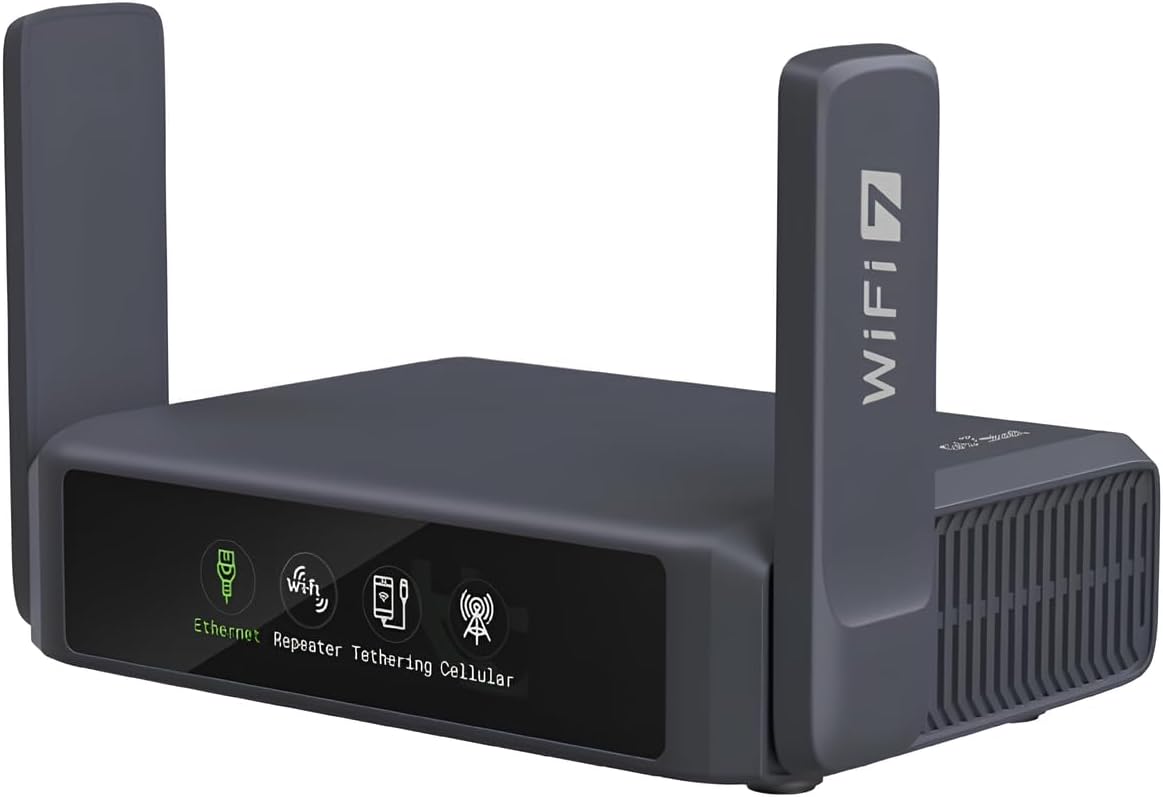
The GL.iNet GL-BE3600 Slate 7 is a compact Wi-Fi 7 router with a 4.4 rating, combining modern wireless performance with a useful touchscreen. It supports dual 2.5G Ethernet, USB 3.0, OpenWrt 23.05, and preinstalled OpenVPN and WireGuard clients, making it a capable travel gateway for technically confident users.
We may earn a commission when you buy through this link, at no additional cost to you.
Its touchscreen simplifies common tasks such as scanning a Wi-Fi QR code, checking speed, toggling a VPN, and switching providers. Color-coded indicators reveal the active Ethernet, tethering, repeater, or cellular mode. Under the hood, the router offers 512MB of storage and an OpenWrt plugin environment for customization, while its VPN server and client can operate simultaneously.
Advertised VPN throughput reaches 100Mbps with OpenVPN and 540Mbps with WireGuard on a local network. The device has only one 2.5G LAN port, so a larger wired network may require an additional switch. Its screen also replaces some traditional administration workflows, although the underlying OpenWrt platform retains advanced configuration options.
The Slate 7 is best for travelers who want current wireless standards, quick everyday VPN control, and enough performance for a temporary office. It is also a strong fit for remote workers who need to switch between hotel Wi-Fi, Ethernet, tethering, and other upstream modes without rebuilding the local network.
Dual 2.5G Ethernet provides room for faster wired backhaul and local transfers, while Wi-Fi 7 improves the experience for compatible modern devices. The combination is useful for temporary workspaces that mix laptops, phones, and wired equipment.
The touchscreen gives nontechnical travelers a simple way to activate the VPN and view network status. Advanced users still have OpenWrt 23.05 available for more detailed configuration.
We may earn a commission when you buy through this link, at no additional cost to you.
The GL.iNet GL-MT2500A Brume 2 is a dedicated wired VPN security gateway with a 4.4 rating. Unlike the travel routers in this list, it has no Wi-Fi function and focuses entirely on routing, encryption, and network security, making it a clean choice for administrators who already have separate wireless coverage.
We may earn a commission when you buy through this link, at no additional cost to you.
Its 2.5G WAN port offers a high-speed internet uplink, while a Gigabit LAN port, USB 3.0 connection, and 8GB eMMC storage provide expansion options. OpenVPN and WireGuard are preinstalled and compatible with more than 30 providers. Advertised local VPN speeds reach 150Mbps for OpenVPN and 355Mbps for WireGuard, and the device can run a client and server simultaneously.
The Brume 2 is limited by having only one wired LAN port and no internal wireless radios. In practical deployments, administrators will probably pair it with a switch and an access point. Another consideration is that the product listing does not explicitly state site-to-site protocol support, although the simultaneous client-and-server capability is relevant to remote-access and routed-tunnel use cases.
This gateway is ideal for a home office, small branch, or secure travel kit where devices are already connected by Ethernet. It is also a good fit for users who want an encrypted network boundary without adding unnecessary Wi-Fi hardware to the appliance.
By removing Wi-Fi from the appliance, the Brume 2 creates a predictable wired security layer. A separate access point can then be placed according to coverage needs without weakening the router's core role.
The ability to operate a VPN server alongside a client can expose selected local services while the router sends internet traffic through another tunnel. That makes it useful for controlled remote access to files and internal servers.
We may earn a commission when you buy through this link, at no additional cost to you.
The GL.iNet GL-MT6000 Flint 2 is a high-performance Wi-Fi 6 gaming router with a 4.5 rating. It stands out for its combination of eight-stream wireless networking, dual 2.5G Ethernet ports, 1GB of DDR4 memory, 8GB of eMMC storage, and exceptionally high stated VPN throughput.
We may earn a commission when you buy through this link, at no additional cost to you.
OpenVPN speeds are listed at up to 880Mbps and WireGuard speeds at up to 900Mbps, although actual performance depends on the internet service provider, network environment, server location, and VPN provider. The router supports large numbers of connected devices, AdGuard Home, and an OpenWrt-based environment, making it suitable for a busy home, creative office, or performance-focused temporary network.
The product is physically and functionally more ambitious than a travel router, so it is less convenient for frequent movement. The two 2.5G ports are useful but modest for a large wired network, and there is no integrated 5G modem. The supplied instructions also recommend updating the firmware during initial setup to enhance performance.
The Flint 2 is an excellent choice when a site-to-site router must also serve many wireless clients and handle encrypted traffic at high throughput. It is less suited to minimalist travel, but it offers the strongest combination of speed, memory, and wireless capacity among the general-purpose routers reviewed.
The stated VPN throughput makes the Flint 2 a compelling choice for busy networks that cannot tolerate a major bottleneck when a tunnel is active. A faster underlying connection remains essential for realizing these figures in everyday use.
OneGB of DDR4 memory and 8GB of eMMC provide resources for additional services and plugins. The platform is better suited to administrators who want a flexible home or office gateway than to a minimal travel accessory.
We may earn a commission when you buy through this link, at no additional cost to you.
The GL.iNet GL-E5800 NA MUDI 7 is the most advanced and premium-oriented router in the guide, with a 4.4 rating. It combines tri-band Wi-Fi 7, an integrated Qualcomm 5G modem, eSIM support, two nano-SIM slots, a battery, touchscreen controls, and a multi-WAN failover system.
We may earn a commission when you buy through this link, at no additional cost to you.
The wireless platform combines 2.4GHz, 5GHz, and 6GHz bands and can support up to 64 connected devices. Cellular download speeds are listed at up to 4.67Gbps, while the 2.5G Ethernet port and 10Gbps USB-C port provide high-speed wired and peripheral options. The router can use Ethernet, Wi-Fi repeater, USB tethering, and 5G cellular at the same time, automatically moving to another path if a connection drops.
Its built-in 5150mAh battery provides up to 13.5 hours of untethered operation and supports 30W PD/PPS charging. The included VPN clients are OpenVPN-DCO, listed at up to 700Mbps, and WireGuard, listed at up to 600Mbps. The device can serve as either a VPN client or server, although a supported provider subscription and active cellular or eSIM plan may be required.
The MUDI 7 is the strongest choice for business travelers, mobile teams, pop-up locations, and anyone who cannot depend on one internet source. Its complexity, subscription needs, and high feature count may be unnecessary for a basic home network, but few alternatives combine cellular failover, tri-band Wi-Fi, battery power, and advanced VPN operation in one enclosure.
The quad-path design can maintain connectivity through Ethernet, repeated Wi-Fi, USB tethering, or cellular service. Automatic failover is especially valuable for business travel, temporary retail, live production, and other settings where a brief outage is costly.
An integrated eSIM and dual nano-SIM slots allow connectivity to be changed without locating a physical SIM. This makes cellular service a practical primary or backup uplink rather than an accessory that requires separate hardware.
We may earn a commission when you buy through this link, at no additional cost to you.
The GL.iNet GL-MT5000 Brume 3 is a sophisticated wired VPN security gateway with a 4.4 rating. It is designed for administrators who care most about encrypted throughput, multi-gigabit links, and network control rather than wireless convenience.
We may earn a commission when you buy through this link, at no additional cost to you.
Hardware-accelerated WireGuard and OpenVPN-DCO are listed at up to 1100Mbps. Three 2.5GbE ports can be configured flexibly for WAN, LAN, or multi-WAN arrangements, including dual-ISP failover. The router also offers VPN obfuscation that disguises VPN traffic as ordinary HTTPS, which can be useful on restrictive or heavily filtered networks.
Deep Packet Inspection provides visual filtering for adult, gambling, and malicious sites, while SQM and QoS can prioritize gaming, calls, and video when bandwidth is constrained. OpenWrt runs on 1GB of DDR4 memory and 8GB of eMMC, and a USB 3.0 Type-C port supports storage or cellular dongles. The absence of Wi-Fi requires a separate access point for wireless clients.
The Brume 3 is a compelling choice for a high-speed home or small-office network, especially where privacy filtering, traffic prioritization, and resilient ISP connectivity are priorities. It is less convenient for a temporary network that needs its own radio, but it provides an excellent foundation for a segmented professional site-to-site architecture.
The Brume 3 can process encrypted traffic at a rate that suits high-capacity internet connections and demanding file transfers. Its three 2.5G ports allow fast links to remain part of the same routed and protected topology.
VPN obfuscation and deep packet inspection address different network obstacles. The former helps encrypted traffic blend into HTTPS, while the latter gives administrators visible control over undesirable categories of traffic.
We may earn a commission when you buy through this link, at no additional cost to you.
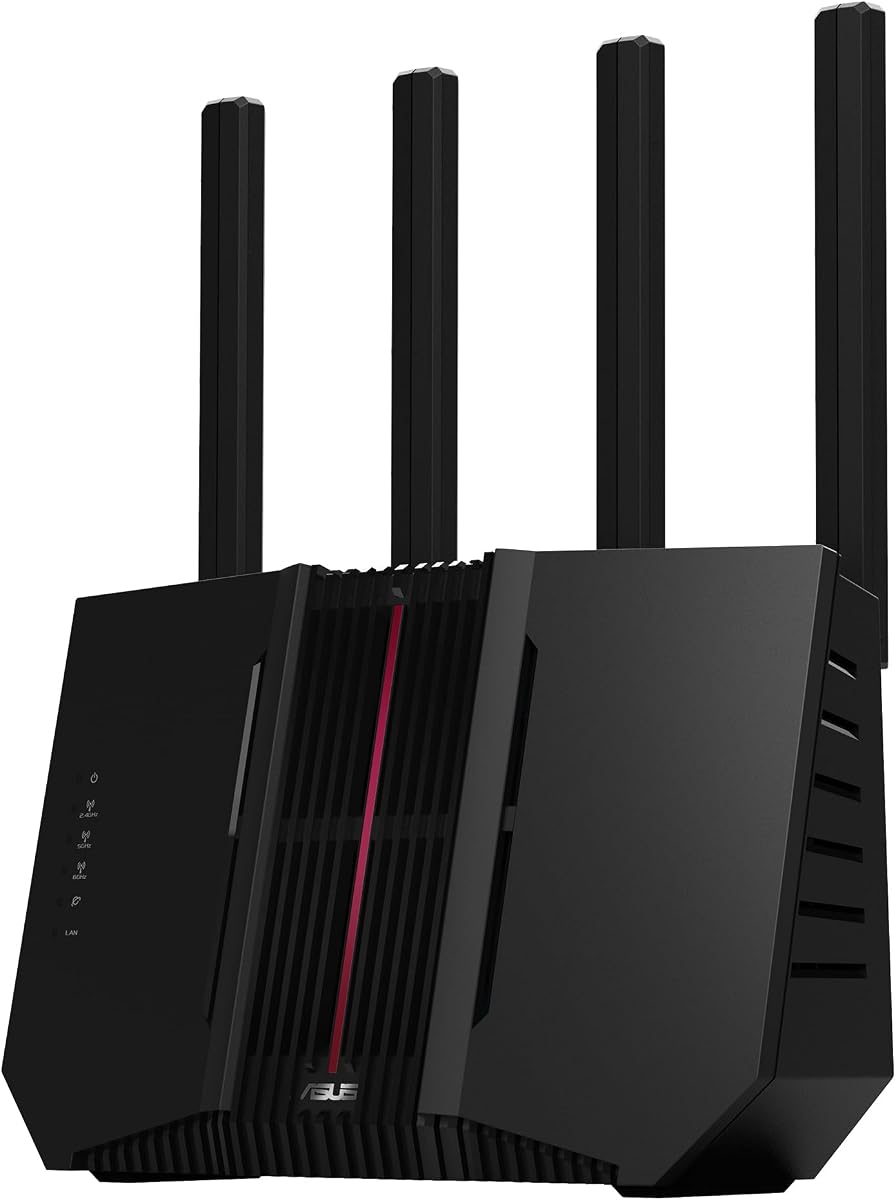
The ASUS RT-BE9700 is a high-end tri-band Wi-Fi 7 home router with a 3.9 rating. Unlike several travel-oriented products, its supplied specifications explicitly identify advanced site-to-site VPN features, making it a notable option for a residence or home office that also needs very fast wireless networking.
We may earn a commission when you buy through this link, at no additional cost to you.
Wi-Fi 7 capabilities include 320MHz channels in the 6GHz band, 4096-QAM, and multi-link operation, with aggregate speeds listed at up to 9700Mbps. Versatile WAN configuration, a USB port ready for 4G LTE and 5G mobile tethering, ASUS Network Security, and the Instant Guard app broaden its role in both fixed and temporary networks.
The router's high-end specifications can exceed the capacity of ordinary internet connections, particularly outside dense Wi-Fi 7 client environments. Its 3.9 rating is also the lowest in this comparison, so buyers should examine current user feedback carefully. The product is a full home router rather than a compact travel unit, and advanced site-to-site configuration will require attention to VPN client and provider settings.
The RT-BE9700 is best for a modern home or home office that needs explicit site-to-site VPN support alongside premium Wi-Fi 7 and future mesh expansion. Buyers with modest internet speeds may find similar results from less advanced hardware, but the RTX platform provides considerable headroom for demanding local wireless networks.
The supplied product information specifically highlights advanced site-to-site VPN, which sets this model apart from many client-focused travel routers in the guide. That makes it a strong candidate for a permanent home-to-office tunnel.
AiMesh compatibility allows the router to become part of a larger wireless system as coverage requirements grow. This is valuable for homes where one high-performance access point cannot provide consistent service throughout every room.
We may earn a commission when you buy through this link, at no additional cost to you.
Choosing a site-to-site VPN router involves matching tunnel requirements, upstream speed, client count, and physical deployment. The most important distinction is whether you need explicit LAN-to-LAN site-to-site support or a router that primarily provides client and server functionality.
A true site-to-site VPN connects two router-configured networks so that devices behind each router can communicate as if they were on the same local network. The TP-Link ER605 explicitly lists LAN-to-LAN IPsec connections, and the ASUS RT-BE9700 explicitly highlights advanced site-to-site VPN. Other products in this guide emphasize OpenVPN or WireGuard clients and servers, which can support remote access and routed tunnels but should not be assumed to provide the same LAN-to-LAN behavior without checking the exact configuration options.
Choose by verified protocol support, not by the words VPN router alone. Confirm whether local subnets can be advertised, whether routing between them is enabled, and whether the router can initiate and accept connections under the intended operating model.
A router's Wi-Fi or Ethernet speed does not guarantee equal VPN throughput. The relevant ceiling is usually the slower of the internet connection, local client link, provider server, processing capacity, and protocol. The Brume 3 lists up to 1100Mbps VPN throughput, the Flint 2 lists up to 880Mbps for OpenVPN and 900Mbps for WireGuard, and the MUDI 7 lists up to 700Mbps for OpenVPN-DCO.
Choose a router whose encrypted throughput comfortably exceeds your normal data needs. If you routinely transfer large files or host services, extra headroom is more useful than a faster radio that the internet connection cannot feed.
Site-to-site networking often involves one WAN uplink, several LAN devices, and sometimes a second internet connection. A dedicated gateway with two or three 2.5G ports is more adaptable than a compact router with a single Gigabit LAN port. The ER605 has five Gigabit ports and up to three WAN ports, while the Brume 2 and Brume 3 emphasize 2.5G wired connectivity.
Count the exact interfaces you need, including any separate access point and a wired backup link. Choose Gigabit or 2.5G ports according to the devices and internal transfers that will actually use them, not simply the highest number advertised.
A wireless router can serve phones, laptops, and smart devices while also handling a VPN tunnel. A wired gateway is often quieter, easier to segment, and better suited to a permanent office. The Brume 2 and Brume 3 intentionally have no Wi-Fi and should be paired with a separate access point if wireless coverage is needed.
Choose a wireless model for portable or mixed-client environments. Choose a wired model for branch offices and home offices where network predictability and physical interfaces matter more than mobility.
Redundancy can prevent a site from losing connectivity when its primary circuit fails. The ER605 supports up to three WAN ports and USB-backed mobile broadband, the Brume 3 supports dual-ISP Multi-WAN and failover, and the MUDI 7 can combine Ethernet, repeated Wi-Fi, USB tethering, and 5G cellular with automatic rerouting. The Slate 7's touchscreen also indicates multiple upstream modes.
List the failure scenarios that matter before choosing. More resilient models make sense for business-critical traffic, while a simpler single-WAN router may be sufficient for temporary or noncritical use.
OpenWrt-based systems provide package installation and extensive configuration, while the ASUS router emphasizes integrated protection and a simpler home-oriented interface. The Brume 3 adds VPN obfuscation, deep packet inspection, SQM, and QoS. The ER605 includes firewall policies, denial-of-service defense, and IP, MAC, and URL filtering. A physical VPN toggle can make client activation easier for nontechnical travelers.
Pick the platform you can confidently maintain. The most advanced router is not the best choice if its configuration model is too complex for the person responsible for updates, monitoring, and troubleshooting.
Travel routers must balance features with size, weight, and battery needs. The Opal weighs 145g and has a pocket-friendly design, while the Beryl AX is similarly compact and includes a physical control. The MUDI 7 goes further with a 5150mAh battery, up to 13.5 hours of untethered operation, and 30W PD/PPS charging, but it is a substantially more complex device.
For frequent travel, prioritize easy packing, simple startup, and reliable power. For a fixed location, port layout, throughput, and management features should carry more weight than portability.
Begin by updating the router's firmware, connecting it to a reliable internet source, and completing the initial administration setup. The Flint 2 specifically calls for an early firmware update, while other OpenWrt-based models may also receive stability and performance improvements. Create unique administrator and Wi-Fi credentials, choose the intended WPA3 security mode where available, and decide whether the router will use an existing access point or provide wireless service itself.
For a site-to-site tunnel, install or import the required VPN client and server configuration on both ends. Use matching networks, subnets, encryption settings, routing rules, and credentials on the two sites. Confirm the remote subnet route before testing individual applications, because successful tunnel establishment does not automatically mean every local network is permitted through the VPN.
Treat the router as part of the site's security perimeter. Keep its administration interface on a trusted network, apply firmware updates, use strong credentials, and review connected clients and VPN logs periodically. Keep a written record of tunnel addresses, DNS settings, firewall rules, and recovery steps so the connection can be restored if one side is replaced or reset.
A site-to-site VPN router creates an encrypted tunnel between two entire networks rather than protecting only one device. Devices at the remote location can use the local router as their gateway, and administrators can route selected private subnets across the tunnel. It is particularly useful for connecting a home office to a company network, linking branch locations, or giving a travel setup access to selected internal services.
Not necessarily. A travel router is primarily designed to create a private Wi-Fi network over an untrusted connection, often with a VPN client. Some travel routers also support a VPN server, but that does not automatically guarantee the same LAN-to-LAN routing features offered by a dedicated site-to-site gateway. Verify the exact protocol, subnet-routing, and server capabilities before purchasing.
The TP-Link ER605 explicitly supports up to 20 LAN-to-LAN IPsec connections, making it a clear choice for traditional routed site-to-site VPN. The ASUS RT-BE9700 also explicitly highlights advanced site-to-site VPN in its supplied specifications. For the GL.iNet models, check the current firmware and manual for the exact tunnel type and routing behavior required by your network.
WireGuard is often efficient and fast, but protocol suitability depends on your provider, operating system, endpoint requirements, and network policy. The listed products use various implementations, including standard WireGuard and OpenVPN-DCO, and their published performance figures come from local-network tests. Enterprise environments may also require IPsec or a specific protocol supported by the remote gateway.
Only if your internet service, internal transfers, or connected devices can benefit from it. A 2.5G WAN can prevent a fast fiber connection from being limited by a Gigabit uplink, while multiple 2.5G ports help with multi-WAN or high-speed local networks. If the actual connection is much slower, Gigabit hardware may be sufficient and easier to deploy.
Several models can repeat a public wired or wireless connection into a private network, and some are designed specifically to work with captive portals. The Beryl AX, Opal, and Slate AX all support relevant repeater functions, while the Slate 7 can display repeater status. Captive portals can still require manual sign-in, and a hotel may restrict VPN traffic or unusual device activity.
First verify that the router supports your required protocol and actual site-to-site routing method. Then compare VPN throughput with your internet speed, count the needed WAN and LAN ports, and confirm whether you need Wi-Fi, cellular failover, an access point, or USB storage. Finally, review the management interface, update process, security features, and ongoing VPN service requirements.
The GL.iNet GL-MT3000 Beryl AX is the most versatile all-around choice because it combines Wi-Fi 6, a 2.5G WAN port, OpenWrt, and simultaneous client-and-server operation in a portable enclosure. The GL.iNet GL-SFT1200 Opal serves as the budget-oriented option for basic private networking, while the GL.iNet GL-E5800 NA MUDI 7 is the premium choice for cellular connectivity, battery operation, multi-WAN resilience, and tri-band Wi-Fi 7.
For a permanent small-business network, prioritize the TP-Link ER605 when explicit LAN-to-LAN IPsec and multiple wired WAN options matter. For a high-speed wireless home or office, consider the Flint 2; for a dedicated modern wired gateway, compare the Brume 2 and Brume 3. The ASUS RT-BE9700 is the most relevant when a full home router must combine explicit site-to-site VPN, Wi-Fi 7, and AiMesh expansion.
Whichever category you choose, verify the exact tunnel type, provider requirements, interface count, and management features before ordering. Prices, firmware, protocol support, and product availability can change, so checking the current listing and official documentation is the best way to confirm that the router still matches the network you intend to build.