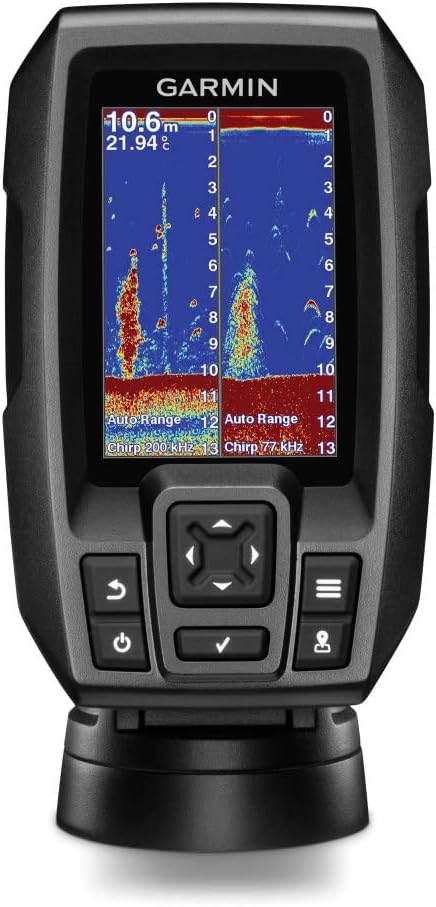
Garmin Striker 4 with Transducer
4.6Editor score
CHIRP sonar target separation
ClearVu near-photographic imaging
GPS waypoint navigation
A small boat depth finder can reveal submerged channels, drop-offs, vegetation, rocks, and fish holding structure that may be impossible to judge from the surface. The most useful unit combines dependable depth readings with a display you can understand quickly, a mounting option suited to your hull, and sonar detail appropriate to the waters you fish.
We compared ten depth-finding options covering portable, castable, transom-mounted, in-dash, and fixed-mount designs. The assessment focuses on stated sonar capabilities, display size, navigation features, depth limits, installation requirements, wireless range, mapping functions, and the practical trade-offs that affect everyday use.
Each selection highlights the type of angler and boat it suits best, from kayak anglers seeking a throwable sensor to skiff owners who want GPS navigation or contour mapping. Ratings reflect the supplied customer feedback, while features and limitations come directly from listed product information. Product availability and pricing can change, so confirm current details before buying.
4.6Editor score

4.6Editor score
4.5Editor score
As an Amazon Associate we earn from qualifying purchases.
This side-by-side comparison covers fixed, portable, castable, transom-mounted, and in-dash depth finders, with emphasis on sonar style, navigation, display, mounting, range, and intended fishing platform.


The Garmin Striker 4 combines a compact 3.5-inch display with CHIRP traditional sonar and ClearVu scanning sonar, giving small-boat anglers a capable all-in-one unit without the complexity of a large marine chartplotter. Its supplied rating is 4.6, which reflects broadly favorable customer feedback while still leaving room for ordinary installation and preference issues.
We may earn a commission when you buy through this link, at no additional cost to you.
ClearVu is the model's defining feature because it is designed to produce near-photographic representations of fish, structure, and underwater objects. CHIRP sonar adds a continuous sweep of frequencies, which supports wider information coverage, crisper fish arches, and improved target separation. The included waypoint map is also useful for revisiting brush piles, stumps, docks, and productive fishing areas.
The tradeoff is screen size. Its 3.5-inch diagonal display is compact enough for a small console but offers less visual detail than the 4.3-inch and seven-inch Garmin alternatives in this guide. The keyed interface and dedicated buttons also feel less modern than a touchscreen, although that can make operation straightforward in wet, sunny, or moving conditions.
This is the strongest general-purpose choice for anglers who want more than a basic depth number without moving to a large display. It suits skiffs, jon boats, pontoons, and similar craft where space is limited but sonar detail, GPS waypoints, and CHIRP performance remain valuable. The stated maximum depth reaches 1,600 feet in freshwater and 750 feet in saltwater, providing ample range for many fishing environments.
The combination of CHIRP traditional and ClearVu scanning sonar provides more information than a basic depth-only device. It is particularly useful when distinguishing fish arches from vegetation, rocks, drop-offs, or other structure beneath a small boat.
Dedicated buttons make the interface approachable, while the waypoint map helps anglers mark and revisit productive locations. The built-in flasher adds another familiar sonar view for ice fishing or vertical-jigging situations.
We may earn a commission when you buy through this link, at no additional cost to you.
The DepthTrax 2B is designed for boaters who prefer a clean dashboard and a straightforward digital depth readout rather than a large sonar screen. Its supplied rating is 4.2, and its strongest qualities center on in-dash integration, continuous readings, and a clearly visible warning system.
We may earn a commission when you buy through this link, at no additional cost to you.
Depth readings extend from 2.5 to 600 feet, and the listed performance remains effective at speeds up to 60 mph. The 200 kHz transducer can be mounted on the transom or glued into a compatible hull. Its polarized LCD, storage sun cover, and glare-conscious display treatment are practical for bright conditions and use with sunglasses.
Its limitations are important because this is not a full fish-finding or navigation console. Instead, it concentrates on depth accuracy, speed, and warning information. The three-stage advanced warning system uses an audible alarm, ultra-bright red LED, and LCD indicators to communicate an alarm condition clearly.
Choose the DepthTrax 2B when dashboard appearance and reliable depth monitoring matter most. It may suit a center-console or other small craft with a suitable in-dash opening, but installers must check hull construction carefully. Glue-in mounting is only appropriate for non-cored fiberglass hulls or aluminum hulls thinner than one-eighth inch, so not every boat qualifies.
An in-dash unit preserves more console space than a standalone fish finder and keeps the most relevant numerical information visible. The included storage sun cover helps protect the display when it is not in use.
The transom option offers flexibility, while glue-in mounting can create a neater permanent installation. Before selecting the permanent route, verify that the fiberglass is non-cored or that aluminum is thin enough to meet the stated requirement.
We may earn a commission when you buy through this link, at no additional cost to you.
The Humminbird PiranhaMAX 4 is a compact fish finder with a four-inch screen and selectable narrow and wide sonar beams. Its supplied rating is 4.6, making it one of the strongest-rated products here, particularly for anglers who want detailed target information from a relatively small display.
We may earn a commission when you buy through this link, at no additional cost to you.
The dual-beam approach lets users choose between concentrated detail and broader lake or shoreline coverage. That flexibility is valuable on a small boat because the unit can be adjusted according to the structure being searched rather than forcing one fixed sonar pattern. Fish, contours, and other structure can be identified using either beam.
The tilt-and-swivel mount is another practical feature for an open or compact console. It allows the viewing angle to be adjusted quickly, which can help reduce glare and make the screen easier to read as the light or seating position changes. The package includes the fish finder, mounting bracket, and XNT 9 28 T transom-mount transducer.
The PiranhaMAX 4 is best for anglers who prioritize fish-finding structure over built-in GPS navigation. It is a sensible match for skiffs, jon boats, and small fishing boats where a four-inch unit is easier to accommodate than a large chartplotter. It also carries a one-year limited warranty for added support after purchase.
A narrow beam concentrates the sonar view for detail, while a wide beam covers more surrounding water. Switching between them helps balance precise target separation against the area scanned around the boat.
The included transom transducer and adjustable mount reduce the need to select accessories separately. The result is a relatively self-contained setup for anglers who primarily need sonar rather than charting.
We may earn a commission when you buy through this link, at no additional cost to you.
The Portable Wireless Fish Finder is built around a castable sensor that communicates with a handheld color LCD rather than a permanently mounted hull transducer. Its supplied rating is 4.3, and its flexibility makes it especially interesting for anglers who move between a kayak, shoreline, boat, lake, river, sea, and ice fishing.
We may earn a commission when you buy through this link, at no additional cost to you.
The sensor can be tethered with fishing line and cast into the water, eliminating the need to drill holes in the hull. Maximum wireless separation is 262 feet, or 80 meters. Once connected, the display provides water depth, temperature, estimated fish size, fish depth, and bottom contour, with selectable measurement units for greater convenience.
The information is useful but less sophisticated than a high-resolution scanning-sonar display. It lacks the detailed CHIRP and ClearVu imagery found on several Garmin models, so it is better viewed as a portable scouting tool than a complete console replacement. The 105-degree beam and depth range of 2.6 to 164 feet cover many common fishing situations.
This pick best serves boaters who do not want permanent wiring or a fixed transducer, especially kayak anglers and shore anglers who can cast the probe. The two-year warranty and stated online brand support add reassurance. Users should also follow the display guidance for checking sensor battery status, because the indicator is only shown correctly when the sensor is in water.
The floating sensor is retrieved by its tether and moved between watercraft without modifying the hull. This makes the system appealing to people who rent boats, use inflatable craft, or want one finder for several fishing methods.
Depth, temperature, bottom contour, fish depth, and estimated fish size give the handheld display more scouting value. Black and white background choices also help preserve readability in bright sunlight or low light.
We may earn a commission when you buy through this link, at no additional cost to you.
The Garmin Striker Vivid 4cv balances a readable four-inch color screen with modern CHIRP sonar, GPS navigation, and mapping. Its supplied rating is 4.6, and it is one of the most complete packages for a small boat that needs more information than a basic depth-only display can provide.
We may earn a commission when you buy through this link, at no additional cost to you.
Its vivid scanning-sonar palettes are intended to help anglers distinguish fish from structure more clearly. The included GT20 transducer supports Garmin CHIRP traditional sonar and CHIRP ClearVu scanning sonar, while high-sensitivity GPS allows waypoint marking, route creation, and boat-speed viewing. Quickdraw Contours mapping is also built in.
Compared with the smaller Striker 4, this model adds color, a somewhat larger screen, and contour mapping. Compared with larger fixed displays, it remains compact enough for many small consoles. The limitation is that the listed feature set does not include Wi-Fi or a compatible smartphone connection, so users wanting that ecosystem should examine the seven-inch model instead.
The Striker Vivid 4cv is an excellent general-purpose choice for anglers who want detailed sonar and useful navigation in a manageable package. The included tilt/swivel bail-mount bracket helps with positioning, and the color display makes target and structure interpretation easier. It is especially suitable for skiffs and small fishing boats where chartplotter-like features are desirable without an oversized screen.
Vivid color palettes make it easier to separate fish arches, vegetation, terrain changes, and other sonar returns. The color screen and scanning sonar create a more informative picture than a basic numeric depth display.
GPS waypoints, route creation, speed display, and Quickdraw Contours provide meaningful navigation tools in a four-inch format. It is a practical middle ground for small-boat anglers who want more than sonar but need to conserve console space.
We may earn a commission when you buy through this link, at no additional cost to you.
The Portable Wired Fish Finder is a straightforward handheld sonar system designed for anglers who need portable depth and fish information without installing a permanent transducer. Its supplied rating is 4.3, and the supplied information supports its use from kayaks, docks, boats, and ice.
We may earn a commission when you buy through this link, at no additional cost to you.
The display reports water depth, approximate fish location, fish size, and features such as short weeds, tall weeds, sand, and rocks on the bottom. Five selectable sensitivity levels let users adapt the response to different conditions, while a fish alarm, backlight, battery-saver mode, and selectable measurement units improve day-to-day convenience.
The wired connection keeps things simpler than a wireless system, but it also limits how freely the sensor can move from the display. Battery life is listed at four to five hours with new AAA batteries in continuous use, which is an important consideration for long outings. The stated detection range extends from 3 feet to 328 feet, or 1 meter to 100 meters, below the sensor.
This unit is most attractive to entry-level anglers, kayak users, and ice anglers who value a compact system over advanced navigation. Settings can be saved when the unit is turned off, reducing repeated adjustments. It is less suitable for anglers needing detailed high-resolution sonar or wireless casting, but it offers a practical collection of fish and depth information in a portable package.
The handheld format can move between a kayak, dock, shoreline platform, and ice hole. A neck strap keeps the display accessible, while its stated ability to fit in a tackle box simplifies storage.
Five sensitivity levels, a fish alarm, backlight, and battery-saving mode make the unit approachable. Saved settings also reduce the need to rebuild preferences after every shutdown.
We may earn a commission when you buy through this link, at no additional cost to you.
The Humminbird Helix 5 CHIRP GPS G3 is the most navigation-oriented product in this roundup, combining a five-inch display, Dual Spectrum CHIRP sonar, an extensive basemap, and automatic chart generation. Its supplied rating is 4.5 reflects a strong balance of fish-finding and boating tools.
We may earn a commission when you buy through this link, at no additional cost to you.
Dual Spectrum sonar provides Wide Mode for broad coverage and Narrow Mode for detailed scanning, while the low-Q transducer supports precise two-dimensional target separation. For navigation, the built-in Humminbird Basemap covers more than 10,000 lakes and the continental United States coastline, and the unit supports premium LakeMaster, CoastMaster, and Navionics charts.
AutoChart Live can create maps of depth contours, bottom hardness, and vegetation while the boat is underway. It includes eight hours of built-in recording time, with compatibility for AutoChart Zero Line SD cards when more mapping capacity is needed. These are substantial tools for anglers who repeatedly visit changing or poorly charted water.
The Helix 5 suits small boats with enough console space for a five-inch screen and owners who want a chartplotter and fish finder in one. Its limitations include a larger physical footprint than the portable and four-inch options, plus a more involved menu system. The softkey-controlled interface is designed for reliable use in changing weather and should appeal to users who prefer physical buttons over touchscreens.
Narrow Mode concentrates on target detail, while Wide Mode searches a broader area. The selectable low-Q transducer is intended to improve target separation and help anglers interpret fish-holding structure more clearly.
AutoChart Live records contours, bottom hardness, and vegetation while boating. That makes the unit especially useful for anglers exploring unfamiliar water or returning to places where the bottom structure matters.
We may earn a commission when you buy through this link, at no additional cost to you.
The Garmin Striker Plus 4 pairs a bright 4.3-inch screen with dual-beam CHIRP sonar, GPS navigation, and substantial Quickdraw Contours capacity. Its supplied rating is 4.6 places it among the most well-regarded options in the guide, particularly for anglers who want mapping and target separation in a compact unit.
We may earn a commission when you buy through this link, at no additional cost to you.
The dual-beam transducer uses Garmin CHIRP traditional sonar for clear images and improved target separation. Supported traditional frequencies are 50, 77, 83, and 200 kHz, with 200 watts RMS transmit power. Built-in GPS allows anglers to mark waypoints, create routes, and view boat speed without adding a separate navigation device.
Quickdraw Contours can store maps with one-foot contours across up to two million acres. That capacity makes this more useful for extensive personal mapping than many small displays. Bluetooth is also listed as a special feature, allowing compatible-device connectivity, although it is not the same broader smartphone and Wi-Fi feature set found on the larger Garmin Vivid 7cv.
This model is a strong fit for small skiffs and fishing boats with a limited but usable console area. Its rugged design is intended for varied fishing environments, and the sunlight-readable display helps maintain visibility in open water. It may be the better choice for a dedicated angler who values detailed sonar and contour storage over the broader wireless ecosystem of the largest unit.
Dual-beam operation gives the unit flexibility for identifying fish and structure. Multiple supported frequencies and 200-watt RMS output add flexibility for anglers who switch between water depths and target sizes.
The ability to store one-foot contours across up to two million acres is especially attractive to anglers mapping multiple lakes. It provides more room for personal charting than the basic mapping tools found on simpler depth finders.
We may earn a commission when you buy through this link, at no additional cost to you.
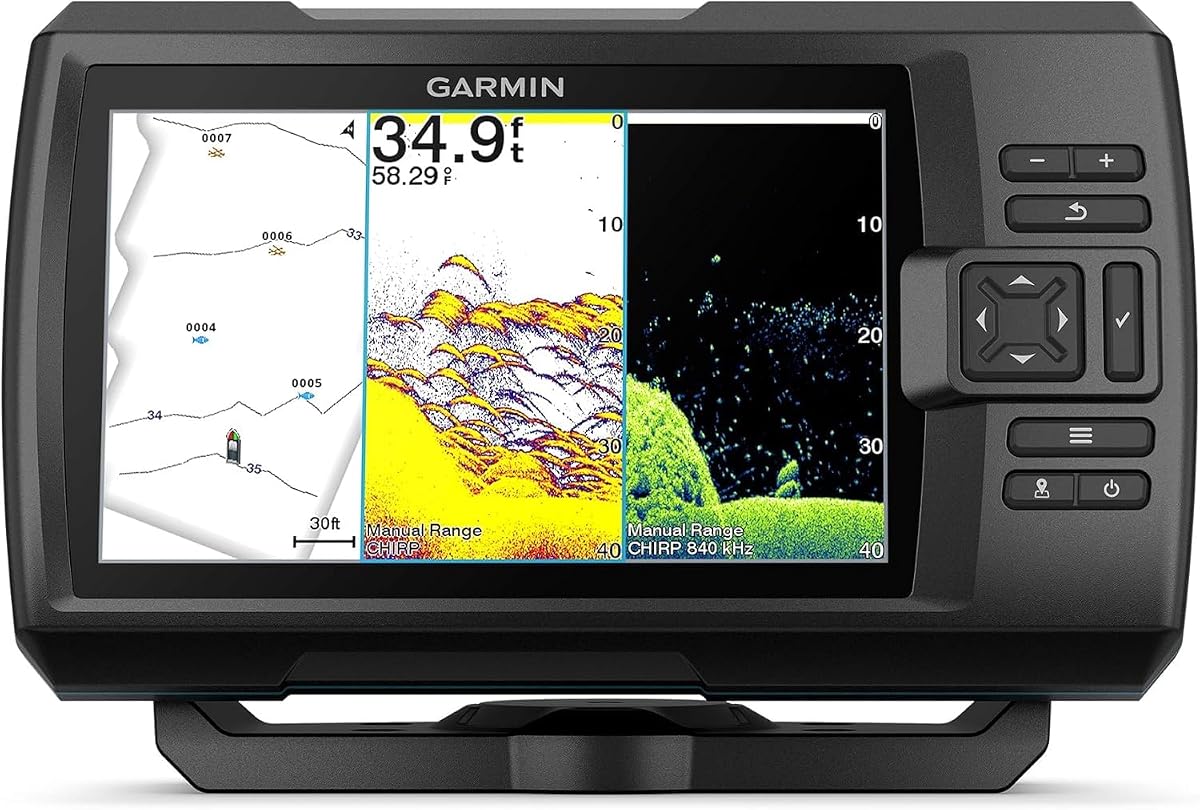
The Garmin Striker Vivid 7cv is the most premium option here, offering the largest display, advanced color sonar, GPS navigation, Quickdraw mapping, and Wi-Fi connectivity. Its supplied rating of 4.5 remains strong, and the seven-inch screen gives it a clear advantage for detailed interpretation on a capable small fishing boat.
We may earn a commission when you buy through this link, at no additional cost to you.
The included GT20-TM transducer supports Garmin CHIRP traditional sonar and CHIRP ClearVu scanning sonar. Vivid color palettes help distinguish fish from structure, while the large display provides more room to examine detailed returns. A tilt/swivel bail-mount bracket is included, allowing the unit to be adjusted for the helmsman's viewing position.
Its premium distinction comes from the connected ecosystem as much as the display. Wi-Fi can link with a compatible smartphone and the ActiveCaptain app to transfer waypoints, receive smart notifications and software-update notices, and access the Garmin Quickdraw Community. High-sensitivity GPS also supports waypoints, routes, and boat-speed viewing.
Choose this model when the small boat has a sufficiently large console and the angler wants a nearly standalone sonar and navigation system. It is less convenient for very compact skiffs, kayaks, or portable use because it requires a fixed installation and power. For owners of a center-console or similarly equipped fishing boat, however, the extra screen area and wireless features create a compelling high-end package.
The seven-inch display provides the most spacious view among the fixed units in this guide. That extra area is useful when comparing fish arches with vegetation, contours, rocks, or other structure during active fishing.
Wi-Fi connectivity adds waypoint transfer, smart notifications, software updates, and Quickdraw Community access when paired with a compatible smartphone. It extends the unit beyond standalone sonar into a broader boat electronics ecosystem.
We may earn a commission when you buy through this link, at no additional cost to you.
The Garmin Striker 4cv delivers a four-inch-class color display, CHIRP traditional and ClearVu scanning sonar, GPS navigation, and Quickdraw Contours in a rugged package. Its supplied rating of 4.6 makes it one of the strongest-rated options and a particularly capable compact fixed-mount choice.
We may earn a commission when you buy through this link, at no additional cost to you.
The stated 4.3-inch display is bright and sunlight-readable, while the intuitive interface is designed for direct access while fishing. The included transducer supports both traditional CHIRP and ClearVu scanning sonar, providing detailed views of fish and submerged structure. Transmit power is listed at 300 watts RMS.
Navigation features include waypoint marking, route creation, and boat-speed viewing. Quickdraw Contours allows users to create and store maps using one-foot contours across up to two million acres. That makes this model more capable as a personal mapping tool than the basic Garmin Striker 4 reviewed earlier in the list.
The Striker 4cv is ideal for an angler who wants detailed color sonar and mapping but does not need the seven-inch screen or Wi-Fi features of the Striker Vivid 7cv. It requires a fixed installation, so unlike the portable products it is better suited to a boat with a permanent console and room for a 4.3-inch display.
CHIRP traditional and ClearVu scanning sonar create richer information than a depth-only unit. A 4.3-inch color display keeps that information manageable in a boat where a full-size chartplotter would be excessive.
One-foot Quickdraw Contours help anglers preserve depth information across favorite areas. Combined with waypoints and routes, the feature supports a more deliberate approach to locating and revisiting productive structure.
We may earn a commission when you buy through this link, at no additional cost to you.
The right depth finder depends on your boat, fishing style, and the information you need. Display size, sonar type, installation style, navigation, power, and portability should be considered together rather than treating one feature as decisive on its own.
Fixed transom and in-dash units provide a stable, always-available display, but they require compatible mounting hardware, a clean cable route, and sufficient electrical power. Transom mounting is often more adaptable because the transducer can be adjusted as the boat moves. In-dash installation produces a cleaner console but may not suit every hull or dashboard layout. Portable systems avoid permanent modifications but trade away some screen size, advanced sonar detail, or sensor freedom.
Select the installation that fits your actual vessel and willingness to modify it. A clean-looking console is not worth an incompatible hull cut, and a permanent unit is unnecessary if you mainly fish from a kayak or rented boat.
Depth-only sonar reports the water column beneath the sensor, while fish-finder sonar attempts to show targets and bottom structure as returns. CHIRP sends a continuous sweep of frequencies, which can improve target separation and make fish arches easier to distinguish. ClearVu scanning sonar adds detailed imaging, while dual-beam systems let users balance broad coverage against focused detail. Portable units often summarize the scene with depth, fish size, and contour information rather than providing equally detailed images.
Prioritize the sonar output that matches how you fish. Detailed scanning imagery helps anglers read structure, whereas basic depth, temperature, and fish-size data may be enough for portable scouting and locating drop-offs.
Display size affects readability, menu complexity, and console fit. A 3.5-inch display is easy to accommodate but offers limited visual detail, while four-inch models provide a practical compromise for many small boats. Five-inch and seven-inch screens are easier for detailed sonar interpretation but require more mounting space. Consider sunlight readability, nighttime backlighting, viewing angle, and whether several people need to see the display at once.
Choose the smallest screen that comfortably delivers the information you use. A large screen on an undersized console can be frustrating to operate, while an undersized screen may force constant menu changes or make subtle structure hard to recognize.
A useful depth finder must cover the water you expect to fish, with some margin for changing conditions. Listed maximum depths vary widely across the guide, from 50 meters for one portable wireless model to 600 feet for the in-dash DepthTrax 2B. Saltwater and freshwater limits can also differ, as seen with the Garmin Striker 4. Range should be judged against local depths rather than a single headline number.
Check both the sensor's depth capability and any difference between freshwater and saltwater ratings. Ensure the unit will operate at the depths where you expect to use it rather than choosing solely on maximum specification.
GPS waypoints, route creation, boat-speed display, and contour mapping can transform a depth finder into a more useful navigation tool. They are especially valuable when an angler returns to offshore structure, navigates unfamiliar channels, or records productive areas. Basic depth-only and portable units may omit GPS entirely. Premium fixed displays may add smartphone connectivity, chart support, or live mapping features that are unnecessary for casual fishing.
Prioritize navigation when you repeatedly visit specific spots or need to navigate open water. If your goal is simply to find the bottom near shore, these extra features may add complexity without changing your day-to-day results.
Portable units are ideal for anglers who move among kayaks, docks, shorelines, and ice holes. Wireless sensors can be cast ahead of the boat, while wired sensors offer a simpler connection but remain tethered to the display. Battery requirements also matter: the included portable unit uses four AAA batteries, and its stated continuous runtime is four to five hours with new batteries. Fixed installations use boat power and remain available throughout a trip.
Choose based on how often you move and how long you expect to fish. Confirm that a portable system can last through a typical outing, or select a fixed unit if uninterrupted power and a permanent display are priorities.
Controls should remain easy to use in bright sun, spray, cold weather, or while the boat is moving. Keyed interfaces, softkeys, adjustable mounts, backlights, and battery-saving modes can be more practical than an uncluttered but touch-sensitive screen. Fish alarms and shallow-water warnings add safety and convenience, particularly for anglers moving at speed. The DepthTrax 2B, for example, uses audible, red LED, and LCD indicators in its warning system.
Favor controls that remain legible and predictable in real conditions. An extra feature is only useful if you can operate it quickly and understand it without navigating an overly complicated menu.
Install the unit where it is visible without blocking controls or creating a hazard. Transom-mounted transducers should sit where they can maintain a clear relationship with the water, while permanently mounted transducers require attention to hull material and the manufacturer's stated limitations. Route cables away from sharp edges, moving parts, and areas where they could be pinched or abraded.
Before each outing, check the display, transducer, cable connections, power source, and mounting hardware. For portable units, install fresh batteries or confirm that the sensor is charged, then pair the sensor and select the appropriate measurement units and sensitivity. Match the sonar mode to the task: use broader coverage while cruising and more focused scanning when investigating a drop-off, vegetation bed, or fish-holding structure.
After use, rinse the transducer and display with fresh water, especially after fishing in salt water. Remove portable batteries for long storage, let the unit dry fully, and keep the screen away from abrasive surfaces. Inspect seals and mounting points periodically, and update compatible software when notices are available. Avoid pressing buttons or adjusting settings while the unit is wet, and follow the included instructions for battery indicators, warnings, and installation.
A transom-mounted unit is often the easiest fixed option because it can be adjusted without modifying the hull. Portable systems require no permanent installation at all, while in-dash and glue-in transducers demand more attention to dashboard openings and hull compatibility. Always verify the listed mounting requirements before buying.
A portable finder is better for anglers who move between locations, boats, shorelines, or ice holes and do not want permanent wiring. A fixed unit is usually better when you want a stable display, advanced sonar, GPS navigation, and continuous power. The best choice depends on whether portability or integrated features matter more to you.
CHIRP is beneficial when you want improved target separation and clearer fish arches, especially around vegetation, rocks, and drop-offs. It is not mandatory for basic depth measurement, but it can make a compact unit much more informative. Consider how clearly you need to distinguish fish from bottom structure before deciding.
Many models can show contours, rocks, sand, vegetation, and other bottom features, while portable units often summarize structure through depth and bottom-contour information. Detailed scanning sonar models generally provide the clearest visual representation. Actual clarity also depends on transducer placement, water conditions, sensitivity, and the selected sonar mode.
GPS is not essential for locating depth, but it helps you mark productive spots, create routes, and return to structure. It becomes more valuable when you fish across multiple areas or navigate unfamiliar water. For portable scouting or casual fishing close to shore, a simpler unit may meet your needs.
The correct range depends on your local waters and fishing style. Most inland lakes and nearshore areas require far less than the maximum depth offered by many units, while offshore anglers may need more capability. Check both the stated depth limit and any separate freshwater or saltwater rating before making a choice.
Some models are explicitly suitable for salt or seawater, while others list separate freshwater and saltwater depth limits. A transducer designed for one environment should not automatically be assumed to work equally well in the other. Confirm the product specifications and installation guidance for your typical fishing location.
Rinse the display and sensor with fresh water after use, especially following saltwater fishing, and allow all parts to dry before storage. Remove batteries if the unit will sit unused for an extended period. Check the cable, connector, sensor floats, and mounting hardware for wear, and replace batteries promptly when readings become unreliable.
The Garmin Striker 4 stands out as the best-balanced value for many small boats, combining CHIRP and ClearVu sonar, GPS waypoints, and a compact display. The Garmin Striker Vivid 4cv adds color and contour mapping, while the Humminbird Helix 5 CHIRP GPS G3 serves anglers who want richer navigation and automatic mapping.
Choose based on the job your unit must perform. Pick the Portable Wireless Fish Finder when no-hole installation and casting ahead are priorities, the DepthTrax 2B when a clean in-dash readout is essential, and the Garmin Striker Vivid 7cv when a large display and smartphone connectivity justify a more permanent setup. Verify hull compatibility, power, depth range, and controls before finalizing your choice.
Ratings, product configurations, technical details, and availability can change, so check the current listing and included accessories before purchasing. Comparing the current product information with your boat layout and fishing routine is the most reliable way to choose a depth finder that remains useful throughout the season.


