
4Pack Solar Bug Zapper Outdoor
4.6Editor score
Four-unit outdoor package
IP66 weather-resistant housing
Automatic dusk-to-dawn operation
Dual-frequency ultraviolet light
Explore the best Solar Mosquito Bug Zapper for Outdoors Waterproof options, comparing charging, protection, coverage, lighting, safety, and placement features.
Solar mosquito bug zappers offer a chemical-free way to reduce flying insects around patios, gardens, campsites, and other outdoor spaces. The most useful models combine reliable solar charging, an effective insect-attracting light, sturdy weather resistance, and flexible placement options for different environments.
We compared the ten products in this guide using their stated charging methods, electrical-grid specifications, waterproof ratings, coverage claims, lighting functions, safety features, and mounting accessories. The list includes single units and multipacks, with options for buyers prioritizing portability, garden lighting, stronger weather protection, or wider outdoor placement.
Each review explains the product's most important strengths, practical limitations, and ideal setting. Reader ratings and seller information can change over time, and product prices are dynamic, so shoppers should confirm current availability, specifications, and ordering options before making a final purchase.
4.6Editor score

4.1Editor score

3.8Editor score
This side-by-side comparison highlights the key differences among ten outdoor solar bug zappers, including power options, weather ratings, grid voltage, lighting modes, mounting methods, and package size.
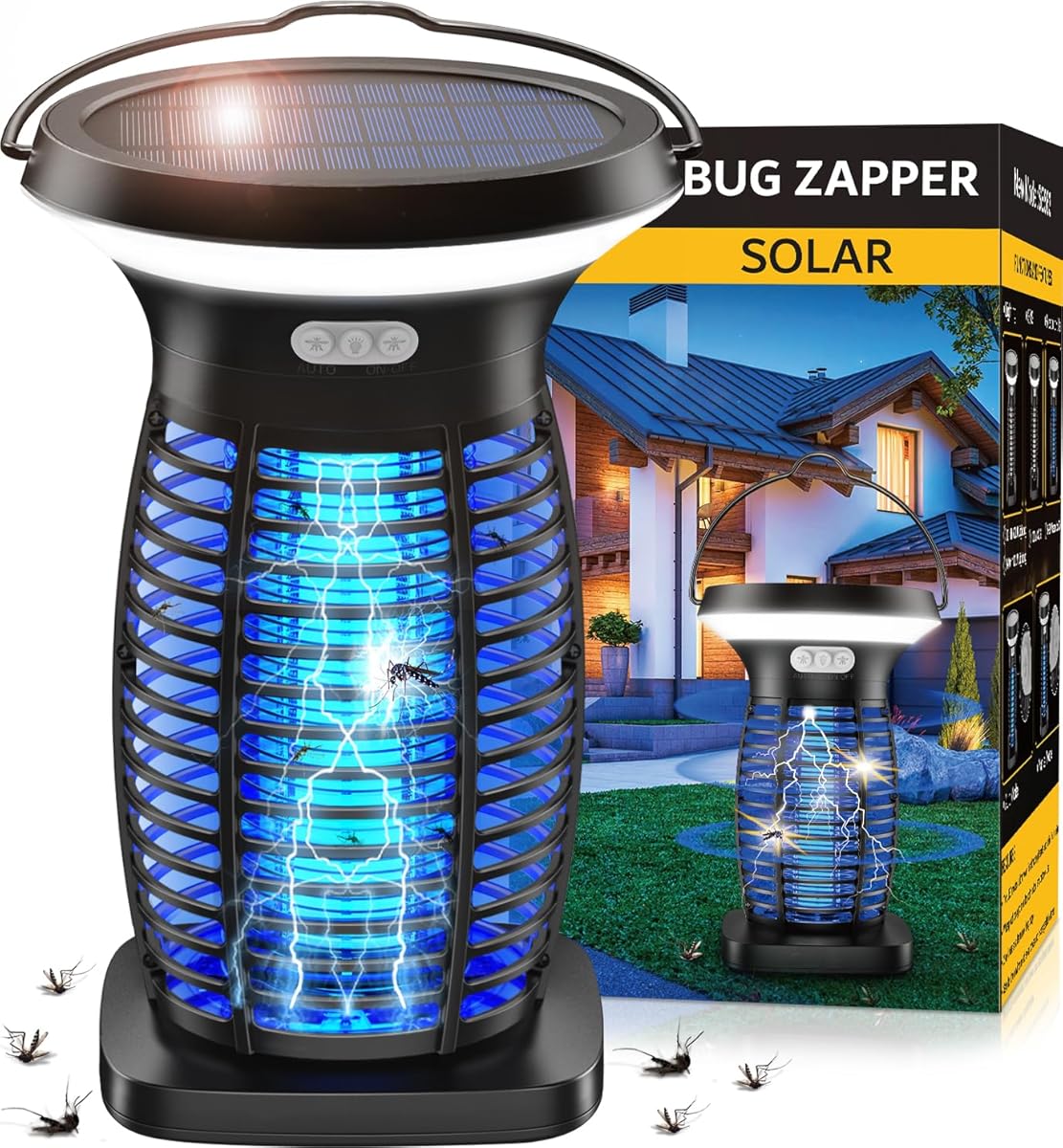


The Solar Bug Zapper 4500V combines a 4500V electric grid, dual ultraviolet LED bulbs, and a 4,000mAh rechargeable battery in a broadly applicable outdoor package. Its 4.1 rating reflects a practical mix of charging versatility, multiple placement methods, and useful protective features, although the ambitious coverage claim should be viewed as a seller-provided estimate.
We may earn a commission when you buy through this link, at no additional cost to you.
Its strongest feature is the combination of a 10-watt solar panel and USB charging. The solar panel can maintain operation in suitable light, while USB charging is intended to fill the battery in about four hours. A stated runtime of up to 13 hours makes the unit suitable for overnight use, and the automatic day-to-night mode removes much of the daily switching involved with conventional zappers.
The product is also flexible in practice. Two grounding stakes allow installation in soil, while the included 2.6-foot chain supports hanging from a hook or elevated position. The IPX5-rated ABS and stainless-steel construction is intended to resist rain, wind, and rust. Buyers must still follow the listed safety advice, keep the unit away from people gathering nearby, and switch it off before cleaning the grid.
This is an appropriate choice for patios, porches, gardens, RV trips, and other areas where one versatile unit is preferable to several inexpensive stakes. It may be less attractive than a multipack for covering an entire property, but the combination of grid strength, battery capacity, mounting hardware, and charging options makes it a well-rounded first recommendation.
Solar charging supports cord-free placement, while USB charging provides a useful backup when sunlight is limited. Buyers should position the extension-mounted panel where it receives direct light and verify the charge level before expecting full overnight performance.
Stakes and a chain make it easy to move the zapper between common outdoor areas. Because the device attracts insects rather than repelling them, positioning it away from seating and food is essential for a more comfortable experience.
We may earn a commission when you buy through this link, at no additional cost to you.
The ZECHUAN Solar Bug Zapper stands apart with a 3-in-1 design that combines mosquito trapping, a soft LED night light, and an SOS signal. Its 4.0 rating reflects a straightforward, chemical-free approach, while the compact form makes it a natural fit for campers, travelers, and users who want more than a basic insect-control lamp.
We may earn a commission when you buy through this link, at no additional cost to you.
Charging can occur through the integrated solar function or USB-C, and automatic mode is designed to charge in daylight and activate after dark. The physical trap captures insects rather than relying on fumes or attractants, which may appeal to households seeking a nonchemical option. Detaching the trap also makes routine disposal and cleaning straightforward.
The main limitation is that the supplied information gives no grid voltage, exact waterproof rating, battery capacity, or numerical coverage area. Buyers who need a clearly documented level of rain protection or a quantified electric-grid specification may find this model less decisive. The soft glow and flashing emergency mode add utility, but they do not replace information about core electrical specifications.
Choose the ZECHUAN for portable use, tent-side placement, emergency visibility, and a straightforward physical trap. It is particularly useful for people who value lighting functions and simple maintenance more than a high-voltage grid or a quantified outdoor coverage claim.
The night-light and SOS modes give the zapper value beyond insect control. These functions are useful around a campsite or entry area where visibility and portable lighting are equally important.
The removable physical trap avoids sprays, coils, and chemical attractants. Regular emptying keeps the unit tidy and allows users to monitor how many insects are being captured in a given location.
We may earn a commission when you buy through this link, at no additional cost to you.
This Solar Bug Zapper combines a 4,500V grid, dual light-source modes, and an IP44 weather-resistance rating. Its 4.7 rating is the highest among the listed products, indicating strong customer reception, and its straightforward feature set makes it a practical option for patios, porches, gardens, and camping trips.
We may earn a commission when you buy through this link, at no additional cost to you.
White and purple lighting modes allow the unit to function as ordinary illumination or as an insect-attracting zapper. A rechargeable battery and solar panels support cordless operation, while the stated safety protection net and anti-leakage system reduce the chance of accidental contact with internal components. The design is also described as easy to clean, which supports regular upkeep.
IP44 is appropriate for outdoor use but does not offer the higher water-resistance rating associated with several competitors. The supplied information also does not state a numerical battery capacity, charging time, coverage area, or exact electrical-grid dimensions. These omissions make it harder to compare operating endurance precisely with products that publish more detailed figures.
This model is a strong fit for buyers seeking a capable 4,500V unit without paying for a multipack. Its dual lighting modes, protective features, and strong rating justify a top-three position, especially for users who want one adaptable device for several outdoor locations.
Purple mode supports insect attraction, while white mode provides everyday lighting. The ability to switch functions makes this model useful during gatherings, quiet evenings, and periods when pathway illumination is needed.
The safety net and anti-leakage system are meaningful around children and pets. Buyers should still keep the zapper on a stable surface, avoid direct contact with the energized grid, and clean it only after switching it off.
We may earn a commission when you buy through this link, at no additional cost to you.
The Solar Bug Zapper Auto On/Off offers a 4,200V grid, a 5,000mAh battery, and a stated runtime of up to 12 hours. Its 4.0 rating reflects a well-documented balance of solar and USB-C charging, automatic operation, and flexible placement, making it a versatile candidate for patios, gardens, garages, and campsites.
We may earn a commission when you buy through this link, at no additional cost to you.
The manufacturer states that the upgraded solar panel can recharge the battery in eight to twelve hours, while USB-C charging can complete in three to four hours. Automatic light sensing activates the unit at dusk and powers it down at dawn. Included stakes and a hanger support standing, ground-mounted, and suspended setups, and the unit can also serve as a night light.
An IPX5 rating indicates resistance to rain and humid conditions, although the product is explicitly not intended for submersion. The bottom tray detaches for rinsing, and the included brush helps remove insects lodged in the grid. The protective spacing of the outer fence is another useful feature, but users should maintain normal electrical precautions and place the zapper away from direct human and pet contact.
This is a good option for someone who values clear charging figures, an automatic operating cycle, and multiple mounting methods. The stated 2,100-square-foot coverage should be treated as a general estimate because actual insect activity, nearby light sources, placement, and weather all influence results.
The three-to-four-hour USB-C charging estimate is useful before a weekend trip or when cloudy weather limits solar gain. Solar charging then provides a cord-free daily operating cycle when the panel receives adequate sunlight.
A removable tray and supplied brush simplify cleanup. Routine cleaning preserves airflow and helps remove accumulated insect residue, but the unit should always be switched off before its internal areas are accessed.
We may earn a commission when you buy through this link, at no additional cost to you.
The 4 Pack Solar Bug Zapper includes four compact stake-mounted units intended for distributed placement around gardens, patios, walkways, and yards. Its 5.0 rating is the highest shown in the guide, while the IP65 housing and tool-free installation simplify outdoor use across multiple zones.
We may earn a commission when you buy through this link, at no additional cost to you.
Each unit uses ultraviolet light in the 365–395nm range to attract mosquitoes, gnats, fruit flies, and other small insects toward an internal electric grid. A light sensor turns the zappers on at dusk and off after daylight returns, provided the power switch remains on and the solar panel is positioned in direct sunlight. White LED mode adds soft landscape illumination.
The four-unit format is the primary advantage over single-device designs. Users can position separate units near a patio, flower bed, lawn, or path instead of expecting one device to cover a large property. The trade-off is that the supplied information does not state a battery capacity, charging time, numerical coverage area, or USB backup option for this set.
Choose this multipack when consistent coverage across several outdoor areas matters more than using one feature-rich centerpiece. It is especially effective for garden borders and walkways, where individual stakes can be distributed without extension cords. Buyers should confirm that each sunny location can charge its unit sufficiently before the first night of use.
Four units let users place protection where insects are most active rather than concentrating all hardware in one area. This configuration is particularly useful for long gardens, split patios, and properties with several gathering areas.
White LED mode lets each stake double as a low-profile garden light. The protective outer cage helps limit access to the internal grid while retaining airflow and insect entry.
We may earn a commission when you buy through this link, at no additional cost to you.
The 2026 Solar Bug Zapper 4 Pack is designed to place four units around distinct areas such as a patio, garden edge, flower bed, lawn, or walkway. Its 5.0 rating reflects a well-liked general-purpose package, and the combination of automatic operation, dual lighting, and distributed placement addresses several common outdoor needs.
We may earn a commission when you buy through this link, at no additional cost to you.
Purple ultraviolet mode attracts mosquitoes, gnats, moths, flies, and other small flying insects toward the internal electric grid. A built-in sensor starts the device at dusk and turns it off after daylight returns. The white LED pathway mode provides gentle illumination, while each unit's stake installs directly into grass, soil, or garden borders without tools or extension cords.
Like other four-unit solar packages, it does not list an exact electric-grid voltage, battery capacity, charging time, or numerical coverage area. Those omissions may matter to shoppers who want laboratory-style detail, but the product's core operating logic remains clear. Direct sun is needed for the best charging results, and every unit requires adequate space around it.
This set is best for owners of medium or large outdoor spaces who want to establish several zapping points at once. It is less appropriate for a compact patio where four units would create redundant coverage, but for a garden or backyard divided into distinct zones, the distributed approach is a major practical advantage.
Four independently placed units can cover spaces that a single zapper cannot reach effectively. This approach is valuable around long paths, multiple patio corners, and planting areas where insect activity varies.
Leaving the power switch on allows the light sensor to manage the daily cycle. The solar panel still needs several hours of direct exposure, so shaded placements may require a different charging strategy.
We may earn a commission when you buy through this link, at no additional cost to you.
This 4Pack Solar Bug Zapper stands out for its IP66 rating, monocrystalline solar panels, and reinforced weather-resistant casing. Its 4.6 rating supports a top-three position, and the four-unit package is well suited to buyers who need dependable outdoor placement in exposed gardens, chicken coops, vegetable patches, and other remote areas.
We may earn a commission when you buy through this link, at no additional cost to you.
The ultraviolet system operates across the 365–395nm range and uses a frequency-shifting light cycle intended to reduce the chance of insects adapting to a fixed attraction pattern. A high-intensity electric grid targets mosquitoes, gnats, flies, and moths. The intelligent sensor recharges during the day and activates the zapping function at night, reducing the need for manual operation.
The IP66 rating is the strongest relevant weather-protection figure among the listed multipacks, while the reinforced casing is specifically designed to address leakage and short-circuit concerns. However, the supplied information does not mention USB charging, a grid voltage, a battery capacity, or a numerical coverage area. It also states that technical assistance and a 12-month quality commitment are available, which adds confidence for troubleshooting and warranty questions.
Choose this package when weather resistance, solar autonomy, and coverage across several outdoor zones are the leading priorities. It is well matched to farms, gardens, campsites, and patios without nearby outlets. Buyers should confirm that each installation position receives enough sunlight and follow the included installation method for the stake.
The IP66 designation and reinforced housing are meaningful for gardens, farms, and patios that encounter rain, moisture, and changing temperatures. Weather resistance supports longevity, although it does not remove the need for sensible placement and routine inspection.
Monocrystalline panels and cordless operation are valuable where extension cables are inconvenient. Garden corners, chicken coops, and vegetable plots can receive insect control without depending on a nearby outlet.
We may earn a commission when you buy through this link, at no additional cost to you.
The TYPEC 2 Pack combines two 4,200V zappers, a three-panel solar arrangement, IP67 weather protection, and USB-C backup charging. Its 4.0 rating reflects a feature-rich package with good charging flexibility, making it useful for yards, patios, gardens, and other spaces where two zapping points are preferable to one.
We may earn a commission when you buy through this link, at no additional cost to you.
The supplier states that the upgraded solar configuration can fully charge the unit in four to five hours, while a light sensor activates it at dusk and shuts it off at dawn. USB-C offers a rapid alternative when sunlight is limited. The vertical-grid shell is designed to reduce residue buildup and can be rinsed for cleaning, while a 360-degree ultraviolet light and turbo fan are included to support insect attraction and capture.
The product is presented as chemical-free, odor-free, and suitable for families and pets. Those qualities are useful for users avoiding pesticides and coils, but physical trapping and electrical operation still require basic precautions. The inclusion of a 60-day money-back guarantee and two-year manufacturer warranty is another positive, while the absence of a stated coverage area makes performance comparisons less precise.
This two-pack is a strong choice for buyers who want the most capable stated waterproof rating, quick solar charging, and a cord-free setup. It is less expansive than the four-unit options, but the two units can be placed at the two most important activity areas, such as a patio and a garden path.
Three solar panels distinguish this model from basic single-panel designs. The stated four-to-five-hour charging cycle can support nightly use more readily when the panels receive strong, direct sunlight.
The vertical grid and rinse-clean design support routine maintenance around outdoor dust and insect residue. Switch the unit off before cleaning and keep electrical components away from standing water during the process.
We may earn a commission when you buy through this link, at no additional cost to you.
The Large Solar Bug Zapper uses three LED tubes, an 18-watt glass solar panel, and a 6,000mAh rechargeable battery. Its 3.8 rating is the lowest in this guide, but the larger lamp, stated 4,000-square-foot coverage, and 13-foot solar-panel reach give it a distinctive role for buyers who want a substantial central unit rather than multiple small stakes.
We may earn a commission when you buy through this link, at no additional cost to you.
The glass panel is described as having strong solar conversion efficiency, while the battery supports extended operation and USB charging when sunlight is unavailable. The unit automatically charges outdoors and activates at night, and its LED tubes are designed for a long working life. A brief rinse is all that is needed for stated cleaning requirements, reducing routine maintenance time.
Installation is flexible: the product can be staked in grass, hung from a hook, or placed on a countertop or floor near a problem area. Its chemical-free and odor-free operation is attractive around people and pets. The tradeoff is that the supplied data does not state a numerical waterproof rating, grid voltage, exact charging time, or a standard coverage area comparable with the competition.
This is a worthwhile option for a single expansive patio, backyard, RV campsite, or pond where a large lamp and extended solar reach are priorities. It is less attractive for buyers who require a clearly quantified IP rating or a compact multipack, and the lower rating suggests checking recent customer feedback before ordering.
Three LED tubes create a larger illuminated surface than many compact stake lights. The design may be useful for users who want one visible unit to cover a broad central gathering area.
The 13-foot extension lets the lamp sit near people while the solar panel remains in a sunnier position. That separation is particularly helpful around shaded patios, trees, buildings, or temporary campsites.
We may earn a commission when you buy through this link, at no additional cost to you.
This Solar Bug Zapper 4500V combines a large lamp, a 4,500V grid, and two operating modes in a portable design. Its 4.2 rating indicates a generally favorable reception, while the ability to operate by light sensing or remain continuously on gives it more flexibility than many basic dusk-to-dawn units.
We may earn a commission when you buy through this link, at no additional cost to you.
The enlarged lamp is designed to attract mosquitoes, flies, moths, and fruit flies from a 360-degree range. Solar power is supported by a rechargeable battery that can charge through USB in about four hours, with up to 12 hours of stated use. The light-sensitive mode turns the unit off during daylight and activates it at night, while always-on mode continues operating while charging.
Placement options include flat surfaces, two grounding brackets, a hanging chain, and a 10-foot extension cable. The IPX5 rating provides a clear level of rain and humidity protection, and a safety net helps reduce accidental contact with internal components. However, no battery capacity is listed, and the half-acre claim should be treated as a broad marketing estimate rather than a guaranteed protected area.
Choose this model for a backyard, patio, poolside area, porch, farm, garage, or camping setup where a user sometimes wants all-night continuous operation and sometimes prefers automatic daytime charging. Its combination of high voltage, flexible placement, and dual modes makes it a versatile final recommendation.
Light-sensitive mode supports efficient solar charging, while always-on mode is useful when insects remain active or continuous coverage is preferred. The manual setting gives users control that automatic models do not.
Stakes, a chain, and an extension cable provide several ways to position the zapper. The extension can place the solar panel in direct light while the lamp remains near a seating area or other target location.
We may earn a commission when you buy through this link, at no additional cost to you.
The right outdoor solar bug zapper depends on weather exposure, charging conditions, insect activity, placement, and the amount of space you want to cover. Use the following factors to compare specifications that are often presented differently across manufacturers.
An outdoor device should have a clearly stated water-resistance rating. IPX5 is common among the stronger single-unit models in this guide and indicates protection against light rain and moisture exposure, while IP65, IP66, and IP67 offer progressively stronger claims for demanding garden, patio, and farm environments. A numerical rating is more useful than a general claim of waterproof construction because it gives a more concrete sense of intended exposure. Weather resistance does not make a product suitable for submersion, and the grid, solar panel, charging port, and seams should all be considered when deciding where to install it.
Choose a clearly rated model for exposed outdoor use and confirm that its rating covers the conditions you expect.
Solar panels work most effectively when they receive several hours of direct sunlight. Look for efficient panel designs, adjustable positioning, and a stated charging cycle, then consider whether the battery can carry the unit through a full night. USB or USB-C backup charging is valuable during cloudy periods and when the zapper will be used at campsites away from outlets. Products with separate solar and USB options provide more resilience, but users should still confirm the battery capacity and expected runtime before relying on unattended operation.
Prioritize good sun exposure and a backup charging method for dependable year-round use.
Most of these products use ultraviolet light in the 365–395nm range to attract mosquitoes, gnats, flies, moths, and related insects. A 4,200V to 4,500V grid provides a clearly stated high-voltage design, while some products use a physical trap instead. Grid voltage alone does not determine total performance: light placement, nearby competing light, fan operation, protective spacing, insect density, and environmental conditions all influence results. Models that also offer white ambient lighting can be useful around paths, but a darker installation generally supports better insect-attraction conditions.
Compare attraction features and grid or trap design, then place the device where competing light is limited.
Coverage claims range from specific figures such as 2,100 square feet and 4,000 square feet to broader estimates involving large properties. These numbers should be treated as general guidance because no universal test accounts for every yard, patio, or insect population. A multipack may create more useful coverage by placing several independent units around different zones, while a large single lamp may be more appropriate for a central gathering area. Choose based on the number of activity areas, the distance between them, and the amount of surrounding ambient light.
More units can outperform one large device when insects are spread across separate outdoor zones.
The best outdoor zapper is one you can position correctly. Ground stakes suit lawns, flower beds, and garden borders, while hanging chains are useful for porches, branches, hooks, and other elevated locations. Flat-base designs work on tables, counters, shelves, and sturdy surfaces. Some models also include extended solar cables, allowing the lamp and panel to occupy different positions when a sunny location is not directly beside the target area. Before buying, sketch your property and identify where people gather, where insects are active, and where the panel can receive direct sunlight.
Match the mounting hardware to the site and ensure insects are drawn away from seating areas.
Look for protective grids, narrow spacing, insulated housings, and anti-leakage systems. These features can reduce accidental contact with energized components, but they do not make unsupervised handling safe. Position the zapper on a stable surface, keep it out of reach of curious children and animals, and do not touch the internal grid while operating. Cleaning should always begin with the unit switched off. Physical-trap designs may eliminate an exposed electrical grid, while higher-voltage models require careful placement and routine inspection.
Use added barriers and stable placement, and always follow the manufacturer's cleaning and safety instructions.
Automatic light-sensing operation is convenient because the zapper can charge during daylight and activate after dark. A manual always-on mode offers greater control for locations where insects remain active throughout the day or where users prefer to determine the operating schedule. Some products include a night light or SOS function, which adds versatility for camping and nighttime navigation. The best control scheme is the one that matches your routine and prevents the unit from operating when it is not needed.
Automatic mode favors convenience, while always-on control provides scheduling flexibility.
A removable trap tray, vertical grid, and included cleaning brush make routine maintenance easier. Insect residue should be removed periodically because a dirty grid can restrict airflow and reduce performance. Check the manufacturer's guidance on rinsing, and avoid directing water into openings unless the product is specifically designed for that cleaning method. Warranty periods, technical support, and satisfaction guarantees also vary. Buyers should retain the product instructions and confirm whether coverage claims, replacement accessories, and support are handled directly through the seller.
Favor accessible components and clear care instructions, and inspect the unit regularly after heavy weather.
Choose a stable location away from the area where people sit, eat, or gather, since the device attracts insects toward its light. Give the solar panel several hours of direct sunlight and use the included stake, chain, or flat base according to the surface. Keep the unit away from pools, sprinklers, puddles, and places where wind could knock it over.
Automatic models generally need their power switch left on so the light sensor can turn the zapper on after dusk. Use always-on mode only when continuous operation is desired. A backup USB charge is useful before cloudy trips or when the panel has not received enough sunlight. Check local light conditions, because bright porch lamps and pathway lights can reduce the device's effectiveness as an insect attractant.
Turn the unit off before opening the trap or touching the grid. Remove accumulated insects with the supplied brush, detach the collection tray where applicable, and follow the manual's rinsing instructions. Let every part dry fully before reassembly or charging. Inspect the solar panel, casing, cable, and protective grid regularly, and stop using the device if water has entered an electrical area or damage is visible.
Solar bug zappers can work in cloudy weather, but charging speed usually decreases when direct sunlight is limited. A unit with USB or USB-C backup charging is more dependable in frequently overcast locations. Leave the panel in an open, unobstructed position and check the charge level before a long period without sunshine.
It is usually better to place the zapper away from the main seating and eating area. The light attracts mosquitoes and other flying insects, so positioning it beside people may move the problem closer to them. Place the unit at a suitable side location, preferably in a darker area, while ensuring the solar panel still receives direct light.
Higher voltage can indicate a stronger electric grid, but performance also depends on light attraction, construction, placement, insect density, and environmental conditions. A 4,500V model is not automatically more effective than a 4,200V alternative in every location. Correct positioning, regular cleaning, and adequate charging are equally important.
Many models include protective grids or safety nets intended to reduce accidental contact with internal components. Even so, children and pets should not be allowed to touch an operating grid, and the zapper should be placed on a stable surface outside their reach. Always follow the manufacturer's safety and cleaning instructions.
IPX5 indicates protection against water jets and moisture exposure, making it suitable for many outdoor patio and garden positions. It does not mean the product can be submerged. Keep the charging port and electrical areas above standing water, and follow the instructions regarding rain, rinsing, and storage.
A four-pack is better when the property contains several distinct activity areas, such as multiple patio corners, garden borders, or pathways. It allows each unit to be positioned where insects are active instead of concentrating one device in a single location. For a small patio or balcony, one capable unit may be more practical.
Cleaning frequency depends on insect activity and how quickly the collection area or grid becomes coated with residue. Inspect it regularly during busy seasons and clean it whenever debris appears to affect airflow or performance. Switch the unit off, use the supplied brush where available, and follow all instructions before rinsing.
Large coverage claims should be treated as broad estimates rather than guaranteed protected areas. A device may influence insects across a meaningful area, but local factors such as nearby lighting, wind, vegetation, water, and placement can change results. Several units placed strategically often provide more dependable control than one unit positioned in the wrong location.
The Solar Bug Zapper 4500V stands out as the strongest all-around single-unit choice because it combines 4,500V power, solar and USB charging, IPX5 protection, and flexible mounting options. The four-pack Solar Bug Zapper Outdoor is the premium multipack for demanding weather exposure, while the Large Solar Bug Zapper offers an extended solar reach and a larger central lamp.
Prioritize the conditions around your property before choosing. Strong waterproof ratings and reliable charging suit exposed gardens, multiple units suit large properties, and a compact multi-function lantern suits portable trips. Whichever design you select, place it away from gathering areas, provide direct sunlight, clean it regularly, and follow every safety instruction.
Current availability, customer feedback, seller information, and product specifications can change, and prices fluctuate over time. Confirm the latest listing details and comparison criteria before ordering so the chosen model matches your weather exposure, power access, placement needs, and insect-control priorities.