
Hon&Guan 25W Solar Attic Fan
4.8Editor score
Up to 320 CFM airflow
Solar and AC power
Smart temperature control
Solar roof vent exhaust fans offer an efficient way to move trapped heat, humidity, and stale air out of attics, garages, workshops, and similar spaces. The right model combines useful airflow, dependable solar exposure, rugged outdoor construction, and installation methods suited to your roof or vent opening.
We compared the ten featured products by examining airflow claims, panel wattage, power-source options, temperature controls, motor and housing materials, installation requirements, and intended applications. The list includes compact solar-only units, high-output roof fans, hybrid systems with mains backup, and one shipping-container-specific model.
Each pick reveals what distinguishes it from the alternatives, from the controller-free simplicity of a 12-inch fan to the adjustable temperature controls and remote operation of hybrid systems. Product ratings and availability can change, so verify current specifications, installation requirements, and pricing before purchasing.
4.8Editor score

5.0Editor score

4.4Editor score
As an Amazon Associate we earn from qualifying purchases.
The comparison highlights major differences in airflow, solar-panel output, backup power, control features, outdoor construction, and the spaces each fan is designed to ventilate.



This 40W solar attic fan combines a 12-inch blade, a heavy-duty copper motor, and a stated maximum airflow of 2000 CFM. Its 4.5 rating reflects a generally strong proposition for buyers seeking substantial roof ventilation without complicated controls. The controller-free design is particularly appealing to anyone who prefers automatic daytime operation and fewer adjustable settings.
We may earn a commission when you buy through this link, at no additional cost to you.
The solar panel and fan arrive pre-connected, eliminating much of the wiring involved in setting up the system. It activates with sunlight and powers down at dusk, while the stated airflow range of 1800–2000 CFM makes it suitable for larger attics, garages, greenhouses, sheds, and barns. A hail-resistant metal housing and IP65-rated motor add useful outdoor resilience.
The primary trade-off is the lack of grid or battery backup. On cloudy days or during shaded periods, output may fall, so the panel needs unobstructed sunlight. There is also no thermostat, meaning the fan runs whenever available solar power is sufficient. Buyers who need constant airflow regardless of weather will find a hybrid model more flexible.
Despite those limitations, this is an attractive choice for large spaces and straightforward installations. It combines one of the highest airflow claims in the group with robust materials and minimal setup. Choose it when maximum solar ventilation, durable construction, and controller-free operation matter more than nighttime operation.
The 12-inch metal blades and 40W panel support a claimed maximum of 2000 CFM, making this one of the strongest options for moving substantial volumes of air. Because there is no thermostat or controller, setup remains simple: the pre-connected assembly operates automatically whenever sunlight is available.
A pure copper motor, metal housing, and IP65 weather-resistant design are well suited to outdoor ventilation. The product information also describes the housing as hail resistant, adding confidence for installations exposed to changing weather, while the managed operating sound aims to avoid the harsh hum associated with some lower-output fans.
We may earn a commission when you buy through this link, at no additional cost to you.
This 8-inch solar roof vent fan combines a 25W single-crystal panel with an IP68 brushless DC motor. Its 4.0 rating reflects a straightforward solution aimed at smaller spaces, workshops, warehouses, sheds, and sunrooms. The removable vent format makes it especially relevant when the vent itself must be accessible or connect to flexible ducting.
We may earn a commission when you buy through this link, at no additional cost to you.
The cover is made from galvanized steel with a polyester powder coating for corrosion resistance, and an aluminum mesh guard helps prevent small animals and birds from entering. A pipe extension beneath the flange accepts flexible duct, while four panel holes provide secure roof attachment. The panel clamps into the cover and locks with screws, creating a practical integrated installation.
Output is stated at up to 240 CFM in sunny conditions. Because the system stores no electricity, it may operate slowly under weak light and stop when clouds or shadows cover the panel. That limitation is understandable for a direct solar design, but it makes careful panel placement essential. Buyers seeking continuous nighttime ventilation should consider a hybrid alternative.
This fan is best for compact installations where an integrated roof vent and optional duct connection are more important than maximum airflow. It offers durable materials, a protected opening, and a straightforward panel without requiring complex controls. Select it for modest ventilation needs and a location that receives dependable direct sunlight.
The removable 8-inch vent gives installers more flexibility than a permanently fixed fan housing. Its extension under the flange can accept flexible pipe, making it practical for distributing air into an attic, shop, warehouse, or other enclosure where a conventional roof opening is already available.
Galvanized steel, corrosion-resistant coating, and an IP68 brushless motor provide a strong outdoor foundation. Aluminum mesh helps exclude birds, insects, and small animals, while the tempered-glass panel and aluminum frame are designed to capture sunlight and support a long service life.
We may earn a commission when you buy through this link, at no additional cost to you.
The iLIVING hybrid-ready fan stands out for its 14-inch blade, 40W adjustable solar panel, and supplied smart thermostat. Its 4.4 rating reflects a polished feature set for homeowners who want more control than a basic solar switch can provide. The fan is rated at 1150 CFM and marketed for spaces up to 2900 square feet.
We may earn a commission when you buy through this link, at no additional cost to you.
The thermostat supports a broad 50°F–122°F range, along with enable and disable functions, allowing operation according to measured temperature rather than simply following sunlight. The solar panel can be positioned at 0°, 15°, 30°, or 45°, which helps installers obtain better solar exposure on different roof pitches. Its IP68 brushless motor is backed by a 15-year warranty.
Although the product is hybrid ready, the non-stop day-and-night AC/DC adapter is sold separately as model ILG8SF304. That distinction matters for shoppers comparing this unit with hybrids that include an adapter in the box. The 14-inch nylon-fiber-aluminum blade is also a different construction from the all-metal blades used by some high-output competitors.
This is a strong premium recommendation for a larger attic or roof space where adjustable solar positioning and thermostat-driven ventilation are important. The separate adapter and higher feature complexity may not suit a minimal installation, but those seeking a refined control system will find the combination well considered.
The included smart thermostat operates across a 50°F–122°F range and can be enabled or disabled. This makes the fan more versatile than a purely sunlight-controlled unit, particularly when the goal is to ventilate only after a chosen temperature threshold is reached.
Four panel angles allow installers to account for roof direction and seasonal sun exposure. Combined with the 40W panel and 1150 CFM fan, that adjustability supports more consistent solar performance in an attic where a fixed panel orientation could limit energy collection.
We may earn a commission when you buy through this link, at no additional cost to you.
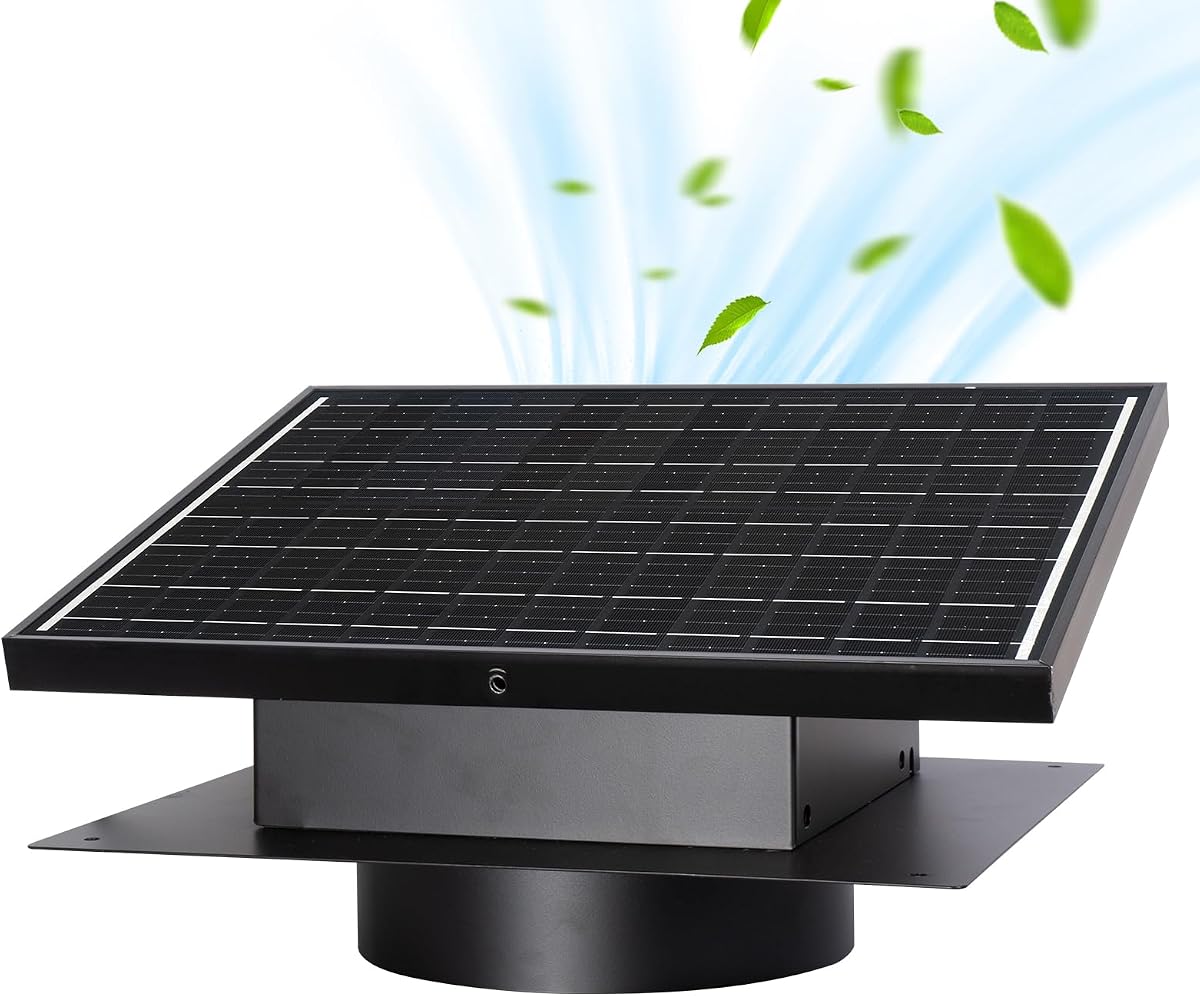
The Hon&Guan 25W fan delivers up to 320 CFM and earns a 4.8 rating, making it one of the strongest-rated products in this guide. It includes both a solar panel and an AC adapter, giving buyers a versatile way to operate beyond sunny daytime periods. It is a practical choice for smaller attics and spaces where the advertised coverage reaches 1300 square feet.
We may earn a commission when you buy through this link, at no additional cost to you.
Two operating modes organize its behavior. Eco mode primarily uses solar energy while the adapter supplies enough power to maintain minimum speed, and Performance mode runs on the AC adapter with four speed settings. A temperature probe detects ambient conditions and switches the fan on at the selected value, with an adjustable range from 68°F to 113°F.
The adapter in Eco mode is worth noting because even the solar-oriented mode is not completely independent of mains power. Performance also concentrates on consistent electrical operation rather than solar-energy maximization. Its 320 CFM output is also considerably lower than the 1150–2000 CFM claims of the larger 40W and 55W systems in the list.
For buyers seeking a well-rated, feature-rich fan without paying for the highest-output category, this model offers an attractive balance. The included adapter, automatic temperature control, multiple speeds, and flexible panel positioning make it more versatile than a basic solar-only unit. It is a sensible budget-focused hybrid for moderate spaces.
Eco mode lets solar output determine the fan's speed while maintaining a minimum level with adapter support. Performance mode bypasses variable solar behavior and offers four stable speeds through the included AC adapter, making the system easier to predict in consistently cloudy weather.
The external temperature probe allows the fan to start at a selected temperature and stop after the attic cools. With a range of 68°F–113°F, this adds practical control for users who do not want a fan running continuously throughout every sunny period.
We may earn a commission when you buy through this link, at no additional cost to you.
This 12W solar roof vent fan is designed specifically for standard 3.5-inch ribbed roofs. Its 5.0 rating is the highest in the group, reflecting a focused product for shipping containers, container offices, workshops, and dry-storage installations. The stated 630 CFM airflow is substantial for a relatively compact 12W system.
We may earn a commission when you buy through this link, at no additional cost to you.
A brushless fan provides the airflow, while the solar panel operates the unit automatically when adequate sunlight is present. Because no grid wiring is required, installation can be especially useful at remote container sites. The mounting kit and manual are included, and the housing is described as heavy-duty and weather resistant for prolonged outdoor exposure.
Its specialization is the key limitation. Shoppers should measure the roof ribs before ordering because the product is not a universal replacement for a conventional round roof vent. It also has no AC or battery backup, so it is most effective in climates and locations that receive dependable daylight.
For container owners or builders seeking a purpose-designed solar roof vent, this is an excellent fit. It combines a strong rating, healthy claimed airflow, and simple electrical-free operation. Choose it when the rib profile matches and daytime ventilation is the main objective.
The fan is designed around a standard 3.5-inch rib profile rather than a generic round opening. Measuring the container before purchase helps ensure that the mounting surface aligns correctly and avoids assuming the unit will fit corrugated or differently spaced roof panels.
Solar-only operation removes the need to run electrical cable to an isolated container or storage space. During daylight, the fan can release heat and excess moisture, making it useful for dry storage, workshops, tool areas, and container offices that suffer from trapped heat.
We may earn a commission when you buy through this link, at no additional cost to you.
This 40W hybrid fan combines up to 2000 CFM of airflow with automatic solar-to-mains switching. Its 4.4 rating makes it a credible high-output option for attics, workshops, and garages up to the stated 2500-square-foot coverage. It is especially useful for users who want solar priority without allowing cloud cover to stop ventilation entirely.
We may earn a commission when you buy through this link, at no additional cost to you.
Energy Saving mode varies airflow with sunlight and allows the adapter to supplement output. Performance mode uses the AC adapter and a control knob for four speed settings. A temperature probe supports automatic start and stop between 68°F and 113°F, while the solar panel adjusts from 0° to 70° in both horizontal and vertical directions.
When the adapter is connected, sunny periods prioritize solar power and cloudy or dark periods use household electricity. This provides consistent operation, but the system has no battery backup, and Performance mode explicitly requires the adapter. Buyers must also plan for the listed cable lengths and confirm that the supplied connector types suit their installation.
This is a strong all-around choice for larger spaces and variable weather. The combination of high airflow, thermostat control, flexible panel positioning, and automatic power switching addresses most shortcomings of basic solar fans. It is best for homeowners willing to run an adapter connection and value uninterrupted ventilation.
The dual-power system favors solar energy when sunlight is adequate and shifts to household electricity when output falls. That makes the fan a good middle ground between a strictly solar unit and a conventional wired exhaust fan, although the lack of battery storage means the adapter must remain connected.
Horizontal and vertical panel movement within the stated 0°–70° range helps optimize solar exposure. In Performance mode, the control knob offers four speed levels, giving users a direct way to increase airflow when stronger ventilation is needed.
We may earn a commission when you buy through this link, at no additional cost to you.
The 55W hybrid fan stands out through its wireless remote, 1300 CFM airflow, and one of the larger solar panels in the list. Its 4.7 rating reflects a well-rounded package for attics, garages, sheds, and greenhouses. The remote can change speed, temperature settings, or manual on/off status from up to 65 feet away.
We may earn a commission when you buy through this link, at no additional cost to you.
The thermostat starts the fan at 77°F and stops it at 68°F, creating a simple operating cycle without the broad adjustment ranges offered by some controllers. A brushless DC motor, waterproof UV-protected aluminum housing, and rust-resistant construction are intended to support long outdoor service. The hybrid system automatically uses AC power when solar output is low.
The fixed start and stop temperatures are less flexible than the 68°F–113°F settings on several competitors. Buyers who require exact threshold control may prefer a model with broader thermostat adjustment. The remote also introduces an extra electronic component, although it solves the inconvenience of repeatedly climbing onto a roof to make changes.
This is a particularly user-friendly choice for anyone who wants high solar output and indoor control access. Its larger panel, hybrid switching, and 1300 CFM airflow make it well suited to medium-to-large installations. Choose it when remote convenience and dependable nighttime operation outweigh adjustable threshold limits.
The 65-foot wireless remote lets users change speed, temperature behavior, or power status without climbing onto the installation. That convenience is particularly valuable when the fan is mounted high on a roof or inside a difficult-to-reach attic space.
The 55W monocrystalline panel is the highest rated solar output among the featured systems. Coupled with automatic AC fallback, it is intended to provide more consistent ventilation than solar-only designs when clouds, shade, or nighttime interrupt solar production.
We may earn a commission when you buy through this link, at no additional cost to you.
The Bghdas 8-inch fan is a direct solar roof vent with a 25W panel, 12V brushless motor, and 240 CFM airflow. Its 3.6 rating is the lowest in this comparison, so buyers should weigh the detailed specifications and installation fit carefully. It is aimed at small and medium spaces that need consistent daytime air exchange.
We may earn a commission when you buy through this link, at no additional cost to you.
The galvanized steel cover and aluminum mesh guard help block birds, insects, and small animals. A plug-and-play connection joins the fan and panel, while pre-drilled holes and included screws simplify mounting. It can also be used with kitchen or bathroom exhaust equipment where broader air circulation is helpful.
Because the system stores no electricity, it requires direct sunlight for peak output and may slow or stop in low light. That makes panel placement essential, and it offers no way to maintain airflow after sunset. The 240 CFM capacity is also modest compared with the 630–2000 CFM claims of larger systems.
This model makes sense for a smaller garage, shed, sunroom, chicken coop, or attic where a compact vent and simple solar operation are the priorities. It is not the strongest recommendation for large spaces or users seeking weather-independent ventilation, but it provides a focused alternative to higher-output hybrid fans.
Directly connecting the fan to the solar panel avoids battery replacement and battery-related upkeep. The trade-off is complete dependence on available sunlight, making an unobstructed, correctly oriented panel essential for the stated performance.
Galvanized steel provides a durable vent cover, and aluminum mesh helps exclude common pests. The compact 8-inch format and supplied fasteners make the unit suitable for small structures that do not need the airflow capacity of a larger roof-mounted fan.
We may earn a commission when you buy through this link, at no additional cost to you.
The HONGUAN 40W MPPT fan combines a five-star rating with up to 2000 CFM of airflow. It targets attics, garages, sheds, workshops, and greenhouses, with a stated coverage area of up to 2500 square feet. The combination of a 40W monocrystalline panel, AC adapter, MPPT controller, and thermostat places it among the most feature-complete options here.
We may earn a commission when you buy through this link, at no additional cost to you.
Energy Saving mode varies airflow according to available sunlight while allowing the adapter to supplement output. Performance mode uses the AC adapter and offers four speed settings through the controller. The thermostat operates from 68°F to 113°F and can be disabled when continuous solar ventilation is preferred, giving users more flexibility than the fixed-cycle model in the list.
The panel adjusts from 0° to 70° both horizontally and vertically, supporting better exposure throughout the day. Like other hybrid fans, it has no battery backup, and Performance mode depends on the included AC/DC adapter. The installation kit includes a template, brackets, screws, a manual, a controller, and a service card.
This is a compelling recommendation for buyers seeking a high-output roof fan with refined controls and flexible power strategies. Its 5.0 rating adds confidence, although actual results still depend on installation quality, sunlight, and attic configuration. It is a particularly strong choice for larger spaces that can benefit from sustained 2000 CFM output.
The included smart controller manages the relationship between available solar power and fan demand. In Energy Saving mode, airflow follows the available sunlight, while adapter support can reduce speed variation and provide a steadier operating level.
The controller's 68°F–113°F range supports different attic and workspace targets. The thermostat can also be disabled, allowing the fan to operate continuously under solar conditions when automatic cycling is not desired.
We may earn a commission when you buy through this link, at no additional cost to you.
The 10W solar roof vent fan is a compact aluminum alloy option for attics, garages, warehouses, greenhouses, and barns. Its 4.8 rating is strong for a straightforward ventilator, although the supplied information does not provide a CFM figure. That makes it harder to compare directly with the more precisely specified high-output models.
We may earn a commission when you buy through this link, at no additional cost to you.
Its 9.8-inch-by-9.8-inch square solar panel is designed to face direct sunlight and support a 12V fan system during daylight. The aluminum alloy housing provides a rust-proof, sturdy structure, and pre-drilled holes with included hardware simplify installation on a suitable roof or vent opening. No complex wiring or household electricity is required.
The 10W rating is the lowest solar-panel output in the comparison, and no numerical airflow capacity is provided. Those factors make the unit less suitable for large attics where a specific CFM requirement is important. It is also daylight-only, so it cannot maintain ventilation after sunset.
This model is a practical selection for a smaller enclosure that needs straightforward air circulation and corrosion-resistant construction. Buyers should verify fit, expected output, and local weather exposure before ordering. It is best viewed as a compact supplemental ventilator rather than a high-capacity whole-attic solution.
Aluminum alloy offers a sturdy, rust-resistant enclosure for outdoor use. That makes the compact fan appealing for garages, warehouses, greenhouses, and barns where a smaller roof opening is more practical than a large 12-inch installation.
The 9.8-inch square panel has a manageable footprint that can be positioned on an appropriate roof or vent opening. Because the unit relies on direct solar energy, the installer should prioritize an unobstructed location with strong daytime exposure.
We may earn a commission when you buy through this link, at no additional cost to you.
The most important choices are airflow capacity, available sunlight, power strategy, control requirements, roof compatibility, and the amount of installation work you are prepared to undertake.
Airflow should be considered alongside the size, heat load, and ventilation goals of the space. Products in this guide range from approximately 240 CFM to as much as 2000 CFM, while the 10W model does not provide a CFM claim. Larger attics, workshops, and garages generally benefit from higher-output systems, whereas compact sheds, sunrooms, and chicken coops may be adequately served by a smaller unit. Comparing the stated coverage areas can provide a starting point, but actual performance also depends on roof geometry, intake airflow, and obstructions.
A solar fan needs direct, unobstructed sunlight to operate at its intended level. Shading from trees, chimneys, nearby structures, or roof angles can reduce output, while cloudy weather can slow or stop a solar-only fan. The 25W and 40W panel ratings indicate relative collection capacity, but they are not interchangeable with battery capacity or guaranteed runtime. Inspect the intended mounting location across the day and season before ordering, and prioritize models with adjustable panel angles when roof orientation is uncertain.
Solar-only operation is simple and avoids household electricity, but it is inherently dependent on daylight. Hybrid systems include or support an AC adapter, allowing ventilation to continue at night or under poor weather. Some hybrids prioritize solar while using the adapter for supplemental power, and others offer a performance mode that runs on mains power. Confirm whether the adapter is included, whether it must remain connected, and whether any battery backup is offered. It is also important to check connector types and cable lengths before planning the installation.
Control needs range from fully automatic solar behavior to detailed temperature and speed management. The 40W controller-free model activates with sunlight and stops at dusk, while other units support temperature thresholds, manual speed settings, or wireless remotes. A thermostat can reduce unnecessary operation but may add a probe, wiring, and setup requirements. Remote control is useful when the fan is mounted high on a roof, although fixed temperature cycles are less flexible than broad adjustable ranges. Choose the simplest control system that meets your operating preferences.
Not every roof vent can be substituted for another. The shipping-container fan is specifically designed for a 3.5-inch ribbed roof and should not be assumed to fit standard corrugated panels. Other choices use round openings or integrated 8-inch and 12-inch housings. Measure the available opening, roof pitch, fastening area, and clearance around the panel. Look for extension flanges or pipe connections when the fan must attach to flexible ductwork, and check whether the installation kit contains a template, flashing, brackets, and the required fasteners.
Roof-mounted equipment must withstand sun, rain, wind, dust, and seasonal temperature changes. Galvanized steel with powder coating, aluminum alloy, UV-protected aluminum, and weather-resistant metal housings each offer different advantages. Brushless motors are featured across several options and can support low-maintenance operation. Pay attention to the stated IP65 or IP68 motor or system ratings, as well as any references to rust, corrosion, hail, or UV resistance. Weather resistance does not eliminate the need to keep the solar panel free of debris and check connections periodically.
The distance between the fan, solar panel, and adapter can determine whether an installation is straightforward or requires additional planning. The 40W thermostat hybrid lists a 196.9-inch adapter cable, 118.1-inch solar-panel cable, and 118.1-inch fan cable, along with specified barrel connectors. Other products use pre-connected leads or a plug-and-play arrangement. Measure the planned cable route, locate a suitable outlet for a hybrid adapter, and confirm that connectors will remain protected from moisture. Avoid placing extension connections where water can collect or where they are difficult to inspect.
The supplied descriptions cover attics, garages, workshops, sheds, greenhouses, warehouses, sunrooms, barns, chicken coops, and shipping containers, but one installation type is not automatically suitable for every location. Consider summer heat, winter moisture, coastal salt, dust, and local roof design. Solar-only models are especially dependent on sunny conditions, while hybrids offer better continuity. For remote locations without electrical access, a battery-free solar design can avoid grid wiring, provided sunlight is dependable and the expected airflow is sufficient.
Begin by selecting a roof location that receives strong direct sunlight and has enough clearance for the housing, panel, blade, and any required intake path. Measure the opening and verify the fan's fit before drilling. Follow the included manual for flashing, brackets, fasteners, cable routing, and adapter placement, and wear appropriate safety equipment when working at roof height.
Position the solar panel toward the strongest available sunlight and adjust it using the permitted angles. For hybrid units, connect the AC adapter through a compatible, protected connection and select the desired operating mode. Set thermostat thresholds or speed preferences, then verify that the fan starts under the intended conditions. Provide a clear path for incoming air so the exhaust fan can move air rather than operate in a restricted cavity.
Maintain the installation by periodically cleaning leaves, dust, bird droppings, and other debris from the panel. Inspect fasteners, flashing, mesh guards, cable connections, and signs of corrosion or water intrusion. Confirm that the blade spins freely without obstruction, and do not operate the fan if the housing is open, damaged, or disconnected. Seasonal checks are especially useful after storms or periods of heavy foliage.
Solar-only models generally do not run at night because they have no stored energy source or alternative power connection. Hybrid models can continue operating through an AC adapter when one is included or supported. Some hybrid systems still prioritize solar during the day and automatically use household electricity when solar output falls. Check the specific model's power configuration before installing.
The appropriate airflow depends on the attic's size, construction, local climate, and how much heat and moisture need to be removed. Models in this guide span from smaller units rated around 240 CFM to high-output systems claiming up to 2000 CFM. Larger attics generally benefit from higher airflow, but intake openings must also allow replacement air to enter.
Yes. Direct solar models and the solar component of hybrid systems generally produce less airflow under cloudy conditions. A fan without battery storage may slow considerably or stop until sunlight returns. Hybrids mitigate this limitation by switching to or supplementing solar power with an AC adapter, provided the adapter is connected and operational.
A shipping-container fan should only be installed if its specified rib profile matches the container. The dedicated 12W model in this guide is designed for standard 3.5-inch ribbed roofs, so buyers should measure before ordering. Other models may require an adapter plate, a different opening, or a more involved flashing installation that is not covered by their included hardware.
Solar-only models generally require no household electrical wiring because the fan connects directly to its panel. Hybrid systems require a connection to mains power through the supplied or compatible AC adapter. These installations also require suitable extension connectors and protected outlets when the adapter is not located directly beside the fan.
A thermostat allows operation to follow measured temperature rather than running whenever sunlight is available. That can limit ventilation during cooler periods and automatically start the fan when a selected threshold is reached. Adjustable ranges offer more control than fixed start-and-stop cycles, while a disable function can support continuous operation when needed.
Inspect the panel regularly and clean away leaves, dust, dirt, and other deposits that can block sunlight. The frequency depends on nearby trees, roof debris, dust, and weather conditions. Cleaning also allows the installer to notice loose fasteners, damaged cables, corrosion, or a partially obstructed blade while addressing the problem early.
Solar-only fans are generally not operating at night because they do not store electricity. Hybrid fans may continue running through an AC adapter, so operating sound becomes relevant. Several products in this guide use brushless motors and emphasize low noise or managed sound, but actual noise can vary with airflow, blade design, installation vibration, and the selected speed.
The HONGUAN 40W MPPT fan leads for shoppers seeking high airflow, broad thermostat adjustment, and flexible solar or AC operation. The Hon&Guan 25W model offers a more compact and budget-conscious alternative with a strong rating, included adapter, and smart temperature control. The iLIVING hybrid-ready fan stands apart with premium thermostat features, adjustable panel positioning, and a 15-year warranty.
Prioritize airflow for the space, direct sunlight at the panel, and compatibility with the intended opening. Hybrid power is worth considering when uninterrupted ventilation matters, while solar-only models reduce electrical complexity. The shipping-container fan is the clear specialist choice for a 3.5-inch ribbed roof, and the smaller 8-inch units suit more modest enclosures.
Ratings, configuration details, and pricing can change over time, so confirm the latest product information before buying. Review the included installation hardware, adapter contents, connector types, warranty, and roof requirements closely. Comparing those details against your attic or structure will help ensure that the selected fan provides useful ventilation after installation.
The guide is scheduled for November 2026 and reflects the supplied product information available for this edition.