
Toptoo Level 1+2 Portable EV Charger
4.9Editor score
Dual 110V-240V operation
16A charging capacity
Adjustable current controls
Color LCD information display
Portable 3.5KW power output
Portable Ev Chargers for Road Trips compared by charging speed, connector, power, cable length, safety features, portability, and vehicle compatibility.
Portable EV chargers give road-trippers a way to top up at compatible outlets instead of relying exclusively on public charging networks. The most useful models balance charging speed, connector compatibility, cable reach, safety protections, and easy storage, while remaining practical for garages, rentals, campsites, and roadside stops.
This guide compares ten portable EV chargers by examining charging levels, maximum output, supported outlets, vehicle connections, cable length, weather resistance, displays, scheduling features, warranties, and included accessories. It covers J1772 models for many North American EVs and PHEVs, a dedicated NACS option for Tesla, and dual-voltage chargers for greater flexibility.
The list shows how each option fits a different road-trip need, from fast 240V charging to dependable 120V backup charging. Ratings and specifications reflect the supplied product information, while product listings, availability, compatibility details, and commercial terms can change over time.
4.9Editor score

4.8Editor score

4.5Editor score
The comparison below highlights charging level, maximum output, connector and outlet support, and major portability features so travelers can identify the charger that best matches their vehicle, electrical access, and expected time away from home.




This 50Amp Level 2 charger is the strongest high-speed option in the group, with a supplied rating of 4.8 and a maximum output of 11.5kW. It uses the standard NEMA 14-50 plug and a 25FT J1772 cable, allowing road-trippers to recharge at compatible 240V outlets without permanently installing separate charging equipment.
We may earn a commission when you buy through this link, at no additional cost to you.
Its five current settings—16A, 24A, 32A, 40A, and 50A—make it more adaptable than a fixed-output unit. A clear LCD provides real-time voltage, current, power, and charging status, while the delay timer can postpone charging by up to eight hours. The stated 10-layer protection system covers conditions such as overvoltage, overcurrent, overcharge, overheating, and leakage.
The charger is also designed for storage and travel. A durable 25FT cable, included storage bag, and wall-mount option make it easier to move between a garage, campsite, job site, or accommodation. Its IP54 housing is intended for indoor and outdoor use, although exposed charging still calls for sensible weather precautions.
This is the best choice for drivers who want the fastest charging supported by this list and regularly have access to a properly configured NEMA 14-50 outlet. It is less convenient when only ordinary 120V power is available, and Tesla owners need a separate J1772-to-NACS adapter. For compatible J1772 vehicles, it offers an unusually strong combination of speed, adjustability, and portability.
At up to 11.5kW, this charger is positioned for drivers who want to regain meaningful range during a meal stop or an overnight stop. Actual charging time depends on the vehicle's onboard charger, battery state, temperature, and the electrical capacity of the outlet.
Five amperage settings and an LCD-controlled delay timer give travelers useful control without requiring an app. These functions are particularly helpful when sharing circuits or when charging overnight during a lower-demand period.
We may earn a commission when you buy through this link, at no additional cost to you.
EVDANCE's dual-voltage charger combines 120V and 240V operation in a portable J1772 package, earning a supplied rating of 4.3. It can deliver 1.44kW through a standard household setup and 3.68kW with a 16A 240V connection, making it suitable for both emergency top-ups and faster destination charging.
We may earn a commission when you buy through this link, at no additional cost to you.
The charger includes a NEMA 6-20 plug for 240V charging and a NEMA 6-20-to-5-15 adapter for 120V use. Its 25FT cable provides meaningful reach from garages, driveways, and parking spaces. A storage bag makes the unit easier to keep in a trunk, while the LED display reports status and errors.
Compatibility deserves attention. The supplied information lists support for many Ford, Chevrolet, Hyundai, Audi, Nissan Ariya, Rivian R1S, and Kia vehicles, but identifies exceptions involving certain Mini Cooper Electric, Toyota plug-in hybrid, Porsche Taycan, and Tesla models. It also does not directly support several large NEMA outlet configurations.
Travelers who own a compatible J1772 vehicle and want one charger for both ordinary outlets and 240V destinations will appreciate the flexibility. Drivers needing broad compatibility across nearly every vehicle should pay closer attention to the exceptions. This model is best treated as a thoughtfully specified travel companion for confirmed compatible cars rather than a universal solution.
Dual-voltage support reduces the need to carry separate Level 1 and Level 2 units. The included adapter lets the charger use common household outlets, while the NEMA 6-20 configuration provides faster charging where suitable 240V access is available.
The product works with many J1772 vehicles, but its supplied compatibility list includes notable exclusions. Confirm the vehicle model, charging port, and required adapter before relying on it during a trip.
We may earn a commission when you buy through this link, at no additional cost to you.
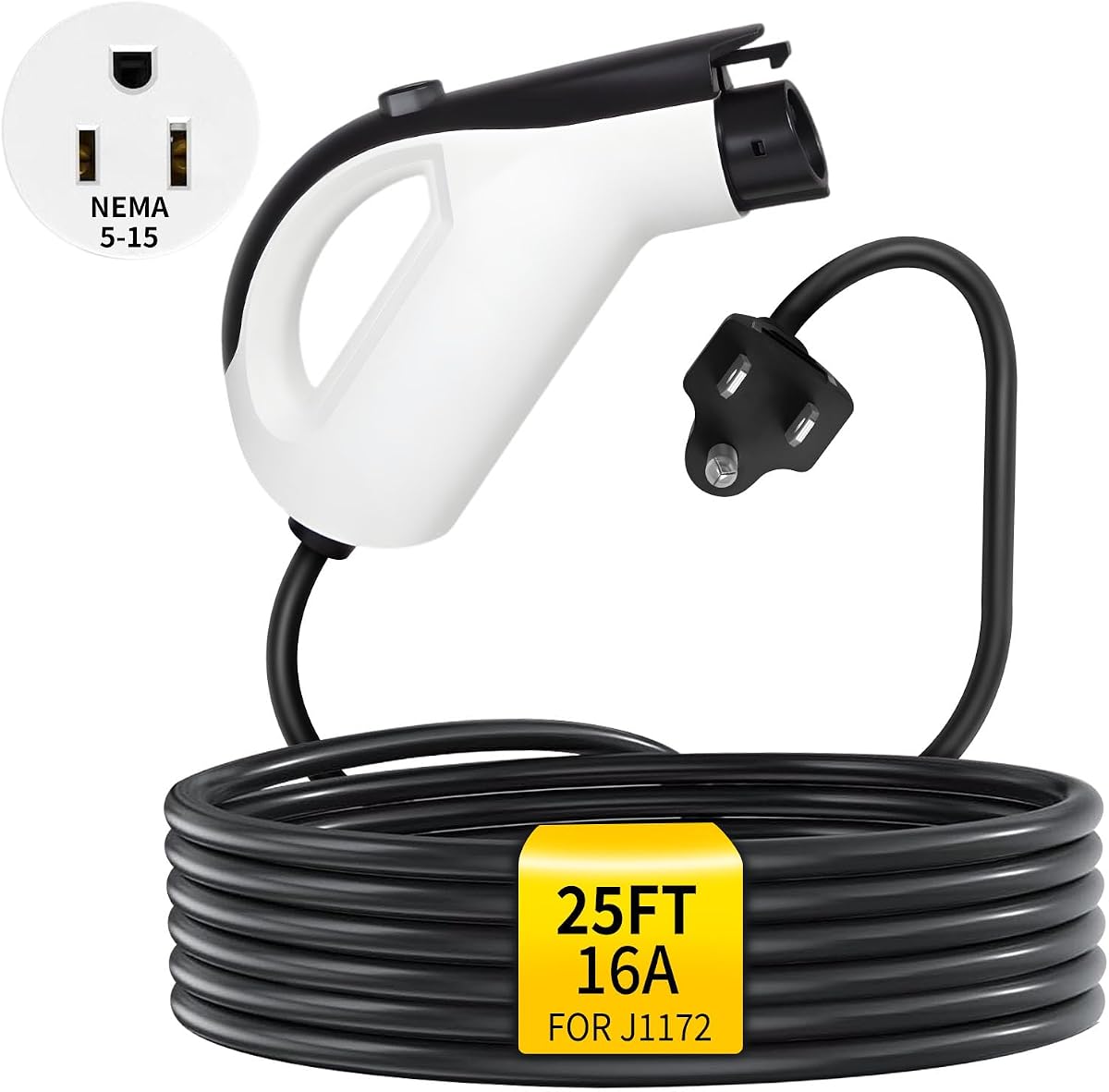
This Level 1 charger prioritizes simplicity and portability, with a supplied rating of 4.7. Its integrated NEMA 5-15 plug connects to ordinary 120V outlets, and its streamlined boxless design reduces the number of separate control components travelers need to organize.
We may earn a commission when you buy through this link, at no additional cost to you.
The charger is designed around a 25FT J1772 cable, which should reach across many garages, driveways, apartment spaces, guest parking areas, and temporary travel locations. The supplied information estimates roughly three to five miles of added range per hour, depending on the vehicle, battery condition, outlet, wiring, temperature, and circuit capacity.
Built-in temperature monitoring can reduce or stop charging if unusual heat is detected, and the IP55 construction supports protected outdoor use. Its limitations are predictable: Level 1 charging is slower than 240V alternatives, and it requires a J1772 inlet or a suitable adapter for vehicles using another connector.
This is a sensible pick for PHEV owners, apartment residents, and drivers who mainly need to add range overnight or maintain a reserve battery during travel. It is not the best choice for a driver who expects a fast turnaround at a roadside destination. For simple, familiar 120V charging with generous cable reach, it provides a focused solution.
Level 1 charging is best treated as a planned top-up rather than a rapid pit stop. Leaving the vehicle connected overnight can be useful for maintaining charge at rentals, campgrounds, or temporary lodging where 120V access is the only option.
The boxless layout is designed to coil and store more cleanly than a unit with a separate control box. That practical detail can make the charger easier to deploy repeatedly during a long journey.
We may earn a commission when you buy through this link, at no additional cost to you.
This NACS Level 1 charger is a focused travel companion for Tesla drivers, carrying a supplied rating of 4.8. It supports Model 3, Model Y, Model S, Model X, and Cybertruck vehicles, removing the need for a separate J1772-to-NACS adapter during trips.
We may earn a commission when you buy through this link, at no additional cost to you.
Its integrated NEMA 5-15 plug makes setup familiar: connect the charger to a properly grounded standard outlet, then attach the NACS handle to the vehicle. A 25FT cable provides useful reach across guest parking spaces, apartments, driveways, and rentals, while the included bag supports organized trunk storage.
The estimated gain of around three to five miles per hour makes this a backup and overnight-charging solution rather than a fast-charging option. Temperature monitoring can reduce or halt charging under unusual conditions, and the IP55 housing is intended for protected outdoor use. Drivers should still avoid exposed outlets in unsuitable weather.
This is the strongest dedicated choice for Tesla owners who want a straightforward 120V emergency charger. It offers the convenience of a native NACS connection and a clean boxless design. Those who need rapid charging while traveling should treat it as a backup and pair it with suitable fast-charging locations.
Because the cable terminates in the charging connector used by supported Tesla models, travelers can avoid carrying and connecting an additional adapter. That makes the charger especially useful as an emergency unit kept in the trunk.
The anticipated three-to-five-mile-per-hour gain suits planned overnight charging in a rental, hotel area, apartment lot, or other location with a suitable outlet. It is less suitable when a driver has only a short stop available.
We may earn a commission when you buy through this link, at no additional cost to you.
ELEGRP's 40Amp Level 2 charger is a fast, weather-focused option with a supplied rating of 4.5. It supports up to 9.6kW, uses a NEMA 14-50 plug, and comes with a 25FT cable, making it well suited to compatible J1772 vehicles at homes, work destinations, and travel stops with proper 240V access.
We may earn a commission when you buy through this link, at no additional cost to you.
The standout physical feature is its IP67 rating, accompanied by a stated operating range of -21°F to 121°F. That makes it a reassuring choice for weather-exposed charging situations, although users should still follow local electrical practices and avoid unsafe extension arrangements. The charger is also ETL certified and uses ELEGRP's PBE overheat-protection approach.
Five current settings from 16A through 40A let the driver match the unit to available circuit capacity, while a one-to-twelve-hour delay can shift charging to a lower-demand period. The supplied information cites broad compatibility with numerous EVs and PHEVs, including Mercedes, Ford, Mustang Mach-E, Chevrolet, Hyundai, Kia, and Nissan models.
Drivers seeking a rugged fast charger for variable conditions should shortlist this model. It is less convenient for locations with only 120V service, and Tesla owners need a separate NACS adapter. For travelers with access to a properly configured NEMA 14-50 outlet, its combination of output, weather resistance, and adjustable current is especially compelling.
The IP67 enclosure and broad stated temperature range distinguish this model from chargers designed mainly for protected locations. This is valuable for travelers who may encounter rain, snow, or seasonal temperature changes during a journey.
The selectable 16A, 20A, 24A, 32A, and 40A levels make it easier to set a safe charging rate appropriate to the circuit. The vehicle's own charging limits and the outlet's rating remain important considerations.
We may earn a commission when you buy through this link, at no additional cost to you.
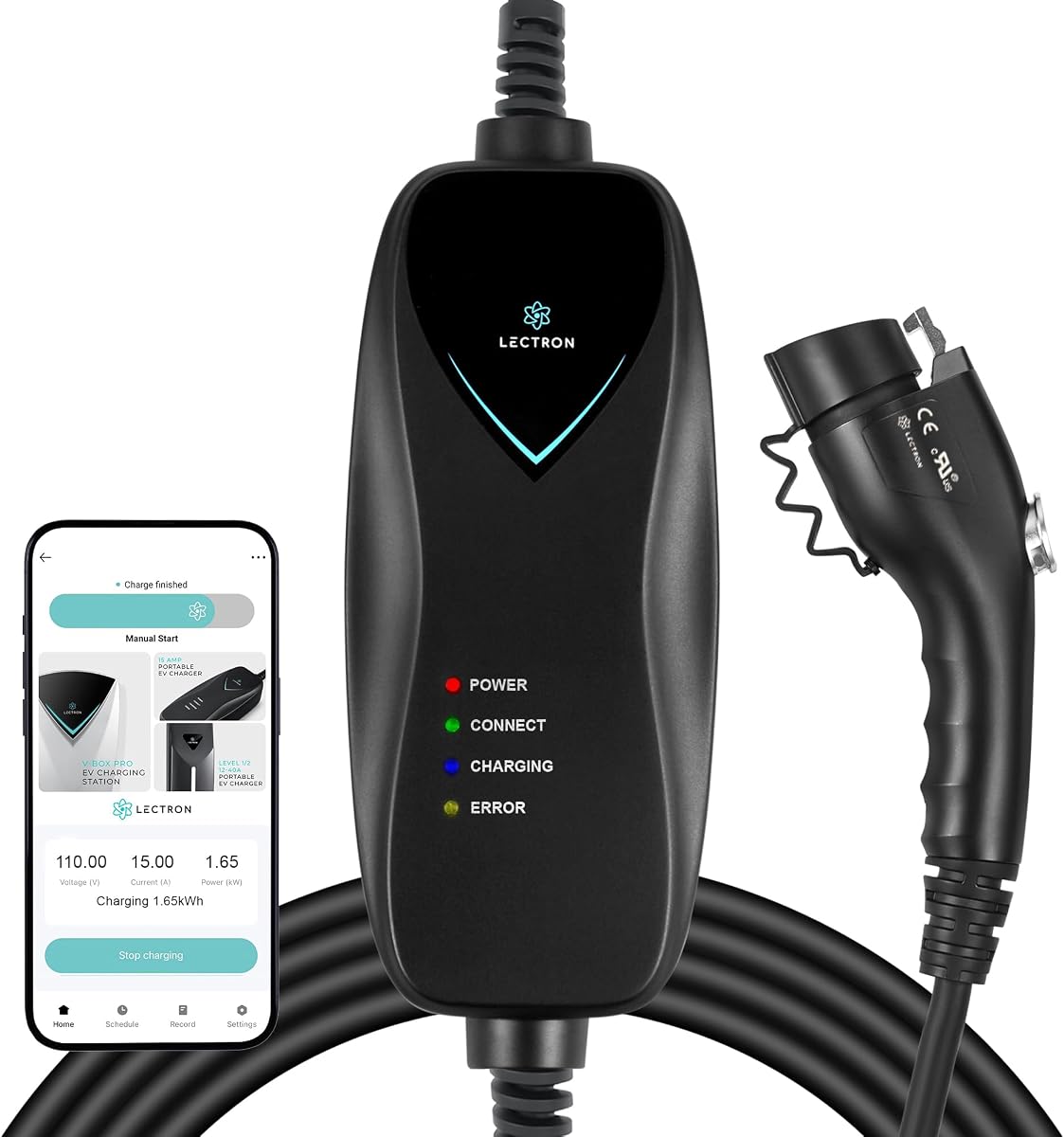
Lectron's Level 1 charger is a straightforward 120V option with a supplied rating of 4.4. It uses a NEMA 5-15 plug, delivers 15 amps and 1.65kW, and connects to J1772 vehicles, making it a practical choice for standard outlets encountered at rentals, homes, and travel destinations.
We may earn a commission when you buy through this link, at no additional cost to you.
Its certification profile is a notable strength. The supplied information cites ETL and FCC certification, UL 2594 compliance, and Energy Star certification, while an IP65 rating addresses dust and water resistance. Built-in protection covers overvoltage, overcurrent, and short-circuit conditions, adding confidence during unattended overnight charging.
The main compromise is cable length. Its 16FT extension and J1772 cable are shorter than the 25FT configurations offered by several other products in this guide. That may be sufficient for a normal parking space but less convenient when the outlet is across a driveway or around a corner.
This charger is best for travelers who value certification, straightforward operation, and a compact 120V backup solution. It does not offer the dual-voltage flexibility of some competitors, app controls, or the long reach of the 25FT models. For compatible J1772 vehicles, it remains a focused and credible travel accessory.
ETL and FCC certification, UL 2594 compliance, and stated overcurrent and overvoltage protections make this a reassuring choice for daily charging. Certification reduces uncertainty, although users must still supply safe wiring and a sound outlet.
The 16FT total reach is adequate for many ordinary parking arrangements and easier to manage than a longer lead. Drivers should measure the distance from their likely outlet to the vehicle's charging port.
We may earn a commission when you buy through this link, at no additional cost to you.
The Grasside Level 1&2 charger offers broad outlet and current flexibility, with a supplied rating of 4.3. It supports 8A, 10A, 12A, and 16A settings, allowing travelers to move between 120V and 240V situations while carrying a single J1772 charging unit.
We may earn a commission when you buy through this link, at no additional cost to you.
The included NEMA 6-20 plug and NEMA 5-15/5-20-to-6-20 adapter make it possible to use common household outlets. Maximum 120V output is 1.44kW, while a suitable 240V NEMA 6-20 outlet supports up to 3.84kW. A 25FT cord, carrying case, LCD, and delay timer round out its travel-friendly feature set.
The charger is described as compatible with many J1772 EVs and PHEVs, including BMW, Mercedes-Benz, Hyundai, Kia, Nissan, Rivian, Ford, Chevrolet, Volkswagen, and Toyota. Its safety features include an IP65 rating, a UL-listed cable, a rubberized connector, and protection against overcurrent, overheating, and electrical faults.
This model fits travelers who need multiple current levels but do not require the highest 240V output. It is especially useful when ordinary outlets are the primary charging option. The 16A maximum is lower than several 40A alternatives, and Tesla drivers need a separate adapter, but the flexible settings and long cord offer a balanced package.
The eight-to-16-amp range is valuable for shared or variable circuits. It gives users more control than a fixed 12A or 16A model without requiring the higher capacity of a 40A charger.
A 25FT cable can reach across larger parking areas, while the included carrying case helps protect the equipment between stops. Together, these details support repeated use rather than occasional emergency deployment.
We may earn a commission when you buy through this link, at no additional cost to you.
Lectron's WiFi Level 1 charger combines familiar 120V charging with app-based monitoring and control. It has a supplied rating of 4.3, uses a NEMA 5-15 plug, and provides a 15-amp Level 1 connection for J1772 EVs and PHEVs.
We may earn a commission when you buy through this link, at no additional cost to you.
The defining feature is remote visibility. Through the Lectron app, users can check charging status and adjust charging current, which is useful for overnight sessions in a rental, apartment, workplace, or campsite. The charger is described as IP65-rated for dust and water resistance, supporting use in protected environments during travel.
Its estimated 40 to 50 miles of overnight range makes it appropriate for maintaining charge rather than rapid recovery. Compatibility includes Ford, Rivian, Honda, BMW, Hyundai, Kia, Porsche, Nissan, Chevrolet, and other J1772 vehicles. As with any connected device, travelers should consider app availability, network access, and account setup.
This is the pick for travelers who value remote monitoring more than maximum cable length or fast 240V output. The 16FT lead may limit reach in some parking situations, and app reliance can be an inconvenience when connectivity is poor. Even so, it provides a useful connected-charging experience for compatible vehicles.
The app lets users check progress and make current adjustments without returning to the vehicle. This can be especially useful when the charger is connected in a garage, driveway, or parking area away from the driver's usual location.
Before relying on the charger during a trip, travelers should set up the app, connect the charger to the available network, and confirm that remote controls work as expected. Core charging still depends on a sound outlet and compatible vehicle.
We may earn a commission when you buy through this link, at no additional cost to you.
EVDANCE's 40Amp Level 2 charger combines up to 9.6kW output with one of the more informative displays in the group, and it carries a supplied rating of 4.5. The 2.4-inch TFT screen presents current, voltage, power, charging time, and operating status, while LED indicators provide an additional visual cue.
We may earn a commission when you buy through this link, at no additional cost to you.
Six current settings—10A, 16A, 20A, 24A, 32A, and 40A—provide fine-grained control over charging speed. A one-to-twelve-hour delayed-start function can shift a session away from peak demand. The NEMA 14-50 plug is designed for 240V outlets, and the 25FT cable offers useful reach across garages and parking areas.
Its IP66 rating and stated operating range from -22°F to 122°F support use across varied conditions. The charger includes protections against leakage, grounding faults, overvoltage, undervoltage, overcurrent, overcharging, overheating, and short circuits, and it is described as shutting off after the battery reaches full charge.
This is a strong choice for J1772 drivers who want substantial 240V output and detailed local feedback without an app. It falls short of the 50Amp model's stated maximum, and Tesla owners need a separate J1772-to-NACS adapter. For travelers who prioritize a clear display, flexible amperage, and durable construction, it remains a well-rounded option.
The TFT display provides a more comprehensive view of session data than a basic LED indicator. It can reduce uncertainty when diagnosing current, voltage, power, or charging-state behavior at a destination.
The broad current range lets users select a lower rate on a shared circuit or move toward full output when the electrical setup supports it. The vehicle's charging limit still determines the final result.
We may earn a commission when you buy through this link, at no additional cost to you.
The Toptoo Level 1+2 charger stands out with a supplied rating of 4.9 and a broad 110V-to-240V operating range. Its 16-amp, 3.5kW specification makes it a versatile middle ground for J1772 vehicles that need both ordinary household charging and faster 240V support.
We may earn a commission when you buy through this link, at no additional cost to you.
The package includes a 6-20P power plug, cable, control box, and a standard US plug adapter for Level 1 household outlets. A 1.8-inch color LCD displays current, voltage, power, temperature, and charging status, while buttons allow users to set current limits and an eight-hour maximum delayed-start period.
Safety features include automatic shutdown when the battery is full and protections against overvoltage, overheating, and overload. The supplied instructions emphasize that charging current must not exceed the outlet's rated capacity and that worn, poor-quality, damaged, or counterfeit outlets should not be used.
This is a strong value-oriented option for travelers who want one portable charger to handle 120V and 240V outlets without moving to the highest 40A or 50A output. Its 16A limit reduces the need for more powerful electrical infrastructure. The absence of a stated weather rating makes it best suited to protected locations or careful outdoor deployment.
The included outlet adapter allows Level 1 use at home or during travel, while the 6-20P plug supports Level 2 operation with suitable 240V power. This makes the unit adaptable without carrying two separate charger bodies.
The charger includes meaningful safeguards, but its instructions correctly place responsibility on the user to use sound wiring and outlets. Inspect plugs, avoid overloads, and confirm that the selected current matches the circuit before use.
We may earn a commission when you buy through this link, at no additional cost to you.
The right portable EV charger depends on your vehicle's connector, the outlets you can realistically use, and how much charging time you have. Consider charging level, electrical requirements, safety features, cable reach, storage, and environmental exposure before making a selection.
Level 1 charging uses a standard 120V household outlet and is ideal for overnight top-ups, plug-in hybrid charging, and emergency backup. It is slower, but it requires less electrical infrastructure and works in many rentals, garages, apartments, and campsites. Level 2 charging uses 240V power and can restore range much faster when the vehicle, charger, outlet, and circuit all support it.
Choose Level 1 when your priority is universal access to ordinary outlets. Choose Level 2 when fast recovery at a destination matters. For the most flexible travel setup, consider a dual-voltage charger that supports both levels.
Most North American EVs and PHEVs use the SAE J1772 inlet, while supported Tesla vehicles use NACS. A J1772 charger therefore works directly with many compatible vehicles but requires an appropriate adapter for NACS-equipped cars. A dedicated NACS charger is simpler for Tesla drivers but will not directly fit J1772 vehicles.
Match the connector to your vehicle before considering other features. Also check model-specific limitations, because some charging systems use different ports or require adapters even within a broader compatibility category.
A charger can support 240V only when a correctly configured outlet is available. Common configurations mentioned in this guide include NEMA 14-50 for some Level 2 models and NEMA 6-20 for 16A Level 2 models. Do not assume a familiar-looking outlet has sufficient capacity; its amperage, wiring, grounding, and circuit rating all matter.
Review the charger's plug, supported outlet types, and required adapters before packing it. For 120V use, choose a properly grounded NEMA 5-15 outlet. For higher levels, verify the circuit with the location's electrical guidance.
A longer cable lets the vehicle reach an outlet across a driveway, garage, guest parking area, or crowded lot without moving the car. Many choices in this guide offer 25FT, while one provides a 16FT configuration. Longer is not automatically better: additional cable adds weight and takes more space to coil and store.
Estimate the distance from a likely charging point to the vehicle inlet, then add enough slack for safe routing. A boxless layout can also make a long cable easier to manage and reduce strain on the control housing.
Look for recognized certifications such as ETL or FCC where the supplied product information confirms them, along with protection against overvoltage, overcurrent, overheat, leakage, short circuits, and ground faults. Temperature monitoring can add another layer of protection by reducing or stopping charging when abnormal conditions are detected.
Certification does not excuse poor electrical infrastructure. Use intact outlets, properly grounded wiring, and circuits that meet the charger's requirements. Follow the included manual and avoid damaged equipment.
Travel can expose a charger to rain, snow, dust, temperature changes, and repeated handling. An IP55, IP66, or IP67 rating indicates increasing levels of dust and water protection, while a stated operating-temperature range provides additional context. These ratings do not make every outdoor charging situation safe, particularly when the outlet itself is exposed.
Choose a higher-rated enclosure for frequent outdoor use, and use the charger in a protected location whenever possible. Inspect the cable and connector for damage before each trip and keep storage dry.
Basic LED indicators are useful for confirming that a charger is active or reporting an error, but richer displays can show voltage, current, power, temperature, elapsed charging time, and operating status. These readings help travelers determine whether a lower current setting or circuit issue is affecting performance.
Adjustable current, delayed-start timers, and app connectivity are worthwhile when sharing circuits or charging overnight. A screen-based model suits users who prefer local controls, while a WiFi model is better for remote monitoring. Confirm that the preferred control method works before relying on it away from reliable connectivity.
A genuinely portable charger should be easy to remove from a wall outlet, coil without excessive strain, and fit in a trunk or storage area. Some models include carrying bags, cable holders, control-box holders, or mounting brackets. These accessories influence how conveniently the charger can be deployed at each stop.
Compare the complete package rather than only the charger's rated output. Look for a bag or organizer that suits your storage plan, and check whether the included adapters cover the outlets you expect to use. Accessories cannot compensate for an incompatible connector or an undersized circuit.
Before the first charging session, read the included manual, identify the vehicle connector and required adapter, inspect the charger for visible damage, and confirm that the wall outlet, plug, and circuit match the charger's specifications. For 240V models, use a properly grounded outlet on a circuit with appropriate capacity and avoid overloaded extension arrangements.
Connect the charger to the power source first, select a current level that does not exceed the outlet or circuit rating, and then connect the vehicle handle. Use the delay timer or app where appropriate, confirm that charging has begun, and monitor the display for errors or abnormal readings. Stop charging if the plug, cable, or outlet becomes hot, damaged, wet when it should not be, or otherwise unsafe.
After charging, disconnect the vehicle connector before removing the charger from the outlet unless the instructions specify otherwise. Coil the cable without sharp bends, clean the connector with a dry cloth, and store the unit in the supplied bag in a dry, protected location. Inspect the plug, contacts, strain relief, and cable before every trip, and avoid using the charger if any component shows damage.
It depends on the charging level and the time available. Level 1 chargers add range more slowly and are best for overnight or backup use, while 240V Level 2 chargers can recover range much faster at compatible destinations. The vehicle's onboard charger, battery condition, temperature, and electrical setup also influence the result.
Only if the charger and plug configuration support the outlet's voltage and amperage. Many Level 2 models require a 240V NEMA 14-50 or NEMA 6-20 outlet, while Level 1 models use a standard 120V NEMA 5-15 plug. Never force a plug into an incompatible outlet or assume a household receptacle can support full Level 2 output.
It depends on the charging port in your vehicle. Most compatible North American EVs and PHEVs use J1772, while supported Tesla models use NACS. J1772 chargers need a suitable J1772-to-NACS adapter for Tesla vehicles, and a dedicated NACS charger will not directly connect to a J1772 inlet.
Some chargers in this guide have IP55, IP66, or IP67 ratings, but the charging environment matters as a whole. The vehicle connector, wall outlet, and any exposed connection points should not be unsafe for the conditions. Protected locations are preferable, and charging should stop if an outlet, plug, or cable becomes wet or damaged.
Cable length mainly affects reach and convenience rather than maximum charging speed. A properly rated 25FT cable can make a distant outlet usable, while a shorter cable is easier to store. Charging speed still depends on charger output, circuit capacity, and the vehicle's onboard charging capability.
Level 1 uses 120V household power and is slower, making it convenient for overnight charging and locations with ordinary outlets. Level 2 uses 240V power and can deliver substantially more output, but it requires a suitable outlet, wiring, and circuit. A dual-voltage charger offers flexibility when both kinds of access are available.
The selected current must remain within the limits of the outlet, circuit, charger, and vehicle. Higher settings can shorten charging time when all parts of the system support them, while lower settings can reduce demand on shared infrastructure. When uncertain, use the lower setting and follow the charger's instructions and local electrical guidance.
Usually not. Portable Level 1 and Level 2 chargers are most useful for planned overnight charging, rentals, workplaces, campsites, and backup scenarios. Public fast-charging networks remain important for short stops when drivers need a rapid increase in range, because portable residential-style chargers are primarily designed for planned charging sessions.
The Toptoo Level 1+2 charger offers a balanced value-oriented combination of dual-voltage support, adjustable settings, and detailed monitoring, while the 50Amp Level 2 unit leads the group in stated output and flexibility. The ELEGRP 40Amp charger stands out for rugged weather resistance and a wide operating range, making it particularly compelling for variable travel conditions.
Prioritize connector compatibility first, followed by the outlets you can realistically use. Choose Level 1 for simple overnight backup, Level 2 for faster destination charging, or a dual-voltage model for maximum flexibility. Cable reach, current controls, weather protection, certifications, displays, and storage should be matched to the way you actually travel.
Before buying, verify the current product listing, supported vehicles, outlet requirements, included adapters, warranty information, and operating instructions. Ratings and specifications can change as products are updated, and current listing details should always guide the final purchase.