
4-Pack Sand Erasers
4.4Editor score
Full and half sizes
Ink and pencil correction
Compact portable design
Ink Eraser for Paper guide comparing 10 options for removing ink and colored pencil marks, portability, precision, paper safety, and daily school or office use.
Ink erasers for paper use controlled abrasion to lift stubborn marks that ordinary rubber erasers may only smear. The right choice depends on your pen types, paper, precision needs, and tolerance for eraser debris, making this a category where material, shape, and construction matter more than the word sand alone.
We compared all 10 options by their stated erasing capabilities, material composition, shape, portability, pack size, and suitability for school, office, and artwork. The guide covers dedicated sand erasers, dual-ended tools, and precision erasers with brushes, providing options for different budgets and correction styles.
Each review explains what stands out, where trade-offs may appear, and which user is most likely to benefit. Ratings and product details reflect the supplied listings, while prices and availability can change, so readers should confirm current listings and product information before purchasing.
4.4Editor score
4.5Editor score

5.0Editor score
The table below compares every product by its design, erasing focus, materials, and practical use. It highlights dedicated sand options, hybrid rubber-and-sand designs, and brush-equipped precision erasers so you can quickly identify the most suitable tool for your paper and correction routine.


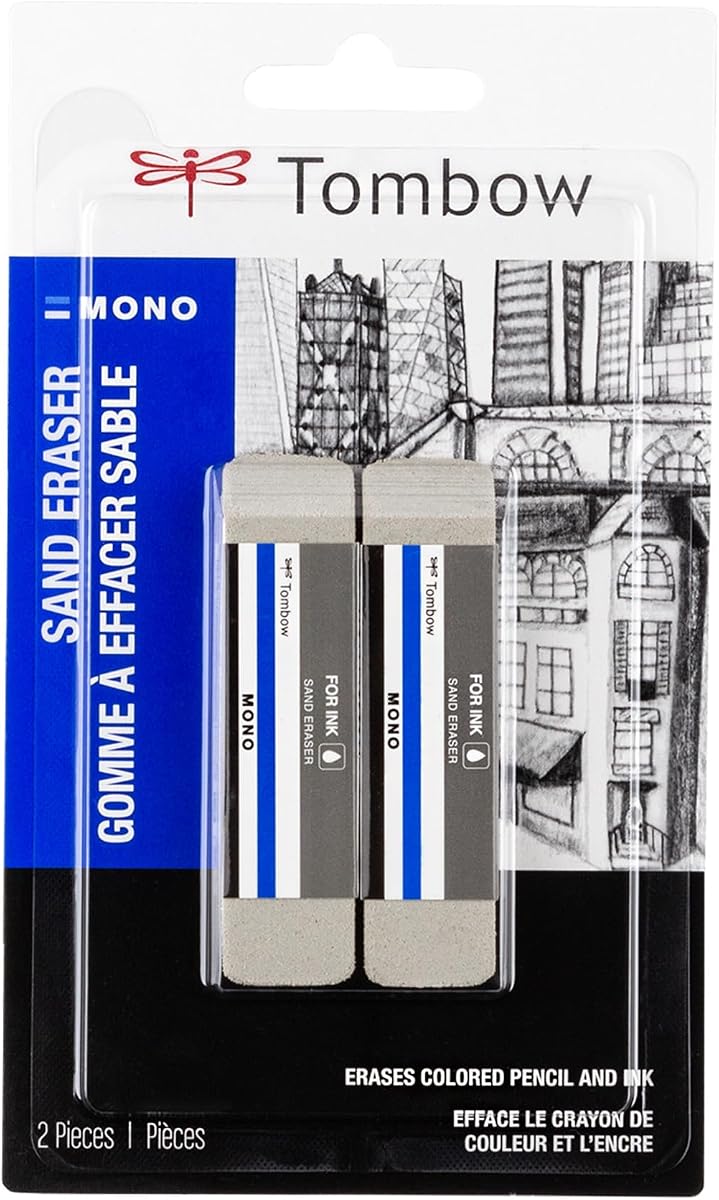
The Tombow 67304 Mono Sand Eraser pairs natural rubber latex with silica grit to remove ink and colored pencil markings. Its 4.5 rating reflects a generally favorable buyer response, and the two-pack configuration makes it convenient to keep one in a pencil case and another in a larger art or office kit. Unlike a conventional vinyl eraser, its abrasive surface is intended for marks that need more aggressive removal.
We may earn a commission when you buy through this link, at no additional cost to you.
The strongest feature is clear compatibility with the kinds of corrections most people struggle to erase. Silica grit works directly against stubborn marks, while the flexible rubber body gives the user a slightly forgiving surface to work with. Because the pack includes two erasers, it also offers a practical distribution of tools for school, home, and office. The listing also identifies the product as environmentally friendly, adding another consideration for buyers who value natural-material stationery.
As with any sand-based eraser, the tradeoff is residue and abrasion. Fine grit can leave particles on the desk or page, and repeated aggressive rubbing may wear through delicate paper. It is therefore better suited to ordinary school paper, notebooks, and sketchbook work than to irreplaceable archival documents. The material is not designed to erase a tiny symbol without some careful control, so a precision eraser is a better choice for very narrow corrections.
This is our leading recommendation for readers who want a straightforward, proven way to remove ink and colored pencil. The 4.5 rating, recognizable Tombow construction, and two-pack format provide a balanced combination of effectiveness and convenience. Choose it when reliable mark removal matters more than residue-free precision, and use light strokes to preserve the paper beneath the mark.
The silica-grit surface distinguishes this eraser from ordinary pencil erasers, making it appropriate for ballpoint, rollerball, and colored pencil marks that resist softer materials. It is particularly useful for homework revisions, note-taking, and everyday sketching.
Natural rubber latex provides a flexible base for the abrasive grit, while the product's two-pack format supports multiple workspaces. It is a practical option for buyers who want a dedicated ink eraser without adding a separate precision tool.
We may earn a commission when you buy through this link, at no additional cost to you.
The 4-Pack Sand Erasers set includes two full frosted erasers and two half erasers, giving buyers more ways to organize and use the product than a conventional single eraser. Its 4.4 rating suggests strong general satisfaction, while the stated ability to remove colored pencil and ink makes it suitable for students, artists, and office workers who need a flexible correction option.
We may earn a commission when you buy through this link, at no additional cost to you.
Size versatility is the defining benefit. The full pieces provide more surface area for broader corrections, whereas the half pieces can fit into tighter compartments or offer greater control over a small area. At 6.6 by 1.4 centimeters and approximately nine grams each, the erasers are small and light enough to carry without adding meaningful weight to a school bag or pencil case.
The product description emphasizes smooth erasing, portability, durability, and simple packaging. Those qualities make the set appealing for keeping several tools in different places, especially if one full eraser is assigned to school, another to an art area, and the smaller pieces remain available for precision work. The principal limitation is that the sand action is abrasive, so residue can be expected after use.
This is a strong budget recommendation because the four-piece arrangement increases its practical value. It is not merely a cheaper single eraser; the mixture of full and half sizes addresses different correction needs. For students managing a large quantity of notes, the set is especially convenient. Users working on very fragile documents should still apply light pressure and test an inconspicuous area first.
Full erasers suit broader corrections, while the half erasers provide a smaller grip and better access to compact spaces. This mix makes the pack adaptable across schoolwork, drawing, and office notes.
The lightweight, compact format makes it easy to keep one eraser in each of several working locations. Four pieces also reduce the chance of leaving a needed correction tool behind.
We may earn a commission when you buy through this link, at no additional cost to you.
The 4Pcs Double Head Sand Erasers stand out for a dual-ended geometry designed to combine broader correction with access to small areas. The product carries a 5.0 rating, the highest displayed rating in this guide, and is positioned for fountain pen, ballpoint, gel pen, colored pencil, exam preparation, note-taking, sketching, and drawing.
We may earn a commission when you buy through this link, at no additional cost to you.
Its most distinctive feature is the combination of a practical end and a precise corner. That shape gives users more ways to approach a correction than a basic rectangular block. A matte gray, finely sanded exterior should also offer a controlled, non-slip grip while the natural-rubber construction is intended to remain in good condition through repeated use. The listing specifically recommends gentle pressure, which is sensible for preserving paper.
Four erasers make this a generous set for anyone who erases frequently. They can be divided among a pencil case, office drawer, art supply area, and travel kit, reducing the inconvenience of searching for a tool when a mistake appears. The possible drawback is unnecessary quantity for a user who only makes occasional corrections. In addition, the abrasive nature of sand means that some debris is inevitable.
This is the most feature-focused recommendation in the guide. Its precise geometry, multiple formats, strong compatibility claims, and perfect rating make it a convincing choice for serious students, artists, and frequent note-takers. Choose it when control and adaptable shapes matter more than minimal packaging. Gentle, deliberate strokes should produce better results than forceful rubbing.
The dual-ended form includes a corner that can reach tight spaces where a broad rectangular face cannot. It is useful for correcting individual characters, margins, and narrow drawing details.
The finely sanded matte surface is intended to resist slipping during repeated corrections. Natural rubber and a compact format also make the tool manageable for prolonged school or studio work.
We may earn a commission when you buy through this link, at no additional cost to you.
The Daiso Sand Eraser is a compact three-piece set marketed for both ink and pencil corrections. Its 4.2 rating places it in the middle of this group, but the simple dual-purpose proposition remains useful for anyone who regularly encounters stubborn marks and wants more than one eraser available.
We may earn a commission when you buy through this link, at no additional cost to you.
The main appeal is straightforwardness. Instead of offering several specialized surfaces, this product gives users a familiar sand eraser format with a stated ability to handle both writing media. The three-piece count is useful for placement around the home, classroom, or office, and the imported construction may appeal to consumers familiar with Daiso's stationery range. Because the listing provides little technical detail, however, buyers should judge it primarily on its stated compatibility.
There is less information about geometry, grip, and paper handling than with some competing products. Its 4.2 rating is also lower than the leading options, so it does not present the same evidence of broad buyer satisfaction. A sand eraser can also create fine residue and is not ideal for delicate pages, regardless of the brand.
The Daiso set remains a sensible choice for simple, portable corrections and for buyers who appreciate a multi-pack of uncomplicated sand erasers. It is better suited to routine school and office use than highly controlled artwork. Checking the current listing for dimensions and material details is advisable because the supplied product information is intentionally brief.
The stated ability to erase both ink and pencil reduces the need to keep different correction materials nearby. That makes the set practical for mixed schoolwork and routine note-taking.
Three compact erasers can be kept in separate workspaces or shared among students and colleagues. The uncomplicated design supports convenient everyday access.
We may earn a commission when you buy through this link, at no additional cost to you.
The Charles Leonard 80795 combines gray and white sides in a single two-in-one eraser designed for ink and pencil. Its 3.8 rating is the lowest in this comparison, but the product remains an accessible option for basic household, school, and office corrections where convenience matters more than specialized performance.
We may earn a commission when you buy through this link, at no additional cost to you.
A two-sided format provides a practical division of labor. Soft, pliable rubber is easier to control than a rigid abrasive block, while the listing promises smudge-free erasures. That combination is attractive for everyday homework and office documents where the user wants to remove a mistake without spreading ink across the surrounding text. The two colors also make it easier to identify each side at a glance.
The main limitation is that the supplied description does not specifically name the many pen and marker types covered by the stronger sand erasers in this guide. It also offers only one eraser, so buyers who work in several locations may need additional units. Smudge-free performance can also depend on the mark, ink formulation, and technique, so it should not be treated as guaranteed across every writing medium.
This eraser works best as a compact, inexpensive dual-purpose tool for common corrections. It may be less suitable for heavy ink, persistent marker, or fine technical drawing than a dedicated precision sand eraser. For students and home offices seeking a simple two-sided solution, however, its light construction and straightforward use make it a reasonable starting point.
The gray and white sides offer separate correction options in a compact body. This reduces clutter when both pencil and ink mistakes need to be addressed.
Pliable rubber should be easier to maneuver over a correction than a rigid block. It is a sensible choice for routine notes where speed and simple handling are priorities.
We may earn a commission when you buy through this link, at no additional cost to you.
The 3-Pack Sand Erasers use fine silica grit to remove ballpoint, gel, fountain pen, and colored pencil marks. Its 4.0 rating places it among the middle performers, while the latex-free, odorless construction gives the product a distinct appeal for students, artists, and office workers who want a dedicated abrasive eraser.
We may earn a commission when you buy through this link, at no additional cost to you.
The product information highlights more than ordinary paper correction. It is described as useful on thick paper, cardstock, and mixed-media sketchbooks, provided the surface is sturdy. It may also lift smudges from photos, clean crafting projects, and address over-inked areas. These secondary applications make the set appealing to art and craft users, although a test on the target material is still advisable.
The strongest stated feature is the combination of fine silica grit and a non-toxic, latex-free formula. The absence of harsh chemicals and odor makes the erasers more broadly approachable, including for younger students. Three full-size units also provide a practical home, school, and bag distribution. The tradeoff is that a sand action remains abrasive, and the listing specifically recommends sturdy surfaces to reduce the risk of paper damage.
This three-pack is a flexible choice for households and studios that handle several paper types. Its utility extends beyond standard ink correction, but the middling 4.0 rating and limited detail about exact dimensions make it less distinctive than the top dual-ended options. Buyers who need a soft, low-abrasion eraser for fine paper should consider that limitation carefully.
The product is also presented as a way to lift photo smudges, clean craft surfaces, and adjust over-inked areas. Those uses make it useful to artists and DIYers beyond the classroom.
Fine silica grit can work effectively on cardstock and sketchbook pages, but the product's own guidance favors sturdy surfaces. Gentle use on an inconspicuous area is advisable before removing an important image or note.
We may earn a commission when you buy through this link, at no additional cost to you.
The Faber-Castell Perfection Eraser is a precision instrument for ink rather than a general-purpose block. Its 4.4 rating aligns it with several stronger entries in the guide, and its pen-shaped construction, hard white eraser, and included brush distinguish it from sand erasers that work by abrading the paper surface.
We may earn a commission when you buy through this link, at no additional cost to you.
The listing specifies suitability for ink, India ink, and ballpoint pens. That focused positioning makes it appealing to artists, calligraphers, students, and anyone who needs to remove a small, defined error without rubbing across a wide area. The included brush is an important companion feature because it helps lift the eraser residue that would otherwise remain on the page or work surface.
Precision is the primary benefit, but it changes the product's scope. A hard eraser designed around ink is not the natural first choice for ordinary pencil corrections, and the brush can require occasional cleaning as debris accumulates. It also includes only one eraser, so a buyer who loses or wears it must replace the entire item.
This is the guide's clearest specialist option. It is well suited to careful ink work, lettering, technical drawing, and carefully edited notes where a compact correction footprint matters. Buyers wanting one tool for every mark should instead choose a dual-sided sand-and-rubber model. For targeted ink removal with neat cleanup, however, the included brush makes this a particularly thoughtful design.
The narrow eraser pencil is suited to removing individual mistakes while preserving the surrounding page. It is especially useful for India ink and ballpoint work where a broad eraser would disturb more than intended.
The included brush sweeps away fine residue after erasing, helping the user judge whether the correction is complete. It is a simple addition that materially improves the cleanup process.
We may earn a commission when you buy through this link, at no additional cost to you.
The Tombow MONO Sand Eraser is a single-unit option made from natural rubber latex and silica grit. It carries a 4.4 rating and is designed to remove colored pencil and ink marks, including ballpoint, rollerball, and some marker ink, making it a broad correction tool for mixed stationery use.
We may earn a commission when you buy through this link, at no additional cost to you.
A major strength is its stated range across several ink types. Ballpoint and rollerball users are well covered, while compatibility with some markers expands its usefulness for everyday office and school materials. Natural materials and a recycled pulp sleeve may also appeal to environmentally conscious buyers, although the sleeve does not make the eraser itself recyclable unless the relevant local program accepts the materials.
Compared with multi-packs, the single-unit format offers no spare or distribution advantage. Sand-based abrasion also means users should expect fine debris and should avoid excessive pressure. The single-piece approach is straightforward, but it lacks the more sophisticated corner geometry offered by some competing sand erasers.
This Tombow is a dependable choice for a household or workstation that needs one dependable eraser for both pencil and common ink. The 4.4 rating supports its position as a solid general-purpose choice, while the recycled sleeve adds a modest material-conscious benefit. It is less compelling than multi-packs for shared workspaces but easier to assess as a focused, single-tool purchase.
The product handles colored pencil, ballpoint, rollerball, and some marker marks. This broad range reduces the need for separate erasers during ordinary school or office tasks.
Natural rubber latex and silica grit form the erasing surface, while a recycled pulp sleeve protects the unit from dirt and grime. The materials align with a more deliberate stationery design.
We may earn a commission when you buy through this link, at no additional cost to you.
The Tombow 57302 MONO Sand and Rubber Eraser combines a sand side for ink with a rubber side for pencil in one compact product. Its 4.4 rating reflects a positive reception, while the two-material design offers one of the clearest ways to match the erasing surface to the mark without carrying two separate tools.
We may earn a commission when you buy through this link, at no additional cost to you.
The rubber side addresses the softer correction task, while the sand side tackles ballpoint, rollerball, and some marker ink. This division reduces the need to press an abrasive surface against ordinary graphite. A protective sleeve keeps the eraser away from dirt and grime while it is stored, which is particularly useful in a pencil case where the tool may rub against pens and other supplies.
The listing says the eraser will not damage paper, but that claim should still be interpreted in context. Sand erasers work through abrasion, so the amount of pressure, paper strength, and duration of rubbing all influence the result. Users should avoid treating the claim as permission to rub vigorously, especially on thin or valuable paper.
This Tombow is a strong all-in-one option for students, writers, and office workers who alternate between pencil and ink. Its two-sided format is more versatile than a dedicated sand eraser and less specialized than a brush-equipped precision tool. For a single daily stationery item, the dedicated sides and protective sleeve create a well-balanced, easy-to-justify design.
The rubber side is the natural choice for graphite, while the sand side is intended for more stubborn ink. Users can correct mistakes without applying the most abrasive option to every mark.
The included sleeve helps protect the working surfaces from pocket debris. It is a small convenience that matters when the eraser is carried regularly between home, school, or office.
We may earn a commission when you buy through this link, at no additional cost to you.
The 2-Pack Sand Eraser includes a sand eraser and a combined sand-and-rubber eraser, offering more variety than a standard two-piece set. Its 4.3 rating indicates solid performance, and the gray sand and white rubber heads are designed to address fountain pen, gel pen, ballpoint, and pencil marks in different ways.
We may earn a commission when you buy through this link, at no additional cost to you.
The gray sand head targets more persistent ink, while the white rubber head is presented as a cleaner way to erase pencil. Fine sand particles are intended to reduce paper damage, and the moderate size is said to provide a comfortable grip. The package also includes one dedicated sand eraser, giving users a choice between a single-purpose abrasive and a dual-material tool.
Its clearest limitation is the limited technical detail in the supplied listing. The claim of environmentally friendly, non-toxic materials is encouraging, but the brand and exact composition are not presented as clearly as they are for the Tombow products. The abrasive head will still create debris, and paper testing remains sensible for thin stock.
This set is a good fit for users who want both a dedicated sand eraser and a hybrid model to compare. It is useful for travel or shared workspaces because each eraser serves a slightly different role. The pair earns its place more through versatility than through a precision-focused design, making it a practical choice for general school, stationery, and office corrections.
The package provides both a dedicated sand eraser and a sand-and-rubber combination. That lets users experiment with the level of abrasion appropriate to each correction.
A moderate size and fine abrasive particles are intended to balance grip and paper protection. The set is most appropriate for routine writing corrections rather than delicate archival work.
We may earn a commission when you buy through this link, at no additional cost to you.
Choosing an effective ink eraser requires balancing the toughness of the mark, the delicacy of the paper, and the amount of control you need. The following factors help separate dedicated abrasive erasers from rubber, dual-ended, and brush-equipped precision options.
The most important starting point is the type of writing medium you need to remove. Dedicated sand erasers are generally intended for persistent ballpoint, rollerball, gel, and sometimes fountain-pen or marker marks, while ordinary rubber erasers are better matched to graphite. Some listed products specifically mention fountain pens, gel pens, ballpoints, and marker compatibility. A dual-ended design can cover both categories by assigning a rubber side to pencil and a sand side to ink.
Sand erasers remove marks through controlled abrasion, which makes them effective but inherently more aggressive than soft rubber. Thinner paper, special sketchbooks, and important documents deserve caution because repeated rubbing can wear fibers or remove printed content. Look for fine particles, a soft pliable base, and explicit paper-care guidance, but also test on a spare area. No eraser should be used with unnecessary force, regardless of the strength of its marketing language.
Shape affects how much of the surrounding page you disturb. A broad block works quickly across larger areas, while a narrow, pointed, or cornered design is better for individual characters, margins, and small drawing details. The dual-ended model in this guide includes a precision corner, and the Faber-Castell option uses a pen-like form. If your corrections are frequent but tightly localized, a more specialized geometry may be worth the added control.
Abrasive erasers can leave fine sand-colored particles on the page, desk, and hands. That residue is a normal part of many sand erasers, but it may be undesirable around artwork, electronics, or freshly printed documents. A rubber side can reduce loose debris for ordinary corrections, while a brush-equipped precision eraser helps lift particles after use. Keep a clean sheet or soft brush nearby when working over valuable surfaces.
Pack size should reflect where and how often you work. Two-piece and four-piece sets are useful for keeping tools at home, school, and work, while compact half-size erasers fit into tight pencil cases. The listed 6.6-centimeter erasers weigh only about nine grams each, illustrating how little space a dedicated correction tool can occupy. More pieces offer convenience, but they are unnecessary if you make only occasional corrections.
Material affects flexibility, durability, and the experience of using the tool. Natural rubber latex can provide a pliable base, while silica grit supplies the abrasive action. Some options are described as latex-free, odorless, and non-toxic, which may be useful for shared classrooms or sensitive users. Recycled-paper sleeves can reduce incidental packaging waste, although the eraser core and sleeve should be disposed of according to local rules.
A school student needs a durable, portable eraser for homework and notes. An artist may value fine control, compatibility with several pens, and a surface that can work over thick sketchbook paper. An office user may prioritize clean corrections and keeping a spare in a drawer. A crafts person might also value an eraser for removing smudges or cleanup around a project. The best option follows the user's most common correction, not merely the most specialized feature in the listing.
Comfort matters during repeated corrections because a slippery or rigid tool requires more pressure. Matte surfaces can improve control, while moderate-size bodies are easier to hold than very small blocks. A pen-shaped eraser offers fine positioning but may encourage a narrow grip. Whichever format you choose, hold the tool at a shallow angle and use repeated light strokes. A comfortable grip should support control without encouraging excessive force against the page.
Begin with the least aggressive method that can remove the mark. For a hybrid eraser, use the rubber side for pencil and the sand side for ink. For a dedicated sand eraser, test an inconspicuous area first, then place the eraser at a shallow angle and move it lightly across the mark instead of pressing straight down. Many scratches become clearer when the direction of the stroke follows the paper grain.
Work in small sections and check the result frequently. A larger correction can be built from several light passes rather than one forceful rub. After erasing, lift away the eraser and use a clean sheet, soft brush, or the included brush to remove loose particles. Avoid brushing residue toward completed artwork, and do not drag a used eraser across unrelated areas, where grit can pick up ink and cause additional streaks.
Store the eraser in its sleeve or a clean compartment when possible, especially when carrying it with pens and other stationery. Keep it away from excessive heat, moisture, and pets. If the abrasive surface becomes heavily clogged or loses its shape, replace it rather than applying more pressure. Test the tool on a spare sheet whenever you move from standard notebook paper to thinner stock, cardstock, or a new type of sketchbook.
A sand eraser or a hybrid sand-and-rubber model is generally the most appropriate choice for ballpoint ink because the abrasive grit is designed to break down persistent marks. The products in this guide list ballpoint compatibility in various forms. Use light pressure, work at a shallow angle, and test on a spare area because aggressive rubbing can damage thin paper.
A sand eraser can wear paper if it is used with excessive pressure or for an extended period. Fine-grit products and light strokes generally provide more control, but paper thickness, ink age, and surface coatings all affect the result. Test on a corner of the page, use a protective sheet beneath the work area, and stop once the mark has been removed.
A sand eraser uses fine abrasive particles to lift persistent ink, while a rubber eraser is gentler and is best suited to graphite or lighter corrections. A dual-ended model combines both surfaces so the user can select the appropriate material for each mark. The Faber-Castell option is different again because it uses a hard precision eraser and includes a brush for residue cleanup.
Several products specifically claim compatibility with fountain pens, gel pens, ballpoints, and even some marker inks. Fountain-pen results can vary because different inks contain different pigments and binders. Test a dedicated sand eraser gently on a small area, as permanent or highly saturated inks may require several controlled passes.
It depends on the mark. A standard pencil eraser is usually gentler and better for graphite, while a sand eraser is more effective against stubborn ink and colored pencil. A hybrid eraser offers the most convenient solution when both types of correction are frequent because the user can switch sides instead of carrying two tools.
Brush or gently sweep away the particles after erasing, taking care not to transfer them onto completed artwork. The Faber-Castell Perfection Eraser includes a dedicated cleaning brush for this purpose. A clean sheet of scrap paper can also lift residue, but avoid blowing particles toward electronics, papers, or other stationery.
They can be suitable under normal supervision, especially options described as non-toxic, latex-free, and odorless. The abrasive action still requires care because children may press too firmly or rub outside the intended mark. A dual-ended or softer model with clear instructions is generally easier for younger users to handle safely.
Choose a single eraser if you make occasional corrections in one location. A multi-pack is more useful when you study, work, draw, or travel in several places and want a backup readily available. Half-size options are particularly handy for pencil cases, while full-size erasers are generally easier to control over broader corrections.
The Tombow 67304 Mono Sand Eraser is the strongest general recommendation because it combines a well-known sand-eraser format, natural materials, ink and colored-pencil capability, and two units per pack. The 4-Pack Sand Erasers is a versatile budget option with full and half sizes, while the 4Pcs Double Head Sand Erasers delivers the most specialized geometry and a perfect 5.0 rating for users who value precision and multiple working surfaces.
Prioritize the media you need to erase, the delicacy of your paper, and the precision of the correction. Choose a dedicated sand eraser for stubborn ink, a hybrid model for mixed pencil and ink work, or a brush-equipped precision tool when residue and localized corrections are the main concerns. Test new tools on spare paper and use light, controlled strokes to preserve both the page and the erasing surface.
Ratings, product details, prices, and availability can change over time, so check the current listing before making a final decision. Consider the included pack size, portability, material claims, and cleanup needs alongside the type of ink you use most often. The right eraser should remove the mark efficiently without requiring you to sacrifice valuable paper or create a larger mess.