
Anker SOLIX C300 Portable Power Station
4.6Editor score
Compact 288Wh capacity
Eight device charging ports
Fast 50-minute recharging
Anker Power Stations compared by capacity, output, charging speed, ports, solar input, and runtime to help you choose the right model for home, RV, or camping.
Anker Power Stations combine battery storage, inverter output, and flexible recharging in packages designed for outages, camping, remote work, and mobile living. A capable model should supply the wattage your equipment needs while remaining portable enough for your intended environment, with enough capacity and port variety to prevent constant compromises.
This guide compares ten Anker SOLIX models using their listed capacity, continuous and surge output, charging options, port selection, expansion support, and user-facing features. It covers compact camping units, midrange systems for everyday backup, high-output models for demanding appliances, and expandable home systems for extended outages.
Each review shows where a particular station fits best, from lightweight travel power to whole-home resilience. The award labels identify the strongest options for budget, overall versatility, and premium capability, while the comparisons explain the trade-offs. Product pricing and availability can change, so confirm current details before purchasing.
4.6Editor score
4.7Editor score

4.3Editor score
The table below places every model on the same practical dimensions: stored energy, available output, charging flexibility, and likely use cases. These figures reveal which units excel for travel, backup power, or heavier household loads.


The Anker SOLIX C1000 Gen 2 combines a 1,024Wh battery with 2,000W of continuous output and 3,000W of peak power. Its 4.7 rating reflects a particularly balanced proposition for buyers who want more capability than a camping unit without moving to a stationary-size system. Fast recharging, 10 ports, app controls, solar input, and rapid UPS response make it unusually versatile.
We may earn a commission when you buy through this link, at no additional cost to you.
The standout benefit is charging speed. With HyperFlash enabled in the Anker app, the station can fully recharge using a 1,600W input. That reduces downtime when preparing for a trip or an approaching storm. At the same time, its 2,000W inverter can power up to 10 devices, while 10ms UPS switchover helps maintain support for sensitive electronics such as laptops and CPAP machines.
Portability is another differentiator. The listed design is 14% smaller and 11% lighter than similar models, making it more reasonable to move between rooms, place in an RV, or carry to a park. The 10-year InfiniPower claim and 80% capacity after 4,000 cycles add long-term reassurance. The tradeoff is that 1,024Wh remains moderate beside the 2,010Wh S2000 and larger F-series stations, so it is not designed to run heavy household loads for extended periods.
Choose the C1000 Gen 2 for balanced power, broad device support, and fast turnaround between uses. It is particularly compelling for RV owners, remote workers, and households seeking outage protection for networking, lighting, communications, and other essential equipment. For anyone needing substantially more stored energy, the S2000 or F2600 may be a better fit, but this model delivers an excellent combination of size, output, and convenience.
A full recharge at 1,600W can be especially useful when weather warnings or travel plans leave little preparation time. The app-controlled HyperFlash function gives users direct control over the charging process, while solar recharging provides a useful off-grid path when suitable panels are available.
Ten ports make the station practical for a phone, laptop, lights, router, camera gear, and other electronics at the same time. Sub-10ms UPS switchover further broadens its role as a compact backup for devices that cannot tolerate a prolonged interruption.
We may earn a commission when you buy through this link, at no additional cost to you.
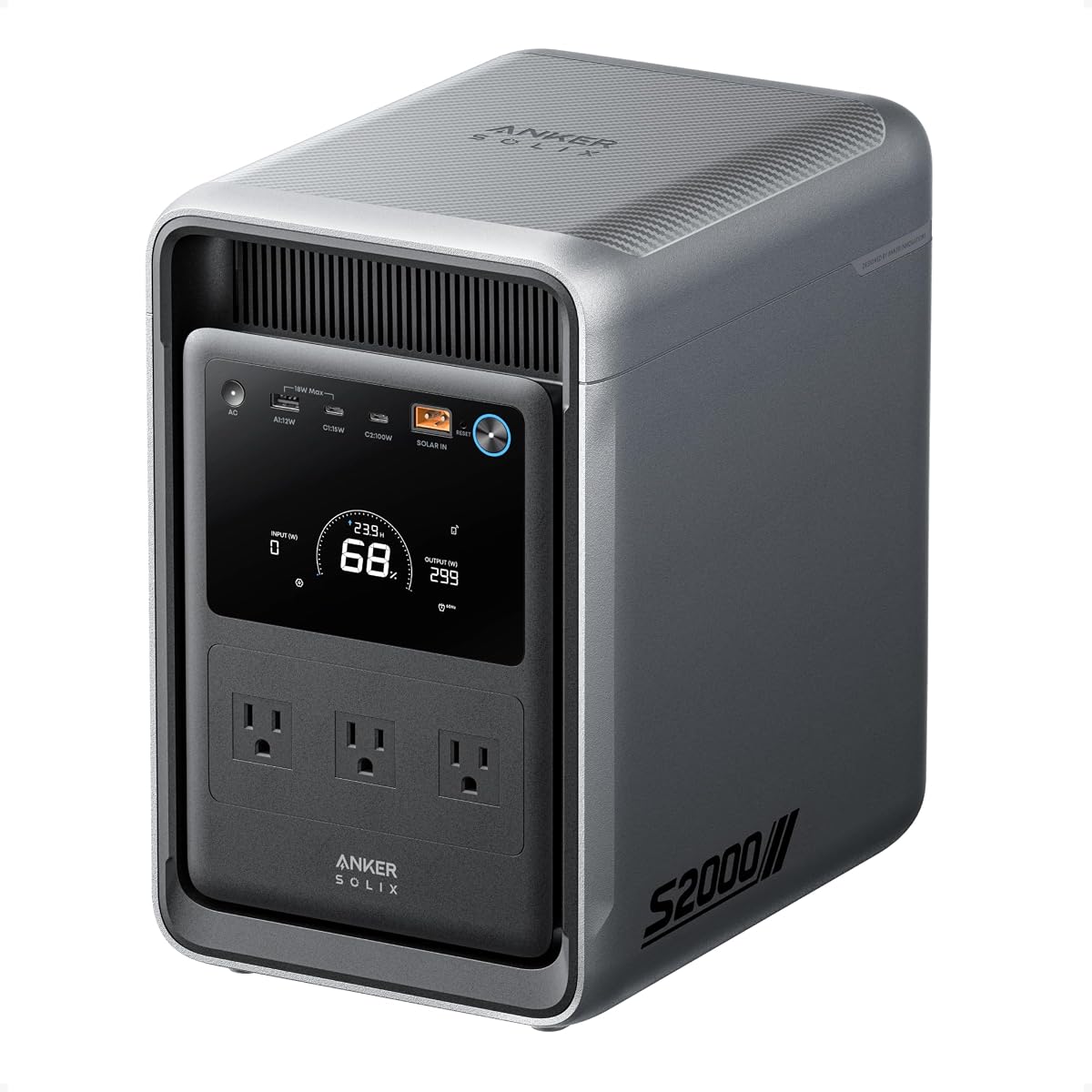
The Anker SOLIX S2000 provides 2,010Wh of storage with 1,500W continuous and 3,000W peak output. Its 4.7 rating and unusual combination of near-2kWh capacity, low idle draw, and a stated 35-pound weight make it a strong middle ground between portable camping stations and larger home backup systems.
We may earn a commission when you buy through this link, at no additional cost to you.
Efficiency is central to the design. A listed 6W idle power draw and 10% higher efficiency are intended to make the unit run longer than other 2kWh systems, with the stated example of keeping a refrigerator powered for 35 hours. Actual runtime naturally depends on the refrigerator, ambient temperature, and usage pattern. The 314Ah LFP battery is also rated for a 15-year lifespan equivalent to 10,000 charge cycles.
Its measured dimensions of 8.2 by 11.1 by 12.7 inches and 35.7-pound weight are lighter and smaller than the stated industry average, though it is still less travel-friendly than the 288Wh C300. The output rating is more modest than the C1000 Gen 2, so the S2000 prioritizes endurance over maximum inverter output. It also omits a dedicated 12V DC port, a detail worth checking against your equipment.
This station is a compelling choice for a home outage, RV, or off-grid setup where battery endurance matters more than extreme output. It can recharge through AC and solar, a wall outlet, generator, solar panels, an alternator charger, or a car outlet. Choose it when you want meaningful capacity in a relatively restrained package, especially for refrigerators, routers, lighting, and moderate electronics loads.
A 6W idle consumption rate can preserve stored energy during periods when only a few essential devices are operating. This makes the S2000 useful for extended refrigerator or networking support where raw inverter capacity is less important than efficient standby behavior.
Six listed charging methods allow users to shift between wall power, solar, a generator, an alternator charger, and a vehicle outlet. That flexibility is valuable for camping, travel, and storm preparation where access to a single charging method may change.
We may earn a commission when you buy through this link, at no additional cost to you.
The Anker SOLIX C300 is a compact 288Wh station rated for 300W continuous output and 600W surge power. Its 4.6 rating reflects a travel-focused design that supports laptops, phones, cameras, drones, and other electronics without approaching the size or weight of a home-class unit.
We may earn a commission when you buy through this link, at no additional cost to you.
Eight ports provide useful flexibility: three AC outlets sharing 300W total, a 120W car socket, two 140W USB-C ports, one 15W USB-C port, and one 12W USB-A port. It can reach 80% capacity in 50 minutes from a wall outlet and also accepts solar or vehicle charging. Two-way USB-C charging further helps when a compatible charger is the most convenient option.
The LiFePO4 battery is designed for 3,000 cycles and comes with a five-year warranty. A listed 15% size reduction, travel-focused form, and 25dB operation measured at 3.3 feet make it particularly suitable for tents, vehicles, and quiet campsites. The important limitation is power: 300W is enough for electronics and small essentials, not high-wattage appliances. A compatible strap is also sold separately.
Choose the C300 for travel, tailgating, photography, camping, or a compact emergency kit focused on phones, laptops, lights, and small devices. It offers more port variety and power than a basic power bank while remaining far easier to carry than the SOLIX F-series. Users who need to operate a refrigerator, power tools, or run a CPAP machine overnight should consider a larger 1kWh-class model instead.
The C300's 288Wh capacity and low-noise operation are tailored to travel use. It can support multiple everyday electronics while fitting more readily into a vehicle or camping setup than the larger C1000 and F-series systems.
Reaching 80% in 50 minutes from a wall outlet is useful for short camping trips or sudden outages. Solar and car recharging add alternatives when the station needs replenishing away from a conventional outlet.
We may earn a commission when you buy through this link, at no additional cost to you.
The Anker SOLIX F3000 combines a 3,072Wh starting capacity with 6,000W output, placing it firmly in the home-backup class. Its 4.5 rating reflects a capable system for users who need to run substantial loads, combine multiple recharging sources, and potentially expand storage to 24kWh.
We may earn a commission when you buy through this link, at no additional cost to you.
A major advantage is 3,600W pass-through charging, allowing the station to remain connected to a 120V generator while appliances operate without requiring the battery to cycle completely through charge and discharge stages. The unit supports 120V and 240V output, and two power stations can be paired for demanding 240V appliances. Ultra-low idle consumption is listed at 125 hours of AC standby or 42 hours with a 190W refrigerator.
Recharging is equally ambitious. The station accepts up to 2,400W from portable or rigid solar panels through 165V or 60V connections. Combining a fuel generator and solar can deliver a stated 6,000W recharging rate. A Bi-Directional Inlet Box and Smart Meter are needed for automatic storage of free solar energy or lower-cost off-peak electricity.
This model is best suited to households, workshops, or off-grid installations that need more than ordinary portable backup. It can maintain essential appliances for 10 hours from its starting capacity, with expansion extending the listed runtime to 80 hours. The trade-off is size, and some advanced energy-management features require separate accessories. Buyers should assess floor space, ventilation, and the electrical demands they realistically intend to support.
Generator pass-through helps preserve operation and reduce avoidable battery cycling. It is a practical feature when a generator can remain connected but a conventional backup setup would repeatedly move energy into and out of the battery.
High solar input and combined generator-and-solar charging shorten the time required to restore reserve energy. This is particularly useful when a storm arrives with the battery only partially charged.
We may earn a commission when you buy through this link, at no additional cost to you.
The Anker SOLIX F3800 starts with 3,840Wh and provides 6,000W of AC output, making it one of the most versatile systems in this roundup. Its 4.5 rating reflects extensive expansion options, dual-voltage support, EV charging, and integration with a compatible Smart Generator 5500.
We may earn a commission when you buy through this link, at no additional cost to you.
Up to six battery packs can raise total capacity to 26.9kWh. For extreme backup requirements, another F3800 and 12 battery packs can provide enough energy for up to two weeks under appropriate use. Two F3800 units can also be paired to reach 12,000W maximum AC output. This scalability makes the system more suitable for long disruptions than a conventional camping battery.
The 120V and 240V output can support demanding household appliances, including a dryer, while the NEMA 14-50 port can charge an EV at up to 6,000W. It can also supply an RV through NEMA 14-50 or L14-30 connections. A ten-year design life, EV-class LFP cells, temperature management, and impact resistance are intended to support frequent long-term use.
Choose the F3800 for a home, large RV, or fixed installation where outage resilience is the priority. App-based monitoring over Wi-Fi or Bluetooth lets users track power sources and configure operation. The main drawback is its physical scale: unlike the C-series products, it is not intended for casual backpack travel. Buyers should also verify generator, EV, RV, and battery compatibility before assembling a complete system.
The expansion path is a major advantage over fixed-capacity portable units. Buyers can begin with the base system and add compatible battery packs as their storage and resilience requirements become clearer.
NEMA 14-50 and L14-30 support extend the station beyond ordinary household outlets. EV charging and RV connection options are especially useful for owners seeking one system to support both property and mobile power needs.
We may earn a commission when you buy through this link, at no additional cost to you.
The Anker SOLIX C300 DC is designed around direct USB and vehicle charging rather than conventional AC outlets. It stores 288Wh and provides 300W of output through a 120W car socket, two 140W USB-C ports, one 100W USB-C port, one 15W USB-C port, and two 12W USB-A ports. Its 4.5 rating makes it an appealing specialist option for travel.
We may earn a commission when you buy through this link, at no additional cost to you.
The strongest feature is fast, flexible USB-C charging. Two ports support 140W two-way charging, and the dual PD 3.1 USB-C connection can reach 80% capacity in one hour. Solar and vehicle recharging are also supported, making it useful away from a wall outlet. The LiFePO4 battery, smart temperature control, and impact-resistant construction are designed for regular travel use.
Users must activate the station for the first time by connecting an 18W-or-higher USB-C wall charger, and only USB-C2 and USB-C3 can be used during that initial process. Because it lacks AC outlets, it is not a substitute for the standard C300 when a small appliance or conventional wall plug is required. That limitation also means the 300W rating is distributed across USB and automotive connections rather than an AC inverter.
Choose the C300 DC for frequent travel with laptops, phones, cameras, and other USB-C equipment. Its compact size, fast recharge, and dedicated high-wattage ports make it particularly useful for users who do not need to run household electronics. If you require an AC socket, choose the standard C300 instead. As with all smaller systems, users should estimate actual device draw before relying on it for an entire trip.
The pair of 140W USB-C ports gives modern laptops and other high-demand devices more useful charging options than a conventional power bank. Additional 100W, 15W, and USB-A connections cover a broad mix of smaller travel equipment.
An hour to 80% from compatible wall power is useful when the station is packed and ready to go. Solar and car recharging add flexibility for longer trips where access to mains electricity changes.
We may earn a commission when you buy through this link, at no additional cost to you.
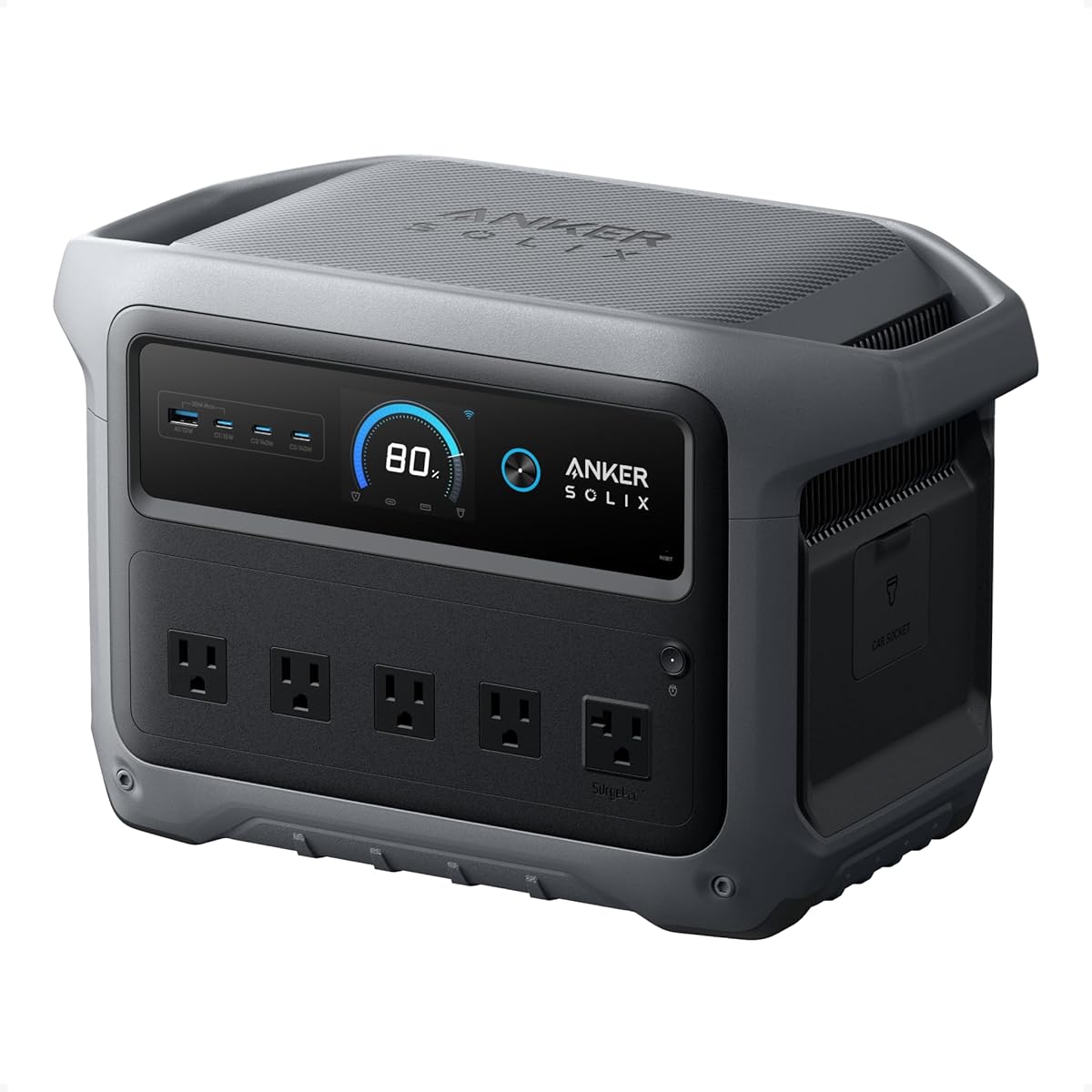
The Anker SOLIX C1000 provides 1,056Wh of capacity, up to 2,400W output through SurgePad technology, and 11 ports. Its 4.7 rating shows the appeal of an established midrange design that balances camping portability, home backup, and RV use without moving into the larger F-series footprint.
We may earn a commission when you buy through this link, at no additional cost to you.
Fast charging is a central benefit. With UltraFast enabled in the Anker app, the station reaches 80% in 43 minutes and fully charges in under an hour, subject to the stated 68–122°F operating range. Solar input supports up to 600W and a full recharge in 1.8 hours. The app also allows users to customize charging speeds and review real-time power statistics.
The LiFePO4 battery is rated for 3,000 cycles across a ten-year lifespan. Eleven ports support numerous devices at once, while the unit is listed as 15% smaller than comparable 1kWh models. Compared with the newer C1000 Gen 2, this model offers very similar capacity and solar performance but differs in output and charging architecture, so buyers should compare the exact specifications rather than assuming identical behavior.
Choose the C1000 for a balanced mix of RV travel, outdoor use, and essential home backup. The included car charging cable improves its usefulness on the road, and the generous port count reduces the need for adapters. Its main limitation is that UltraFast operation requires app activation, while the newer Gen 2 offers 2,000W continuous output, ten ports, and a stated 1,600W full-recharge input. Those distinctions may influence a purchase.
A stated 43-minute charge to 80% is excellent for short-notice preparation. The requirement to enable UltraFast through the app adds a step, but it also gives users control over when the fastest input mode is used.
A capacity just above 1kWh offers more endurance than a compact camping station without reaching the scale of a 3.84kWh home system. Eleven ports and 2,400W SurgePad output make it adaptable to RV travel, outdoor projects, and essential electronics during outages.
We may earn a commission when you buy through this link, at no additional cost to you.
The Anker SOLIX F3800 Plus is a premium home-energy system with 3,840Wh of starting capacity, 6,000W output, dual 120V and 240V support, and substantial expansion potential. Its 4.3 rating is still strong, although the score trails several lighter and more compact models in this comparison.
We may earn a commission when you buy through this link, at no additional cost to you.
Its clearest premium feature is charging speed. The station accepts up to 3,200W from solar and can reach an outage-ready state in 63 minutes by combining solar and a generator. A 240V generator can feed it through a 6,000W bypass. Additional recharge routes include a home power panel and a conventional AC outlet, giving installers flexibility in how the system is prepared.
The battery can be expanded with up to six compatible packs to reach 26.9kWh. Two F3800 Plus systems can provide up to 12,000W of AC output, while a second unit and additional batteries can support much longer outages. EV-grade LFP cells, smart temperature management, impact resistance, and a stated ten-year design life support the premium positioning.
Choose the F3800 Plus for a well-prepared home, large mobile system, or serious off-grid installation where replenishing energy quickly is a priority. The station is capable enough for demanding household appliances and sustained backup. Its size and complexity are substantial, and the 4.3 rating suggests some buyers may prioritize simplicity or portability over maximum charging performance. Compare those needs carefully before committing.
The 3,200W solar input is the standout specification in this list. For owners with a suitable array, that headroom can restore substantial energy much faster than systems limited to lower solar wattage.
A 6,000W bypass lets the station operate alongside a compatible 240V generator. The stated 63-minute solar-and-generator recovery adds a practical route to rebuilding reserve power during a prolonged utility interruption.
We may earn a commission when you buy through this link, at no additional cost to you.
The Anker SOLIX F2600 combines 2,560Wh of storage with 2,400W continuous output, making it one of the most balanced high-capacity options here. Its 4.4 rating reflects solid construction, rapid recharge options, and enough power for a broad collection of household and camping equipment.
We may earn a commission when you buy through this link, at no additional cost to you.
Its InfiniPower design is intended to support a decade of daily use, using LiFePO4 batteries, industrial-grade components, smart temperature control, and an impact-resistant enclosure. The 2,400W output and 3,600W surge protection give it more headroom than many portable stations, allowing it to support several appliances at once under the right load conditions.
Charging flexibility includes AC, solar, and car options. The listed HyperFlash route reaches 80% in one hour and 40 minutes, while a 600W solar panel can reach 80% in two hours. The Anker app supports Bluetooth and Wi-Fi, low-battery alerts, discharge-limit customization, and recharging-speed controls. That combination of monitoring and configuration is useful for long-term planning.
Choose the F2600 for users who need more than a camping battery but do not require 120V and 240V home output. It is well suited to RVs, tailgating, remote work, and outages involving moderate appliances. The main trade-off is portability: 2,560Wh is substantial to carry, and its solar input is below the F3000 and F3800 Plus. Buyers should balance that mass against the added runtime and continuous power.
Many midrange systems offer either meaningful runtime or high inverter output. The F2600 provides both, giving users a more useful balance for mixed loads that include several electronics and moderate household appliances.
Discharge limits, low-battery alerts, and adjustable charging speed make it easier to preserve capacity during an outage. These controls are particularly useful for users who need predictable reserve power rather than simply maximum output.
We may earn a commission when you buy through this link, at no additional cost to you.
The Anker SOLIX F1500 offers 1,536Wh of capacity, 1,800W output, and connections for as many as 13 devices. Its 4.3 rating reflects a practical home-backup design centered on abundant outlets, durable LFP construction, and fast solar recharging rather than the highest inverter output in the range.
We may earn a commission when you buy through this link, at no additional cost to you.
Six AC outlets, four USB-A ports, and a car outlet create an unusually broad connection panel. That arrangement is useful in a home outage because routers, lights, televisions, phones, and other everyday devices can remain connected without requiring a large collection of adapters. A five-year full-device warranty adds a clear ownership benefit for stationary backup use.
The battery is designed for a ten-year lifespan. With HyperFlash technology and a 600W solar panel, the station can recharge to 80% in 1.4 hours, combining renewable input with rapid recovery. The package includes AC, car, and solar charging cables, along with the user manual, which helps users connect common power sources immediately.
Choose the F1500 for households that want more outlets and capacity than a compact camping unit but do not need 6,000W output. It is particularly attractive for a family gathering, home office, or moderate outage involving numerous low- to medium-wattage devices. Its limitations are the lower 4.3 rating and less output than newer 1kWh models. For heavier appliances or longer outages, consider the C1000 Gen 2, S2000, or F2600.
Thirteen connections allow a household to keep several device categories online at once. Six AC outlets are especially useful because many essential backup items use standard wall plugs rather than USB cables.
A listed 80% recharge in 1.4 hours with a 600W solar panel makes the F1500 practical for daytime resilience. It offers a practical balance between usable capacity and recovery speed without reaching the size of a full home-energy system.
We may earn a commission when you buy through this link, at no additional cost to you.
Choosing an Anker power station means matching stored energy to expected runtime, inverter output to equipment demand, and physical design to where it will be used. The most useful purchase is not necessarily the model with the largest numbers, but the one that satisfies your loads without unnecessary bulk.
Capacity is measured in watt-hours and indicates the total energy available for devices. The C300 models offer 288Wh for travel electronics, while the C1000 and F1500 provide roughly 1kWh, the S2000 and F2600 provide around 2kWh, and the F3000 and F3800 families begin at more than 3kWh. Runtime is not the capacity number alone because inverter efficiency, device draw, temperature, battery age, and conversion losses all affect results.
Choose capacity according to the duration and number of loads you expect. A 288Wh unit can be useful for a day trip, but a 1kWh to 1.5kWh model provides much more room for phones, laptops, lights, and networking equipment. Multi-day outages or appliance support generally call for a 2kWh or larger system, especially one that accepts expansion batteries.
Continuous output is the level the inverter can sustain, while surge output is a brief allowance for startup loads. The C300 is rated at 300W continuous and 600W surge, the C1000 Gen 2 at 2,000W and 3,000W, and several F-series models at 6,000W continuous. Surge figures should not be mistaken for the amount of power available indefinitely.
List the wattage of every device you expect to operate, then include motor startup or heating demands. Select continuous output with comfortable headroom above the normal running load. If a high-wattage appliance may start while other devices are active, verify both surge capacity and whether the battery's remaining charge is sufficient for that brief demand.
A power station is useful only when it can be refilled for the next demand. The C1000 Gen 2 supports a listed 1,600W full recharge, the C1000 reaches 80% in 43 minutes with UltraFast enabled, and the F3800 Plus accepts up to 3,200W of solar input. Wall, vehicle, solar, generator, and alternator charging options add resilience when primary power is unavailable.
Prioritize the recharge routes relevant to your normal routine. Travelers may need fast USB-C or car charging, while homeowners may value wall, solar, and generator inputs. Check whether rapid modes require app activation and observe listed operating-temperature conditions. Fast charging is valuable, but compatibility and access to a suitable input often matter more over time.
AC outlets, USB-A, USB-C, and 12-volt vehicle sockets serve different categories of equipment. The C1000 Gen 2 has 10 ports, the standard C300 has eight, the C1000 has 11, and the F1500 can support 13 devices. The C300 DC is the notable specialist, concentrating on USB-C and vehicle connections rather than offering conventional AC outlets.
Match the connector mix to the devices you already own. USB-C power delivery is especially useful for modern laptops, but the negotiated charging rate varies by device and cable. Check whether an adapter is included for your car socket, whether a strap is included, and whether any required charging cable or accessory appears in the box.
Solar charging can extend independence from the grid, but only when the panel, cable, voltage, and power station are compatible. The C300 and C300 DC recommend 100W or 60W Anker Solar Panels and are not compatible with PS30, PS200, or PS400 models. Other stations accept higher input, including 600W on the C1000 models and as much as 3,200W on the F3800 Plus.
Confirm the supported solar range and connector type before buying panels. Higher maximum input does not guarantee that every available panel will operate at full speed; mismatched voltage or protocol can prevent charging entirely. For a camping setup, balance panel size, available sunlight, station weight, and realistic daily energy production rather than focusing only on the headline wattage.
A portable power station can act as an uninterruptible power supply for compatible electronics, but response speed and supported equipment matter. The C1000 Gen 2 lists under-10ms switchover, and the S2000 also advertises less-than-10ms switching. These features are meaningful for computers, networking equipment, and certain medical devices that may react poorly to an abrupt outage.
Test a UPS setup before relying on it during an emergency. Keep the station sufficiently charged, confirm the device and power adapter are compatible, and test normal grid failure rather than waiting for a real outage. Even a fast switchover does not guarantee that every appliance, startup surge, or complex power requirement will be supported.
Expansion can extend runtime without replacing the main unit. The F3800 and F3800 Plus can reach 26.9kWh with up to six compatible battery packs, while the F3000 supports expansion to 24kWh. Dual-voltage output, generator bypass, and the ability to pair stations can support more demanding residential applications, but the setup becomes considerably larger and more involved.
Confirm compatibility among the station, expansion batteries, generator, solar equipment, and connection cables before building a system. Consider available space, ventilation, noise, installation requirements, and access to charging sources. Expansion is most valuable when a long outage is a realistic concern rather than a temporary inconvenience.
Capacity directly affects portability. The 288Wh C300 models are intended for spontaneous travel, the C1000 and F1500 are more manageable for RV and home use, and the F3000 and F3800 families are better suited to stationary deployment. Several models use LiFePO4 batteries, smart temperature controls, and impact-resistant construction, while stated lifespans range from three years or 3,000 cycles to ten years or 10,000 cycles.
Weigh the station against the frequency and location of use. A larger battery can be inconvenient even when its specifications are attractive. Review the stated warranty, operating-temperature requirements, included accessories, and any separate strap or app requirements. Long-term ownership is often better served by a model you can actually use regularly than the largest unit you rarely transport.
Before first use, read the included guide and charge the station with the correct input. The C300 DC requires an 18W-or-higher USB-C wall charger for initial activation, and only USB-C2 and USB-C3 can be used for that step. Other models may require UltraFast or HyperFlash functions to be enabled in the Anker app. Check the displayed battery level and confirm that each intended port works before traveling or relying on the unit for an outage.
Plan charging around the expected load rather than waiting for a complete discharge. Keep the battery topped up when extended grid power is available, especially before storms, camping trips, or periods when the station may need to operate without recharging. Use compatible solar panels, vehicle connections, generators, or wall inputs, and observe the listed voltage, wattage, and temperature requirements for the chosen method.
For backup use, connect essential devices directly to the power station, begin with the most critical loads, and monitor remaining capacity in the app. UPS-compatible equipment can benefit from sub-10ms switching on applicable models, but users should test the arrangement in advance. Store the unit in a dry, temperature-appropriate place, keep ventilation clear, use the correct cables, and follow the manual's guidance for long-term storage and battery care.
For light camping and travel electronics, the C300 or C300 DC is generally the most portable choice. The standard C300 adds three AC outlets, while the C300 DC emphasizes high-wattage USB-C charging and vehicle connections. Campers who need to run more equipment, stay longer away from a vehicle outlet, or use solar should consider the C1000, F1500, or F2600 instead.
Both provide 288Wh of capacity and 300W of output, but their port designs serve different needs. The standard C300 includes three AC outlets, two 140W USB-C ports, a 15W USB-C port, a USB-A port, and a car socket. The C300 DC removes the AC outlets and emphasizes USB-C and vehicle charging, including a 100W USB-C port, for users focused on modern portable electronics.
Many models can run a refrigerator, but runtime depends on the station's capacity and the appliance's actual consumption. The S2000 lists up to 35 hours with a refrigerator under specified conditions, while the F3000 lists 42 hours with a 190W refrigerator. Actual results vary with refrigerator model, ambient temperature, duty cycle, and the remaining battery charge.
The F3800 includes a NEMA 14-50 connection and lists EV charging at up to 6,000W. Smaller units with 12-volt car sockets can support accessories, but that outlet should not be confused with a full vehicle-charging connection. Verify the vehicle, cable, connector, station output, and charging protocol before attempting to charge a car.
Models such as the C1000 Gen 2 advertise under-10ms UPS switchover, which can help maintain operation for compatible sensitive equipment. A UPS function does not guarantee that every appliance will tolerate the transition or that the battery can handle a large startup surge. Test the exact device, adapter, and load before relying on the function during an outage.
No. Solar compatibility depends on voltage, connector type, and the station's maximum solar input. The C300 and C300 DC specifically do not support the PS30, PS200, or PS400 models, while other SOLIX systems accept higher solar wattages. Check the product's supported panel list and use only compatible equipment with the correct cable.
The stated figures vary by model and use. The C300 is designed around 3,000 LiFePO4 cycles, the C1000 Gen 2 retains at least 80% capacity after 4,000 cycles, and the S2000 lists 10,000 cycles. Actual service life varies with temperature, depth of discharge, charging habits, maintenance, and the calendar age of the battery.
Modern charging systems are designed to manage charging states, but operating practices can still affect battery health. For occasional backup use, keeping the battery maintained at a sensible level and disconnecting it when it is not needed may be preferable to leaving it continuously connected. Follow the specific manual's storage and charging guidance, especially when temperatures are extreme.
The Anker SOLIX C1000 Gen 2 is the strongest all-around choice for buyers who value fast recharging, a 1,024Wh capacity, ten ports, 2,000W output, and rapid UPS response. The C300 stands out as the most practical compact option for electronics-heavy trips, while the F3800 Plus represents the premium choice for users who want major solar input, 6,000W output, and extensive home expansion.
Prioritize the constraints of your use case rather than selecting solely by capacity. Light travelers should prioritize size and weight, RV users should inspect output, connector types, and vehicle charging, while households preparing for extended outages should examine expansion, generator integration, and dual-voltage support. A smaller model with the right ports may serve you better than an oversized station with features you will never use.
Before purchasing, verify the latest specifications, included accessories, compatibility requirements, warranty, and current product details. Pricing, promotions, and availability can change, and the best value depends on the balance between capacity, output, charging speed, and portability for your particular needs.