
Solar WiFi Extender Outdoor GULZIIYA
4.6Editor score
26,000mAh battery
360-degree antenna coverage
300-foot stated range
Adjustable mounting bracket
Explore the best Solar WiFi Extenders, comparing coverage, radio bands, solar charging, batteries, weather resistance, setup, and device compatibility.
Solar WiFi extenders bring dependable wireless coverage to gardens, farms, campsites, garages, and other outdoor spaces where running power cables or Ethernet lines is inconvenient. A strong unit should combine useful range, efficient solar charging, adequate battery reserve, resilient outdoor construction, and straightforward setup with your existing router.
We compared all 10 options by examining their stated antenna configurations, supported WiFi bands, maximum coverage claims, solar-panel output, battery capacity, ingress protection, installation features, and compatibility with common routers and wireless devices. The list includes 2.4GHz-only repeaters as well as a dual-band model for buyers who need more flexibility.
Each review explains the product's strongest use case and practical limitations without treating maximum range as guaranteed real-world performance. Our three leading picks are the E8 for long-range 2.4GHz coverage, the GULZIIYA for flexible 360-degree placement, and the E9 for premium dual-band performance. Prices and configurations can change, so verify current listing details before buying.
4.6Editor score
4.5Editor score

The table below compares the 10 solar-powered extenders by radio support, stated coverage, solar power, battery reserve, and outdoor protection, making their main differences easier to assess before purchasing.


The E8 is a purpose-built outdoor repeater for yards, farms, garages, campsites, and other locations where a conventional indoor range extender cannot reach. It combines four high-gain 5dBi antennas with 2.4GHz operation, while its IP66 enclosure is designed to withstand rain, dust, sun, and heat. Its most distinctive feature is the claimed coverage radius of up to 120 meters, which makes it a leading option for buyers with substantial outdoor dead zones.
We may earn a commission when you buy through this link, at no additional cost to you.
Power is supplied by a 15W solar panel and a 27,000mAh internal battery. That arrangement removes the need for outdoor wiring and provides stored energy for nighttime operation or periods when sunlight is limited. The product information says the battery can sustain the unit through cloudy or rainy stretches. Actual runtime will depend on sunlight exposure, temperature, signal quality, traffic, and the amount of energy the panel replenishes.
The E8 supports speeds of up to 300Mbps on the 2.4GHz band and is intended for security cameras, smart garden equipment, outdoor audio, and other 2.4GHz clients. That makes it sensible for low-bandwidth sensors and basic camera traffic, but it is not the right choice when modern phones or computers need a fast 5GHz link. The 120-meter figure is also a maximum claim rather than a guarantee, since walls, foliage, buildings, terrain, and antenna placement can reduce usable range.
This is our leading choice for buyers who prioritize antenna strength, substantial battery capacity, and broad outdoor reach. It works with most mainstream routers, and the listing also identifies Starlink compatibility. Setup is performed through a web interface after connecting a phone or computer to the extender's wireless network. Choose the E8 when a large property and dependable 2.4GHz coverage matter more than dual-band flexibility.
The E8 is a strong all-around outdoor repeater because it balances range, solar independence, and rugged construction. Its four antennas and large battery distinguish it from smaller two-antenna alternatives, while the simple setup keeps it approachable. Install it where the existing router signal is already adequate, and place the solar panel in the clearest available sunlight to get the most consistent results.
The four high-gain antennas are the E8's clearest advantage when the router sits inside a building and the goal is to carry a usable signal into a yard, barn, or distant corner of a property. Positioning remains important: the extender should receive a reasonably strong WiFi signal before it rebroadcasts it farther.
A 15W panel and 27,000mAh battery reduce dependence on grid power and permit installation away from outlets. The panel should face open sky, while partial shade, heavy rain, and seasonal sunlight changes can affect how quickly the battery recharges.
We may earn a commission when you buy through this link, at no additional cost to you.
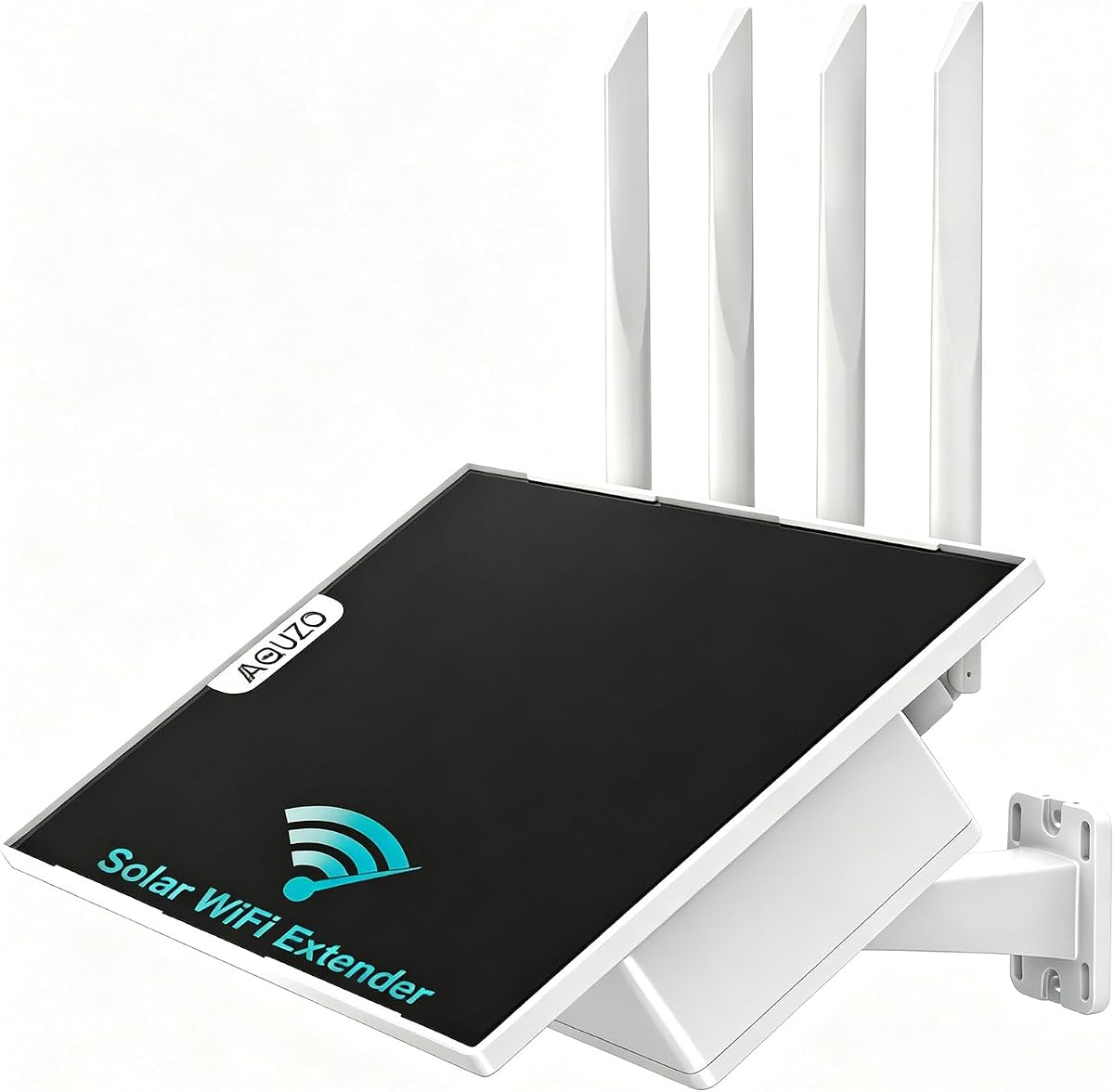
The GULZIIYA is a practical solar repeater for shoppers who want dependable outdoor coverage without paying for the E8's four-antenna or dual-band configurations. It includes two high-gain external antennas, a 360-degree adjustable mounting bracket, a 15W solar panel, and a 26,000mAh rechargeable battery. Its stated operating range extends to 300 feet, with coverage designed to spread in a wider 360-degree pattern.
We may earn a commission when you buy through this link, at no additional cost to you.
The product supports standard 802.11b/g/n/a/ac 2.4GHz routers and can be configured through a browser interface that is accessible from Windows, Android, and iOS devices. It is also described as compatible with WiFi cameras, smartphones, tablets, laptops, smart televisions, and other wireless clients. That broad device support makes it useful for connecting a camera near a barn, extending a smart-home connection into a garden, or covering a detached garage.
Its IP65 weatherproofing and stated temperature tolerance of -30°C to 70°C suit exposed outdoor installations, although the mounting location should still minimize direct impact and water accumulation. The bracket is particularly useful because changing the direction or angle of the external antennas can improve the link between the home router and extender. As with every repeater, buildings, walls, trees, metal structures, and uneven terrain can sharply reduce the actual range.
The GULZIIYA is best for budget-conscious buyers who need a dependable 2.4GHz solution and value flexible positioning. It may not be ideal for a modern 5GHz-heavy network, and its two-antenna arrangement is less ambitious than the E8's four-antenna setup. Even so, the stated range, large battery, universal-router positioning, and adjustable bracket make it a strong general-purpose choice for farms, gardens, courtyards, and garages.
Our best budget recommendation combines the essentials of a solar outdoor extender without an overly complex feature list. It offers a useful balance of capacity, weather resistance, broad compatibility, and simple installation. For most outdoor sensors and cameras operating on 2.4GHz, it should provide a more convenient solution than extending Ethernet or installing a conventional powered repeater.
The 360-degree adjustable bracket and two external antennas make it easier to optimize reception and retransmission. A brief period of testing different orientations can produce a more useful result than relying on a single default placement.
The 26,000mAh battery is large enough to support operation away from an outlet, while continuous solar charging is designed to replenish it during daylight. Install the panel in a location where trees, fences, or buildings do not cast long shadows.
We may earn a commission when you buy through this link, at no additional cost to you.
This solar-powered outdoor WiFi booster is designed for backyards, estates, farms, RV campsites, detached buildings, and other open areas where a router signal needs to be rebroadcast. It uses dual high-gain external antennas with MIMO, supports 2.4GHz networks, and lists a maximum speed of 300Mbps. Its open-air coverage claim extends approximately 200 to 300 feet, depending on obstructions and placement.
We may earn a commission when you buy through this link, at no additional cost to you.
The primary 12W panel is smaller than the 15W panels used by several competing products, but the two USB-C solar inputs provide a useful upgrade path. Owners can add a second panel when the installation has limited direct sunlight or needs faster charging. The 27,000mAh rechargeable battery is stated to run for up to seven days during cloudy or rainy weather when power management is working as intended.
The enclosure carries an IP66 rating for dust and water resistance, with an operating range of -20°C to 60°C. It supports standard 2.4GHz routers and 802.11b/g/n networks, and the product listing also mentions Starlink router compatibility. Setup requires connecting the unit to an existing 2.4GHz router through its web interface, with installation recommended where the router already shows a usable signal of about three bars.
Its main trade-off is a less compelling customer-feedback profile than the leading products in the list. The lower 12W panel may also recharge more slowly than higher-output designs, making the optional second panel more significant for shaded or cloudy locations. Nevertheless, the large battery, dual charging inputs, and MIMO antenna configuration are practical advantages for buyers who want to expand the installation later.
This model is a good fit for outdoor users who prioritize renewable power and the ability to add another panel. It is particularly relevant for off-grid structures where wiring is difficult and the primary objective is connecting 2.4GHz cameras, speakers, plugs, or lawn equipment. For buyers who need 5GHz support or greater stated range, a dual-band or four-antenna model is the more logical choice.
The two USB-C solar inputs distinguish this repeater from models limited to one panel connection. A second panel can be positioned separately in a sunnier area, making it easier to balance charging needs with an unobtrusive extender position.
The repeater can only rebroadcast a signal it receives well. Installing it near a wall, fence, or outdoor edge where the home router already provides about three bars will usually produce a better outdoor result than placing it in the farthest dead zone.
We may earn a commission when you buy through this link, at no additional cost to you.
The 500ft Solar Outdoor Repeater is intended to push a conventional 2.4GHz home network across a large outdoor area without requiring a nearby outlet. It combines a 15W solar panel, a 25,000mAh battery, an IP66 enclosure, and a stated maximum coverage of 500 feet. It also includes a LAN port, giving users a wired output option for a compatible device in addition to wireless repetition.
We may earn a commission when you buy through this link, at no additional cost to you.
The product listing says the battery can maintain operation for approximately seven days in rainy conditions, with the solar system intended to support continuous year-round charging. Wireless performance is listed at up to 300Mbps on 2.4GHz, which remains sufficient for many surveillance cameras, smart devices, and general browsing tasks. The device is compatible with 2.4GHz routers, and setup is presented as a straightforward outdoor installation.
The headline 500-foot range should be treated as a maximum rather than an expected result in every environment. A wall between the router and extender, nearby metal objects, trees, terrain, and competing wireless networks can reduce both the incoming link and the extended coverage. The LAN port can be valuable for a stationary computer or network device, but it does not transform the product into a full outdoor router with multiple wired ports.
The 500-foot claim and included LAN port distinguish this model from simpler solar repeaters, yet its customer-feedback history is less established than that of the top-ranked products. The 25,000mAh battery is also slightly smaller than the 26,000mAh and 27,000mAh batteries offered by several alternatives. These factors make it more of a specification-focused choice than a universally compelling recommendation.
Buy this repeater if the advertised 500-foot reach and wired LAN output match a specific outdoor installation, especially where a network cable can connect directly to one endpoint. For most general users, the E8's four antennas or the E9's dual-band support offer more flexibility. In either case, confirm that your router and intended clients use compatible 2.4GHz networks.
The LAN port provides a bridge between wireless range extension and a wired endpoint. It can be useful for a stationary outdoor computer, camera, or network appliance, although it is not a substitute for a multi-port outdoor switch.
A 15W charging panel and 25,000mAh battery provide a practical off-grid power combination. The stated seven-day cloudy-weather runtime depends on the initial battery level and the amount of repeater activity, so conservative placement remains important.
We may earn a commission when you buy through this link, at no additional cost to you.
The 300Mbps Solar WiFi Booster is built for farms, ranches, RV parks, yards, and outdoor camera installations that need a 2.4GHz signal beyond the reach of the primary router. It uses dual high-gain external antennas, provides up to 300Mbps, and advertises a maximum open-air reach of 492 feet. More realistically, the product description identifies 280 to 300 feet as its recommended stable working range.
We may earn a commission when you buy through this link, at no additional cost to you.
Its most valuable feature is relay mode, which allows multiple units to be daisy-chained when a property is too large for one repeater. The listing also states support for up to seven connected devices, a useful limit for lightweight sensors and selected cameras rather than a busy household network. A 15W panel with tempered-glass protection and a rechargeable 20,000mAh lithium battery provide the power system.
The battery is smaller than the 20,000mAh to 27,000mAh capacities found elsewhere in this guide, and it has a 20,000mAh capacity despite the model name referring to speed. IP65 protection is designed for rain, snow, wind, dust, UV exposure, and temperature changes. The 360-degree mounting bracket allows fine adjustment of the antenna position, which can be helpful in properties containing several buildings or obstructions.
This unit supports most 2.4GHz routers, Starlink routers, and common outdoor smart devices. Its 2.4GHz-only operation and seven-device limit are the main constraints. It will not provide a 5GHz connection, and a camera that consumes a high bandwidth stream may need more robust infrastructure than a repeater designed for basic outdoor coverage can offer.
This is an especially attractive option for buyers planning a multi-unit outdoor mesh-like arrangement. Relay mode makes it possible to extend coverage in stages instead of relying on one unit to span an entire property. Choose it for farms, RV parks, or large yards with several 2.4GHz devices; choose the E9 instead when 5GHz speed and higher-capacity antennas are priorities.
Relay mode allows a second unit to communicate through the first, extending the network farther across a long property. Each additional repeater depends on a good link to the preceding unit, so intermediate positions should be selected carefully.
The stated seven-device capacity suits a small collection of cameras, sensors, speakers, or smart controls. It should not be interpreted as equivalent to a full household router with capacity for dozens of active clients.
We may earn a commission when you buy through this link, at no additional cost to you.
The E9 is the most feature-rich product in this guide, combining dual-band WiFi with four 8dBi external antennas, two 15W solar panels, and a 36,000mAh battery. It operates on both 2.4GHz and 5.8GHz and lists a maximum speed of 1200Mbps, offering a meaningful step up for buyers who need more than a basic 2.4GHz outdoor repeater.
We may earn a commission when you buy through this link, at no additional cost to you.
Its antenna configuration is designed for a stated 150-meter radius, while the dual panels use separate charging paths to improve energy collection. One panel includes a two-meter cable, allowing it to be placed in a sunnier position than the main enclosure. The battery reportedly charges in approximately five hours under strong sunlight and can provide five to six days of operation on cloudy days.
The E9 has an IP66 enclosure for exposure to rain, snow, wind, and changing temperatures. Setup is described as taking about 15 minutes, with no outlet or power wiring required. For larger properties, the high-gain antennas and dual-band support make it the most flexible choice for outdoor phones, computers, cameras, and other connected equipment.
The main limitation is that the product has no published customer rating, so its real-world consistency is less visible than that of the well-reviewed products around it. Its 5.8GHz band is also lower than the 5GHz band used by many modern routers, which may affect compatibility or require careful configuration. Buyers should confirm that the E9 supports the bands and wireless standards used by their existing equipment.
The E9 is our premium recommendation for users who want a more capable outdoor link, have a large property, or need both 2.4GHz and higher-frequency wireless support. The four 8dBi antennas, dual solar panels, and large battery justify considering it over simpler repeaters. It is especially suitable for installations where reliable access to modern devices matters more than minimizing the feature set.
The two 15W panels can be positioned separately, which helps when the ideal antenna location is shaded but another nearby area receives stronger sunlight. Separate charging paths are designed to make the most of available light throughout the day.
Operating on both 2.4GHz and 5.8GHz allows compatible clients to use the less crowded higher-frequency band when appropriate. Because band support varies among routers and clients, checking the E9's manual and your network configuration before installation is advisable.
We may earn a commission when you buy through this link, at no additional cost to you.
The LCLCTEK is a 17-inch solar WiFi extender designed to push a 2.4GHz network into gardens, garages, bedrooms, bathrooms, and other areas that may suffer from weak reception. Its two external high-gain antennas provide 360-degree coverage across an area stated at up to 30,000 square meters, while the listing presents a long-range capability of approximately 300 feet.
We may earn a commission when you buy through this link, at no additional cost to you.
Its 26,000mAh rechargeable battery and solar panel remove the need for a nearby outlet, and the IP66 housing is rated for harsh outdoor climates. The stated temperature range extends from -30°C to 70°C, making it suitable for many farms, detached buildings, and exposed installations. The product listing also describes a built-in battery that supports continuous day-and-night use with solar replenishment.
Compatibility is a strong point. The repeater supports 802.11b/g/n/a/ac 2.4GHz routers and can be configured through a browser address using Windows, Android, or iOS platforms. It is intended to work with standard gateways and a broad collection of phones, computers, tablets, cameras, and other WiFi clients. The brand also advertises a return-or-replacement quality guarantee and ongoing technical support.
The device remains limited to 2.4GHz, so it cannot improve access to a 5GHz-only network. Its area and distance claims are also difficult to guarantee because obstacles, radio interference, antenna orientation, and the incoming router signal determine real performance. The advertised 300-foot range should therefore be treated as an open-area estimate rather than a promise for every property.
The LCLCTEK works well for buyers who want broad platform compatibility and a proven support structure. Its two-antenna arrangement and 26,000mAh battery make it closely aligned with the GULZIIYA, but the larger dimensional format and detailed support commitments may appeal to installers working with demanding outdoor networks. It is a solid choice for 2.4GHz cameras and smart devices that need a more distant connection point.
Browser access through the listed local address makes configuration possible from major desktop and mobile platforms. Keeping the process local can also be convenient for owners who are comfortable adjusting basic wireless settings without a dedicated network application.
The 360-degree antenna arrangement and large stated coverage area are useful across open yards, agricultural spaces, and detached buildings. Dense landscaping, multiple walls, and metal equipment will reduce the effective signal more than open-air estimates suggest.
We may earn a commission when you buy through this link, at no additional cost to you.
The 500-Foot Solar Signal Booster is aimed at users who want to extend a home network across large gardens, farms, ranches, rural properties, and vacation properties. It uses a 15W high-efficiency solar panel, a 26,000mAh rechargeable battery, and an adjustable external antenna. Its listed maximum coverage is 500 feet, or approximately 150 meters.
We may earn a commission when you buy through this link, at no additional cost to you.
The product is designed for more intensive 2.4GHz use, including outdoor security cameras, streaming, and gaming. Its battery allows the repeater to continue operating when sunlight is unavailable, while the solar panel replenishes the charge during the day. The stated 2.4GHz support makes it broadly relevant to older routers, cameras, and smart-home equipment that still use the 2.4GHz band.
An IP66 enclosure provides dust and water protection for long-term outdoor placement, and the 360-degree bracket lets installers optimize antenna direction. A strong outdoor signal still requires the unit to receive a good signal from the router. If the router is deep inside a home or behind several masonry walls, even the stated maximum distance may not be attainable without an intermediate repeater.
Its customer feedback is less developed than that of the better-reviewed products, and the 500-foot figure is especially dependent on a clear signal path. The product offers fewer documented details about wired outputs, relay functions, and exact antenna gain than the strongest alternatives. That narrower documentation makes it a less confident recommendation for complex installations.
This booster makes sense for a simple outdoor extension where the goal is to improve camera or smart-device reception over a large area. Users should prioritize an unobstructed mounting point and clear solar exposure. For installations needing 5GHz, multiple wired ports, or a more sophisticated relay network, the E9 or the 300Mbps Solar WiFi Booster would be better documented options.
The 500-foot specification is most achievable across open ground with the extender placed where it can receive a strong router signal. Obstacles such as barns, trees, fences, and terrain can shorten that distance substantially.
The IP65 shell is suited to rain, snow, dust, and intense sun, while the battery removes the need for a power cable. Mounting hardware should still be secure enough to withstand wind and prevent the panel or antennas from shifting.
We may earn a commission when you buy through this link, at no additional cost to you.
This solar WiFi extender is designed to strengthen an existing network in gardens, farms, ranches, and remote areas where power and strong wireless reception are limited. It combines a 15W high-efficiency solar panel with a 26,000mAh rechargeable battery, allowing cable-free deployment. The product operates on the 2.4GHz band and is intended for wireless cameras, phones, smart televisions, laptops, tablets, and other connected devices.
We may earn a commission when you buy through this link, at no additional cost to you.
One of its clearest target applications is outdoor camera connectivity. A camera placed beyond the effective range of the home router can often be served more reliably by a repeater positioned closer to the building and oriented toward the camera. The product listing describes stable, high-speed internet as a goal, though the actual experience will depend on the source router, traffic volume, and environmental obstructions.
The IP65 enclosure is intended for farms, ranches, and other demanding outdoor environments, while the battery reportedly operates day and night and continues to run during cloudy weather or at night. Setup is described as a simple pairing procedure with the home router after mounting the unit in a sunny location. A straightforward installation process is useful for customers who do not want to configure a complex enterprise network.
Detailed information about antenna gain, exact range, wired connectivity, and multi-unit relaying is limited in the supplied product data. The model also has no published customer rating, so it is difficult to evaluate long-term reliability from the available feedback. Its 2.4GHz-only support is suitable for many cameras and sensors but offers no improvement for a 5GHz-only client.
The model is best suited to a straightforward camera or smart-device installation in a sunny outdoor location. It may appeal especially to buyers who value a familiar 15W-panel and 26,000mAh-battery combination over premium dual-band features. If longer-range, multi-antenna, or relay functionality is essential, one of the more clearly documented repeaters will be a safer choice.
The 2.4GHz network and broad device compatibility align well with many wireless security cameras. Placement is crucial because a camera will benefit most when the repeater can receive a strong indoor signal and rebroadcast it toward the camera.
A 15W panel and 26,000mAh battery make the unit practical for gardens, sheds, and remote structures. Keeping the panel free from shade helps maintain a stable charge through changing weather conditions.
We may earn a commission when you buy through this link, at no additional cost to you.
The LASTCOW is a 2.4GHz solar repeater intended to carry a home network into gardens, ranches, farms, and other large outdoor spaces. It combines a 15W solar panel with a 26,000mAh built-in battery, allowing the unit to operate without a nearby outlet. Its stated range is 200 meters, while the IP66 housing is designed to withstand rain, snow, dust, and intense sun.
We may earn a commission when you buy through this link, at no additional cost to you.
The product targets users who want better reception for outdoor security cameras, streaming, gaming, and general wireless devices. A 360-degree bracket and adjustable antenna make it possible to align the hardware with the incoming router signal and the area where coverage is needed. The enclosure's weather rating is particularly useful for permanent installations on fences, sheds, exterior walls, or rural structures.
Solar replenishment and battery power allow continuous day-and-night operation under the intended design conditions. The 26,000mAh battery provides a substantial reserve, while the 15W panel is a common and effective size for a compact repeater. As with the rest of the category, cloudy periods, deep shade, high traffic, and weak upstream signals can shorten runtime or reduce the apparent speed.
The model remains limited to 2.4GHz, and its 200-meter specification is most appropriate as an open-area estimate. Thick walls, metal barns, dense vegetation, and rolling terrain can interfere with the link. It does not offer the four-antenna configuration of the E8 or the dual-band capability of the E9, but its simpler design may be sufficient for several outdoor cameras and lightweight smart devices.
The LASTCOW is a well-rounded option for buyers who need general-purpose 2.4GHz outdoor coverage and value a proven customer rating. It is particularly relevant to gardens and agricultural properties where a battery-powered, weather-resistant repeater is more practical than a wired installation. Choose it for straightforward expansion; move up to the E8 or E9 when antenna count, maximum range, or 5GHz support is more important.
The repeater is well matched to security cameras, smart controls, and ordinary 2.4GHz browsing. Video quality will still depend on the camera's own transmission needs and the strength of the link between the router and the repeater.
The 360-degree bracket makes it easier to optimize a two-way wireless path. Repositioning the unit or changing antenna direction can be more effective than expecting a single fixed orientation to cover every side of a property.
We may earn a commission when you buy through this link, at no additional cost to you.
The right solar WiFi extender depends less on the largest advertised range figure and more on radio support, antenna design, placement, power reserves, weather resistance, and the devices you need to connect. These are the factors to evaluate before making a selection.
Choose 2.4GHz when the primary goal is connecting sensors, smart controls, or compatible security cameras over a longer path. Choose dual-band when modern phones, computers, or high-bandwidth devices are central to the installation. Confirm that both the home router and extender support the same band and compatible wireless standards.
Prioritize a stated recommended working range over the largest headline number. Look for a placement recommendation that calls for an existing signal at the mounting point. If the dead zone is very far away, a chain of repeaters or a better initial router position may be needed.
Choose two adjustable antennas for a straightforward installation and four high-gain antennas for larger, heavily divided spaces. Whichever option you choose, mount the unit where the source-router signal is stable and experiment with orientation after setup.
Look for a combination of high-efficiency charging and a battery suited to the expected number of cloudy days. The supplied data commonly states seven-day cloudy-weather operation for several models, but this is not a guarantee for every installation. Keep the panel unobstructed and use a secure mount that maintains the intended angle.
IP65 is generally sufficient for a protected outdoor installation, while IP66 offers additional water resistance for exposed sites. Match the stated temperature limits to local conditions and avoid mounting locations where water can pool around cable entries.
Prefer products that explicitly name the standards and setup method they support. Make a list of the devices that must connect, confirm their frequency requirements, and test the existing router signal at the proposed mounting location before installation.
Use a single repeater for a moderate dead zone and consider relay mode for a long property. A wired LAN output can be useful for one stationary device, but it is not equivalent to a full multi-port network installation.
Use ratings as supporting evidence, not as the sole buying criterion. A well-documented product that fits your network is often a stronger choice than a highly rated model with unspecified compatibility or unclear installation guidance.
Begin by mapping the dead zone and testing the existing router signal at the intended mounting point. The extender should generally receive a reasonably strong connection before it rebroadcasts coverage outdoors. Choose a location with direct sunlight for the panel, clear exposure to the intended client area, and enough separation from the router to make extension worthwhile. Mount the unit securely and use the adjustable bracket or antennas to aim the connection rather than placing it directly at the farthest point of the property.
Power the device according to its manual, allow the battery to establish an appropriate initial charge, and connect a phone or computer to the extender's setup network. Open the listed browser interface, select the home router, enter its wireless credentials, and confirm the required network settings. After setup, test the extended connection with the exact devices you plan to use. Move the unit or change antenna direction if performance is inconsistent, and avoid introducing extra obstructions around the final position.
For long-term care, keep the solar panel free of dirt, leaves, bird droppings, and heavy shade, and inspect the enclosure, mounting bracket, and cable connections periodically. Check the battery behavior during extended cloudy weather and avoid changing the location without rechecking both the source signal and extended coverage. Tighten exposed hardware after strong winds, keep drainage paths clear, and do not open a weather-sealed unit in wet conditions. If performance declines, first test the home router and nearby interference before suspecting the extender.
They can, but performance depends on the battery's stored charge and how much energy the panel recovers. Several products in this guide state that their batteries can sustain operation for approximately seven days in rainy or cloudy conditions. Actual results vary with sunlight exposure, temperature, signal strength, traffic, and the number of connected devices. Keeping the panel unobstructed and positioning it where it receives the strongest available light is essential.
The listed maximum figures are best treated as open-area estimates. A repeater needs to receive a strong signal from the home router before extending that signal to a client. Walls, buildings, trees, terrain, metal, and competing wireless networks can reduce the effective distance considerably. For properties with multiple obstructions, installing several linked repeaters or choosing a model with four high-gain antennas may work better than relying on one maximum-range claim.
Most of the models listed are 2.4GHz-only, including the GULZIIYA, LCLCTEK, and LASTCOW. The E9 supports both 2.4GHz and 5.8GHz, but you should verify that your router and client devices support the exact band it uses. A 2.4GHz extender cannot provide a 5GHz connection to a device that only communicates through 5GHz.
Several product listings explicitly mention compatibility with Starlink routers, including the E8 and the 300Mbps Solar WiFi Booster. Compatibility still depends on the current Starlink router, its network configuration, and the extender's supported standards. Follow the manufacturer's setup process and make sure the repeater receives a strong enough signal before expecting extended coverage.
Yes, particularly models designed for 2.4GHz cameras and compatible smart devices. The camera must support the same band and wireless standard as the extender, and the camera's streaming requirements must remain within the repeater's practical capacity. Position the extender where it can receive a strong router signal and can rebroadcast it toward the camera. A wired LAN output on one model may also be useful for a stationary endpoint.
Choose a location that receives a reliable signal from the home router, sits between the router and the outdoor dead zone, and has direct access to sunlight. Avoid placing it in dense foliage, against metal structures, or behind multiple masonry walls. The ideal installation is not always the point with the weakest signal; moving the repeater closer to the building can produce a stronger outdoor signal than mounting it directly beside the target device.
Some models support relay mode, and the 300Mbps Solar WiFi Booster explicitly describes daisy-chaining units for longer properties. In such a setup, each repeater should receive a strong signal from the previous one, and every unit needs sufficient solar charging. More equipment adds placement and maintenance work, but it can outperform a single repeater trying to span several walls or distant buildings.
Both ratings provide substantial dust and water protection for outdoor equipment, with IP66 offering stronger resistance to heavy water jets. They do not eliminate the need for sensible placement. Avoid locations where water pools, orient cable entries appropriately, secure the mount against wind, and keep the solar panel clear. Also check the stated temperature range if the device will operate in severe summer heat or winter cold.
The E8 stands out as the best overall pick because it combines four high-gain antennas, a 15W panel, a 27,000mAh battery, and IP66 protection in a 2.4GHz design aimed at substantial outdoor spaces. The GULZIIYA is the best budget option, offering strong customer feedback, a large battery, broad router compatibility, and a useful adjustable bracket. The E9 takes the premium position with dual-band support, four 8dBi antennas, two solar panels, and the largest battery listed.
Prioritize the requirements of your actual installation rather than the longest headline range. Check band support, confirm that your cameras and smart devices are compatible, test the source signal where the extender will be mounted, and ensure the panel receives strong sunlight. For large or obstructed properties, consider relay mode, four high-gain antennas, or multiple coordinated units rather than expecting one repeater to cover every corner.
Product specifications, router support, and prices can change over time, so review the current listing and manufacturer instructions before ordering. Compare the weather rating, battery and panel combination, and network compatibility at the time of purchase. A carefully positioned unit with a clear signal path will generally provide a better result than a more elaborate installation placed poorly.