
Haudio 10.1-Inch Single DIN Head Unit
4.3Editor score
Wireless CarPlay and Android Auto
Rotating 10.1-inch IPS display
Android 13 with split screen
A modern head unit can transform an older dashboard by adding navigation, smartphone integration, hands-free calling, streaming music, and a much larger display. The right choice depends on dashboard fit, vehicle-specific wiring, screen visibility, sound features, and whether wireless connectivity matters more than simplicity.
We compared ten head units across universal and vehicle-specific platforms, examining their displays, operating systems, navigation options, Bluetooth functions, CarPlay and Android Auto support, camera compatibility, audio controls, and installation considerations. The list includes large touchscreen systems, compact digital receivers, and upgrades designed for particular vehicles.
Each review identifies the strongest reasons to choose a model and also explains important limitations involving fit, adapters, included accessories, or platform limitations. Ratings and specifications reflect the supplied product information, while prices can change, so check the current listing before making a final purchase decision.
4.3Editor score

4.1Editor score

5.0Editor score
As an Amazon Associate we earn from qualifying purchases.
The comparison below highlights screen size, software platform, smartphone integration, and vehicle fit. Universal units offer broader placement options, while vehicle-specific systems can better preserve factory functions; every buyer should confirm dashboard dimensions and adapter requirements before ordering.




The Haudio 10.1-inch Single DIN is a feature-rich way to modernize a wide range of vehicles without relying on a vehicle-specific replacement. It carries a 4.3 rating and stands out for a large, adjustable floating display, wireless Apple CarPlay and Android Auto, and an Android 13 environment that supports split-screen use.
We may earn a commission when you buy through this link, at no additional cost to you.
Its rotatable IPS touchscreen can shift between portrait and landscape orientations, giving the installer flexibility when the center stack is shallow or the original radio opening is unconventional. Bluetooth, Wi-Fi, Mirror Link, FM radio, USB playback, steering-wheel control compatibility, and customizable EQ settings make it useful beyond basic navigation. The included AHD backup camera adds useful parking support.
The main complication is installation rather than feature availability. The radio is designed for single DIN openings, but some dashboards require a suitable dash kit, a vehicle-specific wire harness adapter, and a radio antenna adapter. Its 2GB of RAM and 32GB of storage also position it as an affordable rather than a high-performance enthusiast system.
This is a strong recommendation for owners who want the visual impact of a large screen, familiar smartphone features, and a universal platform. Confirm the opening size and adapter requirements before installation, and budget time for the wiring, screen orientation, and initial setup process.
The floating 10.1-inch IPS panel is the model’s signature feature. Its adjustable viewing angle can improve legibility and reduce the chance that the screen sits awkwardly in a deep center console.
Wireless Apple CarPlay and Android Auto put navigation, calls, music, messages, and voice assistants on the dashboard. Bluetooth, Wi-Fi, and Mirror Link provide additional routes for connecting compatible devices.
We may earn a commission when you buy through this link, at no additional cost to you.
This Ford Escape head unit is a focused upgrade for 2013 through 2019 models, combining a nine-inch IPS touchscreen with Android 15 and a 4GB plus 64GB memory configuration. Its 4.3 rating reflects a capable vehicle-specific package with wireless and wired CarPlay and Android Auto support.
We may earn a commission when you buy through this link, at no additional cost to you.
Navigation is a central strength. The system supports online and offline maps, giving drivers useful route guidance when cellular reception is weak or unavailable. A 1024-by-600 IPS panel, split-screen function, FM radio, Bluetooth calling, and microphone support round out the daily-use features.
The product title describes an eight-core configuration, while the supplied feature details identify 4GB of RAM and 64GB of storage. Buyers should use the listing specifications and compatibility information as the final reference. As with most vehicle-specific radios, the center-console dimensions and shape must be checked before ordering.
This unit is best for an Escape owner who wants a sizable modern interface without choosing a generic dashboard frame. It offers an effective combination of vehicle-specific installation, offline navigation, and smartphone connectivity, making it a practical choice for commuting and longer trips.
Support for both online and offline maps is especially useful for regional trips, rural roads, and areas where mobile data becomes unreliable. The navigation experience is therefore not entirely dependent on a phone signal.
The 9-inch IPS display provides a clear upgrade from the original center-stack design. A vehicle-specific form factor can also look more integrated than a universal unit with an oversized adapter.
We may earn a commission when you buy through this link, at no additional cost to you.
The Toyota Tacoma head unit earns a 5.0 rating and stands as the most feature-rich vehicle-specific option in this guide. It is designed for second-generation Tacoma models from 2005 through 2015 and combines Android 15, an octa-core processor, a 9-inch QLED display, and extensive retention of original vehicle functions.
We may earn a commission when you buy through this link, at no additional cost to you.
Its integration is impressive: the supplied information lists compatibility with factory JBL and non-JBL systems, steering-wheel controls, a rear camera with reverse trajectory, air-conditioning display, parking radar, door alerts, and AUX and USB ports. The Toyota-specific DSP adds a 48-band EQ, filters, surround processing, and multiple output options for an upgraded audio system.
There is an important model-year caveat. Tacoma trucks with the factory seven-inch navigation display, JBL premium audio, and 360-degree camera system require a separate CANBUS decoder box and matching power harness. The 4G hotspot also requires a compatible Micro-SIM, while OBD-II support is listed without the adapter being included.
For a compatible Tacoma owner who wants extensive functionality, this is the most ambitious choice here. It is particularly compelling for drivers planning a larger audio build or wanting navigation, camera support, wireless smartphone integration, and a modern operating system in one vehicle-specific package.
Vehicle-specific integration can be a deciding factor in a truck with useful factory equipment. Preserving steering controls, parking displays, camera guidance, and other functions makes the upgrade feel more cohesive.
The included Toshiba-based DSP provides extensive sound adjustment and flexible preamp outputs. That makes the unit a stronger foundation for amplifiers, additional speakers, or dedicated subwoofers than a basic receiver.
We may earn a commission when you buy through this link, at no additional cost to you.
The Dodge Ram 10-inch head unit is built for drivers who want a modern interface without the complexity of a full open Android ecosystem. It carries a 4.6 rating, boots in about three seconds, and offers wireless Apple CarPlay, Android Auto, and screen mirroring through Bluetooth and 5GHz Wi-Fi.
We may earn a commission when you buy through this link, at no additional cost to you.
Its laminated 10-inch QLED display has an anti-glare treatment, a useful quality for bright conditions, open-air vehicles, and trucks with expansive windshields. The included IP69 waterproof 1080P AHD camera offers a 170-degree view, while the system also includes offline navigation through a connected phone and an AM/FM tuner.
Unlike a full Android receiver, this streamlined Linux environment focuses on acting as a smartphone gateway rather than hosting an open app library. That limitation can be a benefit for users who want fewer distractions, but it means the head unit does not serve as a standalone app platform.
It fits Dodge Ram 1500, 2500, and 3500 models from 2006 through 2012, Jeep Wrangler JK models from 2007 through 2018, and Durango models from 2005 through 2008. Choose it for quick access to navigation and calls, especially in bright outdoor settings.
A roughly three-second startup and a simplified Linux environment make this receiver feel direct. Core functions appear quickly, while CarPlay and Android Auto handle the apps most drivers use during a trip.
The anti-glare laminated QLED screen and broad viewing area are valuable in trucks and open-air vehicles. A large display also makes navigation prompts easier to interpret at a glance.
We may earn a commission when you buy through this link, at no additional cost to you.
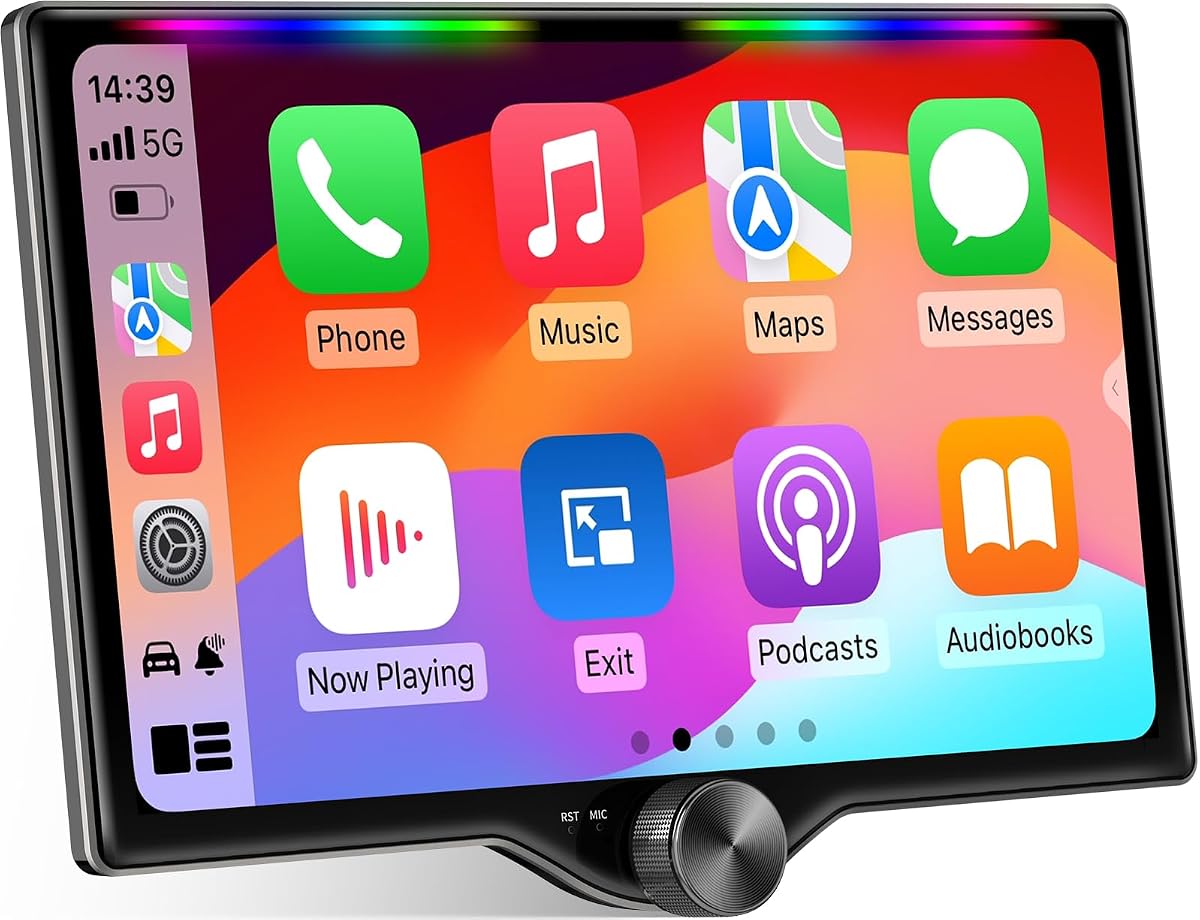
This universal 10.1-inch QLED head unit combines a large display, flexible smartphone integration, and unusually strong audio-output options. Its 4.2 rating makes it a compelling all-purpose option for vehicles with a compatible dashboard opening and a willingness to install the necessary adapters.
We may earn a commission when you buy through this link, at no additional cost to you.
Wireless and wired Apple CarPlay and Android Auto are supported, along with voice control, Bluetooth calling, streaming, and Mirror Link. Internally, a DSP and 10-band EQ provide sound adjustment, 4x60W peak output supplies speaker power, and two subwoofer outputs are available for bass expansion.
The luminous bar above the screen pulses with music, adding visual character that other head units do not offer. That feature is optional in practical terms, but it is one of the model’s most visible distinctions. A backup camera is included, while the steering-wheel control interface is sold separately.
This head unit suits buyers who want a cinematic-looking dashboard and plan to expand the audio system. Confirm the opening size, obtain a correct dash kit if needed, and allow for a separate wire harness, antenna adapter, or steering-wheel interface as required.
Supporting both wired and wireless CarPlay and Android Auto reduces compatibility friction. Drivers can keep a cable when preferred or use a cable-free connection during everyday use.
Dual subwoofer outputs and a dedicated DSP provide a useful foundation for a more serious sound system. The stated peak-power figure should not be confused with continuous RMS output when planning an upgrade.
We may earn a commission when you buy through this link, at no additional cost to you.
The Pioneer MVH-S110BT is a compact digital media receiver for owners who want modern connectivity without a large floating screen. Its 4.4 rating reflects a straightforward design, a super-short chassis, Bluetooth hands-free calling, wireless music streaming, and front USB playback.
We may earn a commission when you buy through this link, at no additional cost to you.
A built-in MOSFET amplifier is specified to deliver up to 50 watts per channel across four speakers. Direct EQ keys for bass, treble, and balance are easy to reach, while the USB input supports FLAC, MP3, and WMA files for listeners who maintain a local music library.
Its chief limitation is intentional: there is no touchscreen and no listed CarPlay or Android Auto compatibility. Drivers who need turn-by-turn maps, phone projection, or a large visual interface should look elsewhere. Those who simply want Bluetooth music, radio, USB playback, and a clean installation may find that restraint beneficial.
This Pioneer is best for a straightforward modernization of a compatible single-DIN opening. The short chassis helps where dashboard depth is limited, and its compact form can look less obtrusive than a large aftermarket screen.
The low-profile single-DIN format suits drivers who prefer their original dashboard to remain visually intact. A short chassis also makes installation more practical in vehicles with tight radio cavities.
Front USB access supports high-quality file formats, while the MOSFET amplifier provides enough power for direct speaker use. This makes the receiver useful even when it is not serving as a navigation display.
We may earn a commission when you buy through this link, at no additional cost to you.
The Honda Accord head unit is designed for 2008 through 2012 models and prioritizes a clean upgrade path. It has a 4.2 rating, a 10.2-inch IPS touchscreen, a 2GB RAM and 32GB storage configuration, and support for wired and wireless CarPlay and Android Auto.
We may earn a commission when you buy through this link, at no additional cost to you.
Its 1280-by-720 QLED screen is specified for clear visuals and rich color, while the Android platform offers a familiar interface for compatible apps. The supplied information also states that plug-and-play installation is possible without additional parts, which can reduce both cost and complexity for a correctly matched vehicle.
An IP69 waterproof AHD1080P rear camera is included, with a 170-degree lens designed to improve the view behind the car. The memory specification is modest compared with newer Android systems, but basic navigation, calling, and media functions should remain the primary focus of this vehicle-specific unit.
This is a strong choice for an Accord owner who prioritizes display size, wireless connectivity, and a straightforward installation. Confirm the model year, center-console dimensions, and shape before ordering, as fitment details remain essential even for a vehicle-specific head unit.
A 10.2-inch screen gives maps, calls, and media more room than a conventional radio while remaining shaped for the listed model years. The vehicle-specific approach should produce a more integrated appearance.
The included AHD camera adds a wide rear view through a durable, waterproof design. Its specified 170-degree lens is particularly useful for tight parking areas and vehicles with limited rear visibility.
We may earn a commission when you buy through this link, at no additional cost to you.
The ATOTO S8L stands out as the most connectivity-focused head unit in the guide. Its 4.1 rating reflects a 7-inch QLED touchscreen running Android 15, 4GB RAM, 64GB storage, wireless CarPlay and Android Auto, Wi-Fi, and an independent 4G LTE connection.
We may earn a commission when you buy through this link, at no additional cost to you.
That built-in cellular capability solves a practical problem: wireless CarPlay or Android Auto can occupy the normal Wi-Fi hotspot, making many Android head units lose internet access. With a compatible SIM installed, the S8L can maintain a separate data connection for maps, streaming, and other online functions. USB tethering is also listed as a backup option.
Audio processing is unusually thorough, with assignable channels, a 32-band EQ, time alignment, adjustable crossovers, a 24-bit DAC, three-volt RCA pre-outs, optical or S/PDIF output, and subwoofer support. The included Bluetooth OBD scanner can provide vehicle data and diagnostics, while the ATOTO app suite adds tracking, radio, privacy lock, and application-management features.
This is our editor’s choice because it balances open-platform flexibility, independent connectivity, sound customization, vehicle diagnostics, and privacy controls. Its seven-inch size is more modest than some competitors, and front and rear cameras are sold separately, but the broader feature set makes it a strong all-round modern conversion.
The separate 4G LTE connection keeps the head unit online even when wireless CarPlay or Android Auto is using the Wi-Fi link. This is particularly useful for continuous maps, music, and app access.
Time alignment, adjustable crossovers, a 32-band EQ, and flexible preamp outputs provide room for careful system matching. The processor can support both simple factory speakers and more ambitious aftermarket audio.
We may earn a commission when you buy through this link, at no additional cost to you.
The Pioneer DMH-W3050NEX combines a conventional 6.8-inch double-DIN receiver format with contemporary smartphone integration. It has a 4.3 rating and supports wired or wireless Apple CarPlay and Android Auto, giving drivers access to maps, music, messages, phone functions, podcasts, and voice commands.
We may earn a commission when you buy through this link, at no additional cost to you.
Built-in Bluetooth supports hands-free calling and audio streaming, while Amazon Alexa can be accessed through the Pioneer Vozsis app. The tuner includes HD Radio alongside local AM/FM broadcasts, and a quick One Touch navigation bar is designed to make switching between smartphone and receiver functions more direct.
Its defining limitation is the lack of built-in navigation. The screen becomes the navigation interface when a phone is connected, so a buyer who wants standalone maps without relying on a phone should choose a different model. At 6.8 inches, the display is also smaller than many modern floating or oversized screens.
This Pioneer is a sensible option for drivers who want a polished double-DIN dashboard, wireless projection, and broadcast radio without a large open Android ecosystem. It is also camera-ready, allowing a backup camera to be added during installation.
The restrained 6.8-inch design fits a common dashboard category and may integrate more neatly than a protruding floating screen. It is well suited to owners who prioritize familiar controls and a conservative appearance.
Wireless CarPlay and Android Auto supply familiar mapping and communication functions, while the built-in HD Radio tuner provides local programming and artist information without a phone connection.
We may earn a commission when you buy through this link, at no additional cost to you.
The Pioneer MVH-S230BT is a straightforward single-DIN receiver that focuses on the essentials: wireless calling, music streaming, USB playback, and AM/FM radio. It carries a 4.3 rating and offers a mechless design with a chassis depth of less than four inches.
We may earn a commission when you buy through this link, at no additional cost to you.
The front USB port can play music from connected devices or storage drives, with support listed for MP3, WMA, AAC, and WAV. Pioneer’s Advanced Sound Retriever is intended to restore detail affected by digital compression, while direct EQ controls provide quick adjustments to bass, treble, and balance.
There is no touchscreen or listed CarPlay and Android Auto support, so this is not a phone-projection navigation system. Its strengths are simpler: clean installation, familiar Pioneer operation, local media flexibility, and a low-profile dashboard appearance.
Choose the MVH-S230BT when you want to replace an aging single-DIN radio without changing the dashboard’s visual character. It is especially attractive for older modern cars that need Bluetooth and better audio but do not require a large navigation screen.
Bluetooth adds hands-free calling and wireless music, while USB provides a dependable route for local files. The result is a practical receiver for drivers who do not need a full mobile interface.
The compact chassis is intended to simplify installation in vehicles with limited dashboard depth. With dimensions listed at 3.875 by 7 by 2 inches, it suits a traditional single-DIN opening.
We may earn a commission when you buy through this link, at no additional cost to you.
A good head unit must fit the dashboard, meet your navigation and connectivity needs, and integrate cleanly with the vehicle. Compare physical dimensions, software capabilities, audio features, and installation requirements before choosing a model.
Begin with the center-console opening rather than screen size. A head unit may fit physically while still obstructing vents, controls, trim panels, or camera displays. Universal single-DIN and double-DIN models often require a vehicle-specific dash kit, while vehicle-specific units should be matched by model year, console shape, and original audio configuration.
Compare the supplied fitment details carefully and measure the opening before ordering. In particular, Tacoma trucks with the factory seven-inch navigation display, JBL system, and 360-degree camera require an additional CANBUS decoder box and matching power harness. Ask a seller for photographs or dimensions if the listing is unclear.
Choose only a unit whose listed fitment matches your exact vehicle, or prepare for the correct adapters before installation.
Navigation can come from a connected smartphone through CarPlay or Android Auto, from dedicated GPS hardware, or from an Android platform that supports downloadable maps. The Dodge Ram model uses compatible offline navigation through a connected phone, while the Ford Escape offers both online and offline map modes. Standalone map capability is especially useful in areas with weak cellular service.
Consider how often you travel beyond reliable mobile coverage and whether route guidance should remain available without a hotspot. Check app compatibility as well: navigation quality depends on the mapping application, map updates, phone connection, and licensing rules.
Favor dual online and offline navigation if remote travel is common, and choose phone-projection navigation if you already maintain a current mapping app.
Displays in this guide range from 6.8 inches to 10.2 inches, with several larger options using floating or rotating mounting designs. A larger screen can make map labels and menus easier to read, but it may protrude into the driver’s view or require a wider opening. IPS and QLED panels, anti-glare treatments, and specified viewing angles affect visibility in strong daylight.
Do not choose solely by diagonal size. Consider the screen’s position, whether it blocks climate controls or safety information, and whether portrait orientation is useful for navigation or landscape orientation is better for media. Touch responsiveness and the quality of the interface are also more meaningful than a resolution number alone.
Select a large, bright display only if it can sit securely in the intended dashboard position without compromising controls or visibility.
Wireless Apple CarPlay and Android Auto reduce cable clutter and make it easier to begin navigation or music playback when entering the vehicle. Wired operation can be useful for steadier charging or connection, so supporting both modes provides added flexibility. Mirror Link, Bluetooth, Wi-Fi, and USB broaden the ways compatible phones and media can be integrated.
Open Android head units provide more control over installed apps but also require more configuration, permissions, and ongoing software management. Streamlined Linux receivers act mainly as phone gateways and may feel faster and less distracting. Independent 4G LTE can preserve internet access when wireless phone projection occupies the Wi-Fi connection.
Choose an open platform for app flexibility, a streamlined receiver for simplicity, or dual cellular and Wi-Fi connectivity if uninterrupted service matters most.
Head units vary widely in amplifier power, equalization, preamp outputs, and filter controls. A straightforward Pioneer receiver with direct EQ keys may be sufficient for factory speakers, while the Tacoma and ATOTO models offer much deeper processing for aftermarket audio. The Tacoma includes a 48-band EQ and multiple digital outputs, and the ATOTO S8L adds time alignment, adjustable crossovers, a 32-band EQ, and a 24-bit DAC.
Treat advertised peak wattage as a maximum output figure rather than a continuous rating. If you plan to add amplifiers, subwoofers, or component speakers, verify the available preamp outputs, speaker-level connections, and supported crossover functions. Some double subwoofer outputs are conveniences for conventional systems, not necessarily connections for independent bass management.
Match the receiver’s processing and outputs to your current speakers and future audio plans rather than choosing on headline power alone.
A backup camera can make a large head unit especially valuable because the display can provide a brighter, larger reversing view. Several products include an AHD camera, while the ATOTO S8L supports front and rear camera inputs but sells its cameras separately. The Dodge Ram model includes an IP69 waterproof 1080P AHD camera with a stated 170-degree view.
Confirm the signal standard, connector type, camera resolution, and whether the head unit supplies guidelines or parking-sensor overlays. Vehicle-specific units may retain the factory camera and add trajectory lines, while universal models may need a dedicated camera input. For vehicles with factory camera systems, verify whether the original camera can be reused.
Verify camera compatibility before installation, especially when retaining a factory system, and ensure the camera angle provides useful coverage without excessive distortion.
A head unit that looks attractive on a listing can still create electrical or compatibility problems. Steering-wheel controls, power windows, climate readouts, parking sensors, warning sounds, and factory cameras may depend on specific adapters. Some radios also require an interface module, wire harness, antenna adapter, or CANBUS decoder to function correctly with the vehicle.
Universal systems offer more model coverage but often transfer the burden of finding the correct accessories to the installer. Vehicle-specific systems reduce guesswork but may carry the same exception for certain factory configurations. The supplied Haudio information recommends professional installation, and the ATOTO model adds customizable steering-wheel key learning and third-party controller support.
Budget for both parts and labor, and verify that the replacement will retain the vehicle functions you use most before committing to an installation.
Connected head units can expose personal information through messages, contacts, call history, navigation traces, and app accounts. Screen locking, app privacy controls, and account separation can help manage that exposure. The ATOTO S8L includes a Bluetooth screen lock, live tracking, trip playback, and geofencing features designed for shared, parked, or valet vehicles.
Vehicle diagnostics are another differentiator. The included ATOTO Bluetooth OBD scanner can read fault codes and provide information such as tire-pressure, ABS, airbag, and turn-signal status, although exact functions should be confirmed with the seller. Over-the-air updates can improve software, but ownership of the app ecosystem and update process also matters.
Look for privacy controls, diagnostic usefulness, and credible software support if the head unit will remain in the vehicle for many years.
Before installation, record the settings of the original radio, disconnect the vehicle battery according to the service guidance, and label every harness connector. Compare the supplied wiring diagram with the vehicle diagram, and install the correct steering-wheel, antenna, CANBUS, or camera adapter before securing the head unit. If the system is vehicle-specific, confirm that the connector orientation and original system match.
After power is restored, follow the initial setup sequence. Set the date and time, pair Bluetooth carefully, grant only the phone permissions needed for calling and media, and complete any steering-wheel or display-protocol setup. For CarPlay or Android Auto, use the manufacturer’s approved connection method, update the corresponding phone app, and verify that the display orientation remains usable in both portrait and landscape modes when applicable.
For long-term care, keep the screen away from prolonged direct sunlight when parked, clean the lens with a soft microfiber cloth, and avoid harsh cleaners. Review firmware and app updates periodically, maintain separate and secure driver accounts, and do not leave sensitive documents stored on shared storage. Check camera connectors, trim panels, and heat-sensitive adhesive at regular service intervals.
It depends on the radio and vehicle. Universal single-DIN or double-DIN units may need a vehicle-specific faceplate, while plug-and-play vehicle-specific units can include the correct housing. Some dashboards also require a wire harness adapter, antenna adapter, CANBUS decoder, or steering-wheel interface. Measure the opening and check the listed compatibility information before purchasing any accessories.
Some Android-based units support built-in or preloaded offline maps, while other navigation systems depend on a connected phone. The Ford Escape supports both online and offline maps, and the Dodge Ram supports compatible offline navigation through a connected smartphone. Confirm whether maps are actually included and whether map updates require Wi-Fi, an app store, or a separately installed application.
Wireless connectivity is more convenient because it removes the need to plug in a cable every time, while wired operation can provide a more consistent link and may support charging. Several head units in this guide support both methods. The most reliable choice depends on the phone, head unit, software version, and how long you typically spend in the vehicle.
A compatible head unit may be able to retain the original camera, but it must support the camera’s signal and connector requirements. Vehicle-specific units often advertise factory-camera compatibility explicitly. Universal models may include a new camera while still requiring the correct video input, reverse trigger, and wiring. Verify these details before removing the original radio.
Not necessarily. A receiver with a suitable built-in amplifier can drive many factory or basic aftermarket speakers. An external amplifier becomes more useful when adding higher-power speakers, multiple subwoofers, or a carefully matched signal chain. Check the head unit’s continuous output, preamp connections, and crossovers rather than relying only on its peak-wattage figure.
An open Android head unit can install compatible apps and offers greater control over the interface, storage, and connected services. A streamlined receiver usually focuses on CarPlay, Android Auto, radio, and media while using a simpler underlying operating system. The open platform is more flexible, whereas the streamlined approach can be quicker to configure and less distracting.
It is useful if you want uninterrupted internet access for navigation and music, especially when wireless CarPlay or Android Auto takes control of the Wi-Fi connection. However, it requires a compatible SIM and an ongoing cellular plan. If your phone hotspot is reliable and your needs are modest, a Wi-Fi-equipped model may be sufficient.
Installation quality strongly affects stability, display fit, steering-wheel operation, camera visibility, and audio quality. Incorrect harness or CANBUS connections can cause warning messages or nonworking factory features, while poorly routed cables can interfere with a rotating or floating screen. Professional installation is particularly worthwhile for vehicle-specific units, camera integration, or complex DSP and amplifier wiring.
The Haudio 10.1-inch Single DIN stands out as the best overall value for a large universal upgrade, while the ATOTO S8L is the most connected and creatively featured option with independent 4G LTE, extensive DSP controls, and an included OBD scanner. The Toyota Tacoma Android head unit is the premium choice for compatible second-generation trucks because it combines polished vehicle integration with a sophisticated display, audio processing, and broad factory-function support.
Your priorities should guide the decision. Choose a vehicle-specific model for a cleaner installation and retained functions, an open Android system for app flexibility, or a streamlined receiver for quick and simple smartphone access. Check dashboard dimensions, wireless standards, camera requirements, audio outputs, and every needed adapter before ordering, because these details matter more than screen size alone.
Ratings and product configurations can evolve, and prices and availability change over time. Review the current listing and seller information in November 2026, especially for compatibility notes, included accessories, and software support. Taking the time to match the head unit precisely to your car will produce the most satisfying and dependable result.