
AEKE Smart Home Gym System K1
4.1Editor score
17-point skeletal tracking
350+ guided movements
Five adaptive resistance modes
No recurring subscription fees
Our guide compares the best AI powered smart home gym systems, covering resistance, coaching, tracking, workouts, space needs, ownership, and value.
AI powered smart home gym systems combine connected equipment, digital resistance, motion tracking, and guided programs in one home fitness platform. A worthwhile system should make training easier to begin, provide meaningful feedback, and offer enough exercise variety to replace repetitive routines while fitting naturally into the available space.
We compared ten systems across resistance, exercise selection, artificial intelligence features, performance tracking, display experience, installation, portability, and ongoing ownership considerations. The list includes compact all-in-one machines, wall-mounted trainers, a portable cable system, and an adaptive treadmill, giving readers several ways to build a connected gym.
Each pick highlights a distinct approach to at-home training, from expansive course libraries to space-saving digital resistance and automatic workout adjustment. Ratings, software features, included accessories, and availability can change, so readers should verify current product details and prices before making a final purchase.
4.1Editor score
5.0Editor score
4.1Editor score
The table below compares the ten systems by their core training features, intelligent functions, resistance capabilities, and physical format, helping shoppers identify the option that best matches their space, goals, and preferred workout style.


The AEKE K1 is a mirror-like all-in-one fitness system that combines digital resistance, skeletal tracking, guided classes, and a large interactive display. Its 4.1 rating reflects a capable product with a particularly strong combination of exercise variety and intelligent feedback. The 17-point tracking system stands out because it can analyze movement during a session and turn that information into performance reports, completion reports, and recommendations for future training.
We may earn a commission when you buy through this link, at no additional cost to you.
The K1 supports more than 350 movements and over 200 professional courses across strength, cardio, and flexibility. Five strength modes and a digital servo motor create adjustable resistance, while the AI coach uses workout data such as repetitions, sets, exertion balance, and calories burned to guide progression. The 43-inch 4K touchscreen and 2.1-channel surround sound give the system the feel of a connected fitness studio rather than a basic exercise machine.
Its most useful practical feature may be the auto-folding frame. Once folded, the system occupies approximately 0.3 square meters, making it easier to store than a conventional rack or cable machine. The trade-off is that buyers still need enough open space to use the screen and move through cable exercises, and the listing does not provide a maximum resistance figure comparable to the specifications published for several cable-based competitors.
This is a strong choice for households that want guided strength, cardio, flexibility, and form feedback without a recurring membership. It is especially suitable for beginners, mixed-ability families, and users who value content variety and detailed performance reports. For people who mainly want maximal cable resistance, the less bulky, easier-to-store MAXPRO may be a better fit, but the K1 offers the most complete all-in-one experience in this guide.
The 17-point skeletal tracking gives the AI coach a detailed view of body movement. Performance reports and visual progress charts can help users identify completion trends and adjust future sessions, making the system more useful than a machine that merely displays preselected workouts.
With more than 350 movements, 200-plus courses, motion-sensing games, and multiple resistance modes, the K1 can support different goals and experience levels. The broad program selection also reduces the likelihood that users quickly exhaust the same routine.
We may earn a commission when you buy through this link, at no additional cost to you.
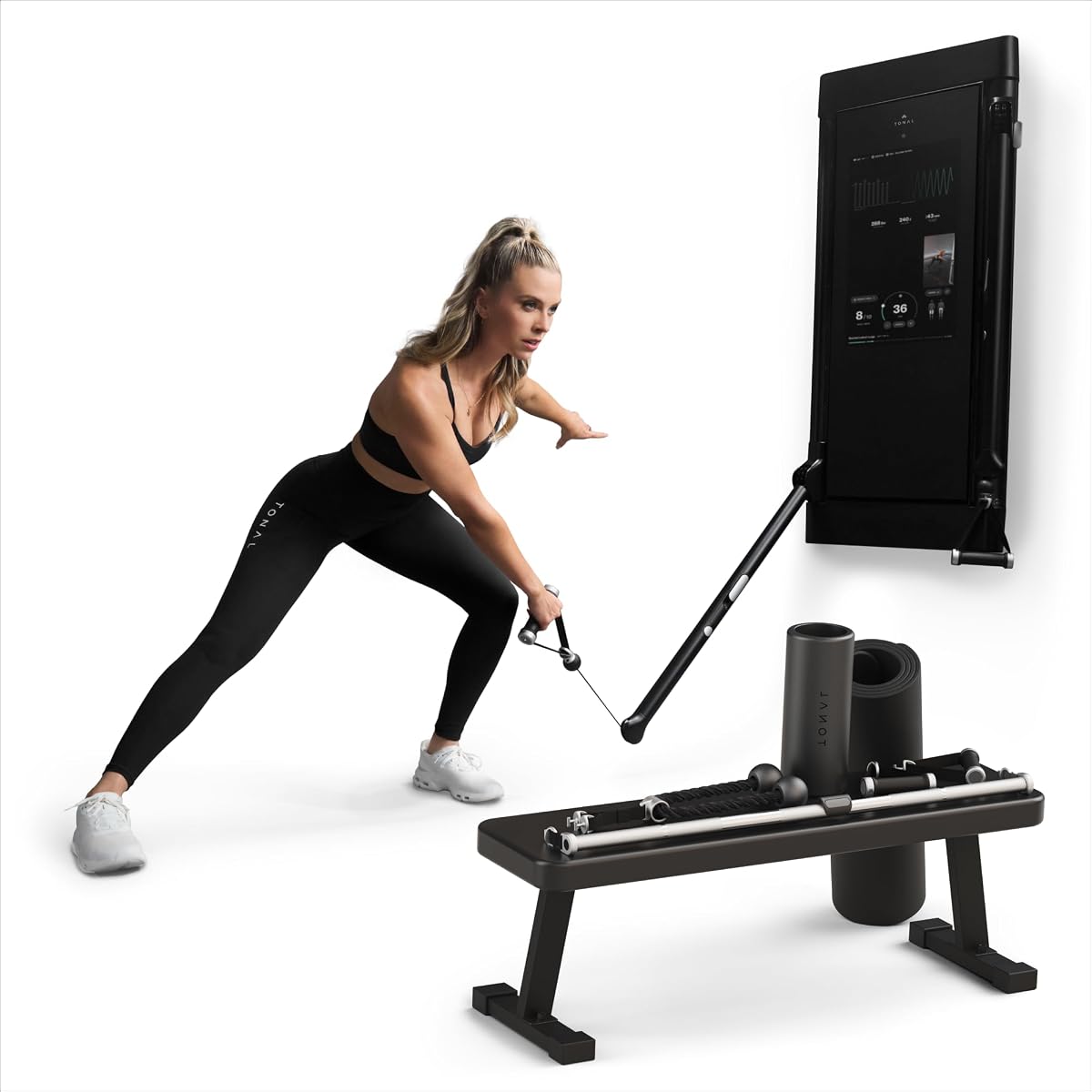
Tonal 2 is a wall-mounted smart strength system built around adaptive cable resistance, digital performance tracking, and expert-led programming. It carries a 4.1 rating and stands out for a 250-pound resistance capacity, which makes it a compelling option for users who want more substantial loading than many compact connected systems offer.
We may earn a commission when you buy through this link, at no additional cost to you.
The central intelligence is adaptive resistance. Rather than requiring the user to manually select every load, the system evaluates strength and performance and adjusts the resistance in precise increments as the user progresses. It also records repetitions, sets, milestones, total volume, power, and other performance measures, then uses personalized weekly targets to make progress easier to understand.
The wall-mounted format is the system’s biggest structural advantage and its most important commitment. It preserves open floor space and can replace a cluster of separate machines, but the owner also gives up some flexibility in moving the equipment. Tonal 2 includes a space survey, delivery, and professional installation so the unit can be safely mounted and calibrated.
Tonal 2 is best for serious strength users who want sophisticated adaptive loading, extensive guided programming, and a permanent home-gym installation. The wall-mounted approach may not suit renters, travelers, or anyone wanting a system that can be moved easily. For those buyers, a freestanding or portable model offers more practical flexibility.
The adaptive engine is more than a convenient digital weight stack. It continuously aligns the load with the user’s demonstrated performance and raises resistance in measured increments, supporting progressive training without forcing constant manual adjustments.
Wall mounting keeps the cables and hardware elevated and organized. That makes Tonal 2 attractive for dedicated rooms, but buyers should carefully review the space survey process before treating the purchase as final.
We may earn a commission when you buy through this link, at no additional cost to you.
The AEKE S1 Pro is a 220-pound digital-resistance home gym with AI coaching, real-time motion tracking, and personalized programs. Its 4.1 rating reflects a capable smart strength platform, and the system is especially attractive to users who want precise, quickly adjustable cable resistance without managing separate stacks of weights.
We may earn a commission when you buy through this link, at no additional cost to you.
Its dual smart components are personalization and adaptability. Sensors track body mechanics, while the AI platform uses performance information to shape guidance and training plans. The motor-driven resistance system is designed to deliver smooth changes across different movements, supporting controlled muscle building as well as explosive power work.
The product information promises hundreds of exercises, professional training modes, and a space-conscious design. However, it does not state a precise movement count, screen size, resistance-mode count, or folded footprint. That means buyers should not assume it offers the same numerical breadth as systems whose specifications are more clearly documented.
S1 Pro is a compelling option for strength-focused users who prioritize smooth digital loading and individualized motion feedback. It is less suitable for shoppers who need exact measurements before purchase or want to compare every course and feature in advance. Confirming the final dimensions, display experience, included accessories, and software terms can prevent disappointment.
Rather than treating AI as an exercise selector alone, the S1 Pro uses sensor data to evaluate body mechanics. That focus on form and movement intelligence can make the coaching more relevant to individual mechanics and training goals.
The 220-pound motor-driven system allows resistance to change quickly and consistently between exercises. This is useful for circuit-style sessions where moving between movements should not require a lengthy manual weight change.
We may earn a commission when you buy through this link, at no additional cost to you.
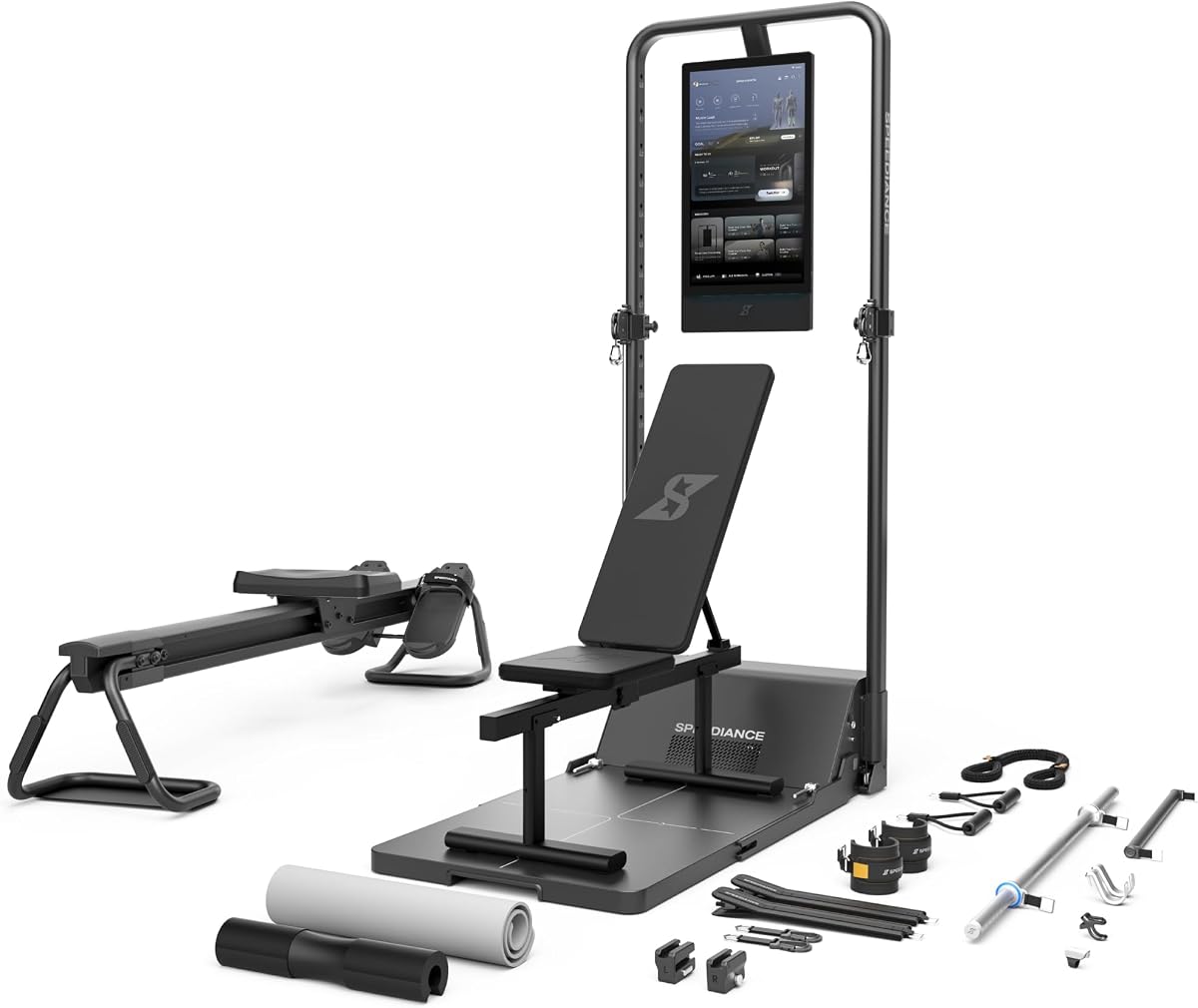
The Speediance Gym Monster 3 is a freestanding all-in-one gym that combines strength, cardio, Pilates, mobility, and functional training. Its 5.0 rating is the highest among the ten products listed, making it an especially strong editorial selection for buyers who want one system to cover many training styles.
We may earn a commission when you buy through this link, at no additional cost to you.
Its technical foundation is a 220-pound digitally controlled resistance system with precise one-pound adjustments, four resistance modes, and 19 cable positions. Those numbers give users considerable control over loading and movement angles. The system supports squats, presses, rows, pulls, and other functional patterns without requiring a separate rack for every exercise.
AI-powered coaching is designed to assist with assessment, workout planning, guidance, and progress tracking. Hands-free voice control allows users to change settings without interrupting a session. Some selected AI functions are slated to arrive through future over-the-air updates, so current buyers should distinguish between available features and planned enhancements.
The 23.8-inch HD display, 20-watt 2.1-channel stereo system, and ambient lighting create a more entertainment-focused experience. Unlike wall-mounted alternatives, it does not require drilling, and its listed footprint is under 10.8 square feet. Gym Monster 3 is our choice for users who want a high-rated, versatile, freestanding platform with granular resistance control.
Precise adjustments make it easier to use the same machine for isolation work, compound lifts, and users with different strength levels. Four resistance modes add another layer of control beyond a simple weight increase.
The system avoids the installation commitment required by wall-mounted trainers. It still needs a substantial training area, but it can be positioned more freely and is better suited to renters or homes without suitable mounting locations.
We may earn a commission when you buy through this link, at no additional cost to you.
The Speediance Gym Monster 2 is a multifunctional strength station that combines a power cage, Smith machine, squat rack, bench rack, cable machine, and pulley system. It has a 4.2 rating and differentiates itself through an unusually small folded footprint of approximately 0.25 square meters.
We may earn a commission when you buy through this link, at no additional cost to you.
Digital resistance reaches 220 pounds through dual 800-watt permanent-magnet synchronous motors. The AI coaching system tracks performance in real time and recommends weight adjustments after each set. That focus is especially relevant for progressive strength programs, where consistent load changes and repeatable records can be more useful than entertainment-heavy features.
The main trade-off is that the product emphasizes strength rather than the broad cardio and motion experiences highlighted by the Gym Monster 3. Its multifunctional bench and pulley arrangement support chest, back, leg, core, and functional exercises, but it is better viewed as a compact rack system than a complete cardio studio.
Gym Monster 2 fits users who want a squat rack, pulley station, and digital cable machine in one relatively compact product. The two-year main-unit protection and accessory coverage add reassurance for long-term ownership, while software updates and an expanding workout library help the system evolve after purchase.
The folded area is unusually small for a system that includes rack components and digital cable functions. It offers a more practical storage option for apartments and shared spaces, provided the surrounding area is large enough for safe use.
Recommending adjustments after each set aligns the coaching system with conventional strength training. Users can use the guidance to support progressive overload while retaining control over how quickly they progress.
We may earn a commission when you buy through this link, at no additional cost to you.
The OxeFit XS1 Peak is a premium all-in-one machine that combines digital strength training with rowing, canoe, kayak, paddleboard, surf-swim, ski-cross, and controlled Pilates modes. Its 2.9 rating is the lowest in this group, so buyers should weigh its unusually broad feature set against a less favorable customer feedback history.
We may earn a commission when you buy through this link, at no additional cost to you.
The OxeAI platform uses precision analytics to adjust workout protocols as the user progresses. Performance feedback includes power, velocity, load, and balance, giving users a more technical view of each repetition than a basic workout counter. Trainer-led classes and guided programs add instruction for users who want structure without designing every session independently.
Ownership terms deserve careful attention. The OxeFit membership is activated during account setup, normally before installation, and requires an initial 12-month commitment. Membership billing is separate from the purchase and is not included in the listed financing options. Buyers should review renewal terms and determine how frequently they will use the content.
XS1 Peak is well suited to a buyer who wants the widest variety of movement styles in one machine and values detailed performance analytics. It is less suitable for someone committed to traditional strength training alone, reluctant to accept recurring service costs, or particularly sensitive to the system’s lower listed rating.
The range of paddling, skiing, swimming, rowing, and Pilates motions distinguishes the XS1 Peak from conventional strength towers. These modes can provide variety and appeal to users who want cardio and mobility in the same training footprint.
Membership activation normally occurs before installation, and an initial commitment is required. Reviewing the account process and service terms early can prevent surprises about when access begins and how future billing works.
We may earn a commission when you buy through this link, at no additional cost to you.
The original Speediance Gym Monster is a connected strength and cardio system rated 4.2 by customers. It combines two direct-drive engines with up to 220 pounds of adjustable resistance, while its content library includes more than 700 movements and over 300 classes.
We may earn a commission when you buy through this link, at no additional cost to you.
A smart touchscreen provides access to visual training programs and precise resistance adjustments. The system is designed for chest, back, legs, core, free lifting, and partner-style sessions. Its most distinctive cardio feature is Ski Mode, which uses two ski handles and ten height settings to create a year-round pulling workout.
Compared with the K1, this model offers a much larger stated movement count but less explicit information about skeletal tracking and form analysis. Its resistance platform is a major strength, although the product details do not specify as many operating modes or cable positions as the Gym Monster 3 listing.
The Gym Monster is a good middle ground for users who want substantial digital weight, many exercises, and a cardio option without moving to a treadmill. It is particularly attractive to families that value shared content variety. People who prioritize detailed form correction should compare the tracking explanations offered by the K1 and AEKE S1 Pro.
More than 700 movements and 300-plus classes can keep multiple household members engaged. Free-lifting and partner-style options also extend the system beyond a fixed set of guided strength classes.
Ski Mode adds a distinct pulling-cardio experience without requiring a treadmill or rowing machine. Users need the appropriate handles and enough clearance to complete the movement safely.
We may earn a commission when you buy through this link, at no additional cost to you.
The Echelon Strength Pro is a commercial-grade, wall-mounted smart trainer built around digital cable resistance and a large interactive display. It supports up to 132 pounds per arm, giving both sides of the system independent loading potential, and it includes four heavy-duty concrete anchors for stability.
We may earn a commission when you buy through this link, at no additional cost to you.
Five resistance modes—Normal, Concentric, Eccentric, Progressive, and Isokinetic—give the system more advanced programming than a conventional fixed-weight cable tower. The 24-inch HD touchscreen presents instructor-led strength, HIIT, yoga, mobility, and recovery workouts. Wi-Fi connectivity supports guided programs, a movement library, and real-time workout tracking.
Four interchangeable attachments support traditional lifts, rotational training, and floor-based exercises. Built-in bar and grip controls are intended to make mid-workout adjustments convenient. The main compromises are installation and data availability: the system must be securely anchored, and the source listing does not provide a numerical customer rating.
Echelon Strength Pro is best for users with a permanent training space who prioritize commercial-grade construction, independent-arm resistance, and varied resistance behavior. It is less appropriate for renters, small spaces, and buyers who require a large volume of established customer feedback before choosing a system.
The per-arm resistance specification provides meaningful capacity for unilateral and bilateral cable movements. Buyers should still confirm the available movement geometry and attachments fit their preferred program.
Concentric, eccentric, progressive, and isokinetic modes can support different training focuses. These options make the system more versatile for experienced users who understand how each pattern affects their program.
We may earn a commission when you buy through this link, at no additional cost to you.
MAXPRO takes a different approach from the large smart gyms in this guide. It is a portable cable system that weighs less than nine pounds and folds into a compact package. Its 3.7 rating reflects a useful but less universally favored product, particularly for buyers who want more substantial digital equipment.
We may earn a commission when you buy through this link, at no additional cost to you.
The included SmartConnect uses Bluetooth and onboard sensors to track workouts in the MAXPRO app, monitor progress, provide analytics, and deliver coaching. Users can follow strength-based HIIT, suspension, and strength classes or create their own routines. The app-based approach avoids the need for a large built-in screen.
Resistance markings are adjustable from 5 to 300 pounds using a simple turn of the dial. The package includes a SmartConnect, a three-piece quick-connect long bar, two workout handles, two ankle or wrist straps, two door-mount brackets, and a USB charger. That accessory set supports strength, cardio, suspension, plyometric, and functional training.
MAXPRO is ideal for travelers, apartment residents, and people who need a system they can carry between locations. It is less suitable as a permanent centerpiece for someone who wants a large display, expansive hardware, or a fixed cable tower. Door mounting also requires a suitable, secure anchor point and careful setup.
A five-to-300-pound range and under-nine-pound body make the system more capable than a basic resistance band. It is particularly useful for travelers who need meaningful cable training without transporting multiple fixed weights.
SmartConnect turns the portable hardware into a connected trainer through Bluetooth and onboard sensors. The trade-off is that the experience depends on a compatible phone or other display rather than a large integrated screen.
We may earn a commission when you buy through this link, at no additional cost to you.
The AI-Adaptive Smart Home Treadmill is a connected running machine focused on automatic pace and incline control. It has a 4.7 rating, making it the second-highest listed score in the guide, and its real-time AI running coach distinguishes it from the strength-and-cable systems that dominate the category.
We may earn a commission when you buy through this link, at no additional cost to you.
SportMind AI monitors heart rate and automatically changes speed from 0.6 to 9.6 MPH and incline from zero to 10 percent. These micro-adjustments are intended to keep the runner in a selected training zone, easing off when recovery is needed and increasing the challenge when the current effort is manageable.
The brushless motor delivers a maximum 5.0 horsepower, and the machine supports users up to 440 pounds. Its 20-by-54-inch non-slip deck provides more running space than many compact treadmills, while shock absorption is designed to reduce impact on the joints. Compatibility with Apple Watch and Fitkol wristband supports heart-rate input.
This treadmill is a strong choice for runners who want the machine to manage workload changes automatically. It is not a complete replacement for a strength system, and its running deck requires more floor space than portable or foldable cable products. Buyers should also confirm that their preferred heart-rate device and connection method are compatible.
Automatic speed and incline changes reduce the need to reach for console controls during a run. Heart-rate feedback gives the AI a basis for adjusting the session in real time, making it particularly useful for pace-oriented training.
The 5.0-horsepower motor, 440-pound user capacity, and extra-wide deck support a range of running styles. Its physical size should be planned carefully because the machine is designed for sustained cardio rather than compact storage.
We may earn a commission when you buy through this link, at no additional cost to you.
The best AI powered smart home gym system should fit your available space, support the training you actually enjoy, and make its intelligent features visible in everyday use. Compare hardware, software, resistance, installation, and long-term ownership before ordering.
Resistance is one of the most important hardware decisions in a connected gym. Cable-based systems in this guide range from the MAXPRO’s adjustable 5-to-300-pound range to the Tonal 2’s stated 250-pound adaptive capacity, while several Speediance and AEKE models offer 220 pounds. A broad maximum is useful for advanced lifters, but beginners should also consider how smoothly the resistance changes and how easily the interface can be adjusted between sets.
Choose a system with enough capacity for your current level and a progression path for future training. Digital resistance is especially convenient for circuits because loads can change quickly, while fixed resistance may be more familiar to traditional gym users.
AI features vary considerably. The AEKE K1 uses 17-point skeletal tracking to analyze movement and produce completion and performance reports. The AEKE S1 Pro combines AI coaching with motion sensors, Gym Monster 2 recommends weight changes after each set, and the OxeFit XS1 Peak analyzes power, velocity, load, and balance. Other systems focus more heavily on adaptive loading than explicit form correction.
Look for intelligence that matches your priorities. Runners may prioritize automatic speed and incline changes, while lifters may want load recommendations, set tracking, and technique feedback. A broader feature list is not automatically better if the software remains difficult to understand or is still developing.
The size of the workout library affects long-term engagement. The original Speediance Gym Monster lists more than 700 movements and 300-plus classes, while the AEKE K1 offers more than 350 movements and 200-plus courses. Other products emphasize a smaller set of specialized experiences, such as the OxeFit XS1 Peak’s rowing, paddling, skiing, and Pilates modes.
Compare the actual movement categories rather than relying only on counts. Strength, cardio, mobility, yoga, Pilates, rehabilitation-style work, and functional training are not interchangeable. The best library is the one that matches the routines you will realistically perform.
Smart gyms range from a portable cable unit weighing under nine pounds to freestanding racks, folding systems, wall-mounted trainers, and treadmills. Wall-mounted systems minimize floor clutter but require a suitable structure and professional installation. Freestanding systems are easier to position but may need more training clearance. Folding systems are more practical for storage than for maximum equipment in a single footprint.
Measure the intended room, doorways, ceiling height, and exercise envelope before buying. Check the manufacturer’s fit information carefully and account for the space needed to move through cable positions, perform floor exercises, and access the display.
A large display can make guided sessions more engaging and easier to follow. The AEKE K1 uses a 43-inch 4K touchscreen with surround sound, while Speediance Gym Monster 3 pairs a 23.8-inch HD display with stereo sound and ambient lighting. The Echelon Strength Pro includes a 24-inch HD touchscreen, and portable products generally rely on a phone or separate screen.
Think about how often you will use the display and whether you value immersion or portability. A big screen needs more space and electrical placement, while an app-based system is lighter and easier to move. Sound and lighting matter most to users who regularly follow entertainment-oriented classes.
Some systems provide ongoing access without a recurring charge, while the OxeFit XS1 Peak requires an initial membership commitment and separate billing. Read account activation, renewal, cancellation, and financing terms before installation, especially when setup normally begins before delivery.
For a fair comparison, calculate the total cost of ownership over the period you expect to use the machine. Also consider whether the content library, performance history, and coaching remain useful if you pause your membership or stop using the service.
Construction should match the intensity and location of your workouts. The Echelon Strength Pro uses commercial-grade construction and concrete anchors, while the Speediance Gym Monster 2 includes two-year main-unit protection and one-year accessory coverage. Included attachments can materially expand exercise options: the Tonal 2 includes an accessory bundle, and the MAXPRO package provides bars, handles, straps, and door-mount brackets.
Check the warranty distinction between the main unit and accessories, along with replacement availability for straps, handles, cables, anchors, and other wear items. Durable construction is valuable, but maintaining the small components is part of owning a connected cable gym.
The best system for a dedicated runner may not be the best system for a family seeking strength and cardio. A treadmill offers automatic running adjustments but cannot replace a rack. A cable tower supports resistance training but may not satisfy a dedicated cardio goal. Mixed-use systems aim to cover more categories, often at the cost of a larger footprint or a higher level of product complexity.
Consider who will use the machine, how often they will train, and which sessions they look forward to. Solo strength users may prioritize precise loading, while family members may value broad content, simple touch controls, and enough exercise variety to prevent boredom.
Begin by completing the account, fitness profile, equipment pairing, and any required installation process before the first workout. Wall-mounted systems need secure anchors and calibration, while freestanding models should be positioned on a level surface with adequate clearance. For digital resistance equipment, confirm that cables, attachments, and moving parts are properly connected before pulling against them.
Start with a guided assessment or introductory program when the manufacturer provides one. Use the recommended resistance or speed rather than immediately selecting the maximum. Review motion feedback carefully, but treat it as useful coaching information rather than a substitute for professional medical advice, physical therapy, or qualified instruction. Stop if pain or unusual discomfort occurs.
For upkeep, wipe the screen and moving surfaces regularly, keep cable paths free of obstructions, and inspect handles, straps, anchors, and fasteners for wear. Follow the manufacturer’s lubrication and tightening schedules where applicable. Update the app and operating software when requested, and preserve the account credentials and recovery information needed to restore progress data and subscriptions.
An AI powered gym should use data from sensors, machine settings, or connected wearables to influence programming, feedback, or resistance. Examples include automatic treadmill speed and incline changes, skeletal movement analysis, post-set load recommendations, and adaptive cable resistance. The strength of the AI experience depends on how often those features are available, how clearly they are presented, and whether the hardware can act on the analysis.
They can be especially useful for beginners because guided workouts, automatic adjustments, and performance reports reduce the need to design every session from scratch. Buyers should still begin with introductory programming and avoid selecting more resistance than they can control comfortably. A system is most helpful when its difficulty settings and tracking are easy to understand.
No. The AEKE K1 advertises lifetime access without subscription fees, and the AI-Adaptive Treadmill includes lifetime AI membership. The OxeFit XS1 Peak uses a membership model with an initial commitment and separate ongoing billing. Check the current terms before ordering, particularly for accessories, premium content, or account-dependent features.
A smart home gym can replace many routine gym visits by providing cable resistance, guided classes, cardio modes, and progress tracking. It may not duplicate every specialized machine, free-weight environment, or social aspect of a commercial facility. The best answer depends on your weekly routine, preferred exercises, and willingness to train consistently at home.
The MAXPRO is the most clearly portable option in this guide because it weighs under nine pounds and folds into a compact package. The AEKE K1 also auto-folds, although its full-size display and broader movement system require more space during use. Wall-mounted systems such as Tonal 2 are designed to stay in place.
It depends on the model. Tonal 2 and the Echelon Strength Pro are wall-mounted and require suitable anchoring, with Tonal 2 including professional installation. The Echelon listing specifically mentions heavy-duty concrete anchors. Freestanding systems such as Speediance Gym Monster 3 require no drilling, and portable systems avoid permanent installation.
The right capacity depends on your training level and exercise selection, but a higher maximum offers more room for progression. Systems in this guide advertise capabilities from 220 to 300 pounds, while some provide per-arm or adjustable specifications. The most important comparison is whether the resistance remains smooth, changes quickly, and supports the movements you perform most often.
Leave enough room to move safely through the full range of cable positions, access attachments, and perform seated, standing, and floor exercises. The listed footprint of a product may describe only the folded or occupied area, not the complete movement envelope. Wall-mounted units can save storage space but still require a safe workout area in front of the system.
The AEKE K1 stands out as a value-focused all-in-one system with skeletal tracking, extensive content, five resistance modes, and no recurring subscription requirement. Speediance Gym Monster 3 is the strongest all-round choice for buyers who value a 5.0 rating, precise one-pound resistance adjustments, multiple cable positions, and a freestanding design, while Tonal 2 delivers the most polished premium package with adaptive loading and professional wall installation.
Prioritize the features you will use consistently: form feedback for strength, automatic pace control for running, broad workouts for family use, or portability for frequent relocation. A larger display and longer content library are useful, but they should not outweigh safe dimensions, sufficient resistance, dependable construction, and an ownership model that suits your habits.
Before ordering, verify the current specifications, included accessories, account requirements, delivery process, and price. Ratings and software can change over time, and promotions also fluctuate. Comparing the final manufacturer and retailer listings will help ensure that the chosen system still delivers the capabilities that mattered most during your research.