
HPFIX Silicone Soldering Mat
4.7Editor score
ESD wrist strap included
932°F heat resistance
Built-in organization compartments
15.9 by 12-inch surface
Anti static mats create a more controlled work surface for handling circuit boards, computer parts, phones, tablets, and other sensitive electronics. A properly grounded mat can help dissipate built-up static charge, while useful features such as component compartments, heat resistance, wrist straps, and portable construction make a repair bench more practical.
This guide compares ten anti static mats using the specifications and features listed for each product. It covers conventional repair pads, portable kits, silicone soldering mats, and full-length rolls, with attention to working area, included grounding accessories, electrical characteristics, storage, and suitability for different electronics tasks.
The selections show which options are most practical for bench work, mobile repair, compact setups, and larger installations. Individual ratings are included for reference, but the right choice depends on your grounding method, available space, soldering habits, and the types of components you regularly handle. Prices and availability can change.
4.7Editor score

4.7Editor score

4.3Editor score
As an Amazon Associate we earn from qualifying purchases.
The table below compares the ten anti static mats by physical format, working area, grounding package, heat handling, and the most useful feature for each design. It is intended to make it easier to distinguish a compact portable kit from a full bench roll or an organization-focused repair mat.




This anti static mat combines a 17-by-25-inch work area with a two-layer composite structure and a 4.2 rating. Its blue dissipative layer is designed to collect and absorb static electricity around the work surface, while the conductive black layer provides a path for discharging that accumulated charge.
We may earn a commission when you buy through this link, at no additional cost to you.
The grounding package is unusually useful for a mat of this format. It includes an adjustable wrist strap, a coil cord, and a common-point ground cord with a ring terminal. Together, these components give the user a way to connect both the mat and person to a suitable grounding point, which is important when working with circuit boards, computers, pads, and cellphones.
There are a few limitations to keep in mind. An outlet ground adapter is not included, so users need an appropriate grounding arrangement already available in the workspace. The listed information also does not provide a specific heat-resistance rating, making it less compelling for continuous contact with very hot soldering tools than the silicone mats in this list.
Despite those qualifications, this is a sensible general-purpose option for a home workshop or professional repair counter. Its generous dimensions allow a device and several tools to remain on the mat, while the included accessories reduce the number of separate grounding purchases required for a basic electronics setup.
The combination of a dissipative upper layer and conductive lower layer is central to the mat's operation. That structure gives the work surface a controlled way to manage static charge when the mat is properly connected to ground.
The listed applications include personal computer repairs, circuit boards, electronic pads, and cellphone work. Its broad rectangular surface can serve as both a protected work area and a general staging zone for small tools and components.
We may earn a commission when you buy through this link, at no additional cost to you.
The HPFIX Silicone Soldering Mat combines static-dissipative protection with a 15.9-by-12-inch silicone work surface and a 4.7 rating. Its surface resistivity is listed at 10^6 to 10^8 ohms, while the stated 932°F heat resistance makes it well suited to soldering and general electronics repair.
We may earn a commission when you buy through this link, at no additional cost to you.
One of its strongest practical features is organization. Built-in rulers, compartments, and trays provide dedicated places for screws, small components, and tools. That organization can be particularly valuable during phone, tablet, laptop, camera, or circuit-board repairs, where tiny parts are easy to misplace.
The included grounding plug, grounding cord, and ESD wristband make it easier to establish the proper connection between the mat, user, and ground. The main trade-off is size. Its footprint is smaller than several rolls and large rectangular pads in the comparison, so a technician working on several open devices may need more room.
This mat is an attractive option for beginners, hobbyists, and repair professionals who want a single surface that combines ESD protection, soldering resistance, and component organization. It is particularly useful when bench space is limited but a dedicated protected work area is still important.
The stated 932°F heat resistance sets this silicone mat apart from many conventional rubber alternatives. That makes it suitable for work involving soldering irons and other hot tools while also helping shield the underlying bench.
Compartment layouts, trays, and a built-in ruler keep small items visible and sorted. These details can reduce downtime spent searching for screws or trying to identify tiny electronic parts during a repair.
We may earn a commission when you buy through this link, at no additional cost to you.
The StarTech Anti-Static ESD Mat offers a broad 24-by-27.5-inch surface, a low 0.1-inch profile, and a 4.6 rating. Unlike a simple conductive surface, it is described as static dissipative, which is the appropriate operating principle for controlling charge around sensitive equipment.
We may earn a commission when you buy through this link, at no additional cost to you.
Its thin construction allows it to sit comfortably under desk equipment, making it more versatile than bulky repair mats. The product information also states that the design meets IBM and US military static-control specifications, offering a clear technical focus for users who value documented standards.
The tradeoff is that the additional anti static wrist strap identified as model SWS100 is not included with the mat. There are also no listed trays or compartments for organizing fasteners. Buyers who already own a suitable wrist strap and prefer an uncluttered, equipment-friendly surface may find this a strong fit.
This mat is a good choice for a home office, professional desk, or large repair bench where a substantial protected area is needed without taking up much vertical space. It is especially appealing for users who want the mat to blend into an existing workstation.
At only 0.1 inch thick, the mat can sit beneath CPUs, displays, keyboards, and other equipment without creating a tall obstacle. That low profile suits permanent installations more than portable field work.
The listed compliance with IBM and US military static-control standards provides a stronger basis for comparison than an unsupported marketing claim. Users can evaluate the mat according to a defined static-control context.
We may earn a commission when you buy through this link, at no additional cost to you.
This HPFIX mat is a well-rounded repair platform with a 4.7 rating, a 20.9-by-13.5-inch overall size, and a listed 20.5-by-10.4-inch active working zone. Its surface resistivity of 10^6 to 10^9 ohms is intended to protect delicate components from electrostatic discharge.
We may earn a commission when you buy through this link, at no additional cost to you.
The mat supports the full range of jobs commonly found at an electronics bench. Motherboards, laptops, tablets, cameras, and other larger devices fit within the broad workspace, while the 932°F heat resistance provides a barrier for soldering work. A grounding plug, ground cable, and anti-static wrist strap are included.
Both the ground cable and wrist strap lead measure three meters, or 9.84 feet, which provides useful flexibility around larger benches. Numbered storage slots help organize small disassembled parts, while the large active zone reduces the chance that components will sit beyond the protected area.
Although the product title uses the word magnetic, the supplied feature details do not clearly explain a magnetic function. Buyers should judge the product on the documented grounding system, workspace, compartments, and heat resistance. It remains the most balanced combination of those features in the list.
The usable 20.5-by-10.4-inch area gives large projects room to remain on the mat. This is helpful for motherboard-level work and for technicians who want tools, replacement parts, and the device under repair arranged together.
Three-meter grounding cable and wrist strap leads make it easier to route the connection around a bench. The length gives users more freedom in where the ground point and seated workstation are positioned.
We may earn a commission when you buy through this link, at no additional cost to you.
The Portable Anti Static ESD Mat Kit is designed to make grounded repair setup approachable for first-time PC builders and everyday upgraders. It has a 4.7 rating and a square 24-by-24-inch surface large enough for graphics card, memory, storage, power supply, laptop, and phone work.
We may earn a commission when you buy through this link, at no additional cost to you.
The accessory package includes an adjustable wrist strap, grounding hub, grounding cord, alligator clip, and grounding plug. The stated setup sequence is simply to connect, plug in, and follow the quick-start images, which makes this especially accessible for users who are new to ESD procedures.
Its limitations are clearly defined. The mat is static dissipative rather than a bare conductor, is not intended for direct multimeter continuity testing or industrial certification testing, and is not designed as a heavy-duty soldering bench mat. Light creases and a mild new-mat smell may appear initially.
This kit is a strong match for students, first-time builders, and mobile technicians who want a complete, approachable setup that folds into a backpack or tool bag. It prioritizes portability and easy grounding over a permanent bench role.
Including the hub, cord, clip, plug, and wrist strap removes much of the guesswork from initial setup. It is a convenient package for a new PC builder who wants the essential grounding pieces in one place.
The 24-by-24-inch format still provides meaningful working area, yet the mat can be folded for transport. That balance makes it suitable for classes, home projects, and repair work away from a permanent bench.
We may earn a commission when you buy through this link, at no additional cost to you.
The Pangda ESD Mat Roll is the premium choice for users who need continuous bench coverage rather than a small pad. Its 2.5-by-10-foot format can cover a substantial repair bench, while the 0.08-inch thickness keeps it relatively low profile.
We may earn a commission when you buy through this link, at no additional cost to you.
The product uses pure natural rubber instead of a conventional synthetic rubber blend, with the stated benefit of lower odor. Its two-layer construction combines a static-dissipative gray top with a conductive black bottom, and the textured surface is intended to reduce glare and help keep small parts from sliding.
Electrical details are unusually specific. Listed surface resistance is 10e6 to 10e9 ohms, base resistance is 10e3 to 10e5 ohms, and volume resistance is 10e5 to 10e8 ohms. The manufacturer also states that the mat dissipates static charge in less than 0.5 seconds when correctly grounded.
A dedicated grounding cord is required, and the product is larger than most home hobbyists need. In exchange, it provides a uniform work area for circuit board repair, computer and phone service, aerospace assembly, semiconductor handling, and medical device manufacturing. It is best suited to a dedicated professional bench.
The ten-foot length eliminates the need to position several small mats across one bench. This is valuable in a workshop where technicians move between devices and tools and need consistent grounding conditions.
The use of natural rubber addresses a common complaint associated with conventional rubber mats. It may be particularly welcome in enclosed indoor workspaces where a strong chemical smell would be disruptive.
We may earn a commission when you buy through this link, at no additional cost to you.
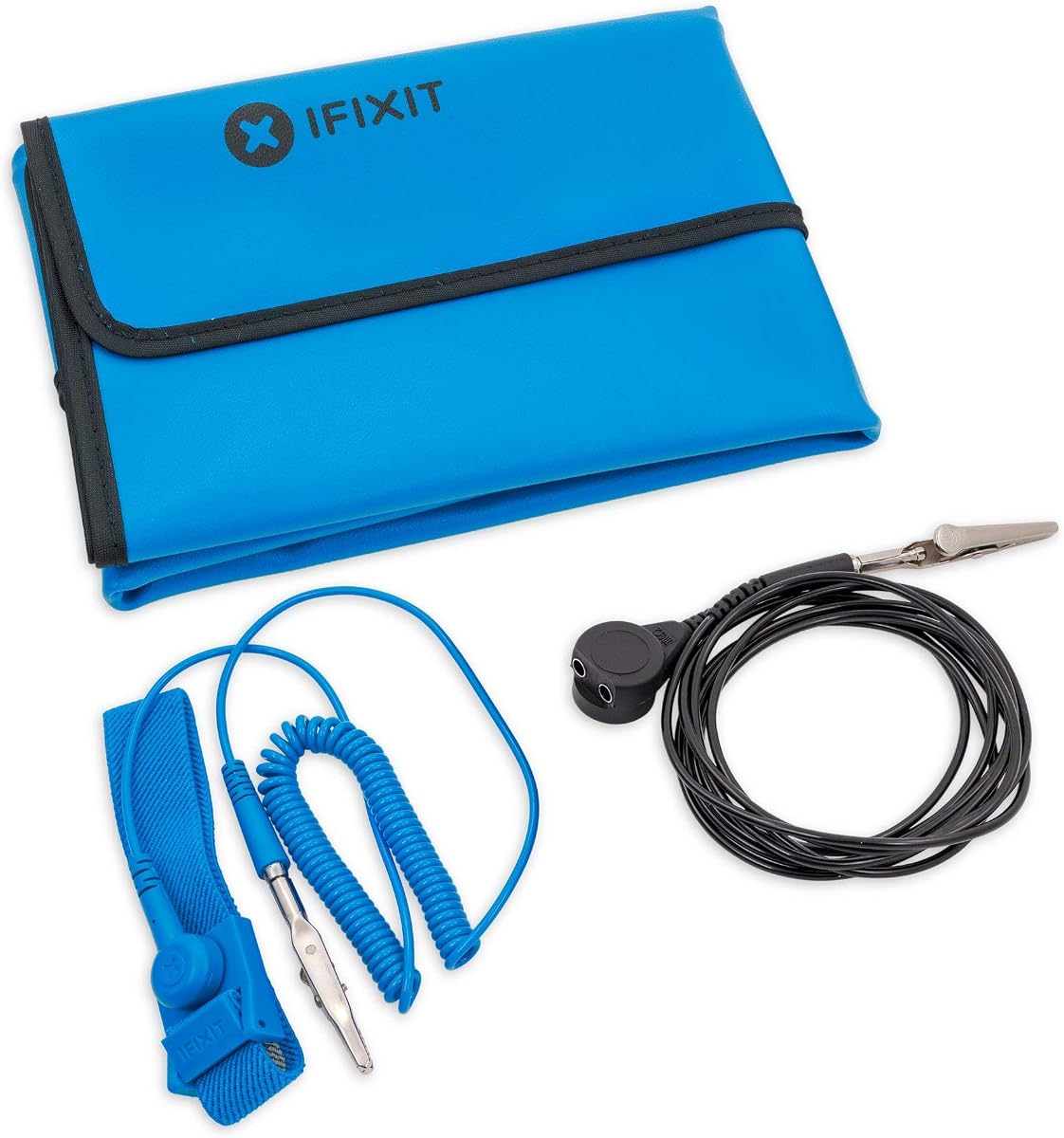
The iFixit Portable Anti-Static Mat combines a 60-by-60-centimeter pad, an adjustable wrist strap, and a 1.8-meter grounding cord. Its 4.7 rating and straightforward design make it a practical choice for hobbyists, professional engineers, and technicians who work away from a fixed bench.
We may earn a commission when you buy through this link, at no additional cost to you.
The pad can be folded, wrapped, and transported without losing its core function. Listed surface resistivity is 10^7 to 10^9 ohms, while the grounding system uses a 10-millimeter snap and a 1.8-meter cord with a stated resistance of 10^5 ohms.
The compact dimensions are the primary limitation. While suitable for phones, tablets, and many component-level repairs, the mat is not as accommodating for large laptops, multiple motherboards, or extensive tool staging. The simple grounding instructions also give an example of connecting to a grounded object, so users should ensure their chosen point follows appropriate safety practice.
This mat is a strong option for mobile repair kits and field service. Its included wrist strap and cord support a complete setup, and its portability makes it easier to establish a controlled static work area wherever the job takes place.
The flexible mat can be folded and wrapped for transport, allowing the protective surface to move between workstations. This is especially useful for technicians who carry small parts from one client location to another.
The adjustable wrist strap and attached grounding cord create a simple connection between the worker and the mat. The included components make the system approachable while keeping the user's hands and components on the same controlled surface.
We may earn a commission when you buy through this link, at no additional cost to you.
The Kaisi Large Anti Static Mat provides a 21.6-by-16.9-inch silicone work area with a 4.4 rating. Its 48 built-in screw and parts positions are a major feature, giving technicians clearly separated places to organize small pieces during complex repairs.
We may earn a commission when you buy through this link, at no additional cost to you.
The grounding kit includes a plug, grounding wire, and ESD wrist strap, allowing users to connect the mat and themselves to ground. The mat also has a listed 932°F heat resistance and is described as corrosion resistant, making it suitable for soldering irons and hot-air workstations that make direct contact with the surface.
Its broad footprint supports larger electronics and common projects such as PC building, computer and laptop repair, MacBook, iPad, iPhone, drone, PCB, and Raspberry Pi work. The tradeoff is that the grounding accessories are packed in the middle of the paper tube, so buyers should check the package carefully when it arrives.
This is a useful all-around repair mat for people who want a generous area, high heat tolerance, and extensive part organization. Its combination of storage and grounding accessories reduces the need for separate trays, although users should verify all included pieces during unpacking.
A large number of dedicated positions is unusually useful for repairs involving numerous screws, shields, connectors, and other tiny components. Separating parts by position can make reassembly more methodical and reduce accidental mix-ups.
The listed 932°F temperature tolerance allows soldering irons and hot-air workstations to contact the silicone pad directly. This makes the mat more than a static-control surface; it also serves as a protective soldering surface.
We may earn a commission when you buy through this link, at no additional cost to you.
The Green ESD Anti-Static Soldering Roll stands out with a 5.0 rating and a long, narrow 23.7-by-118-inch format. At nearly ten feet long, it can create a continuous protected zone along a bench, giving repairers room to spread out larger projects.
We may earn a commission when you buy through this link, at no additional cost to you.
Its dual-layer rubber design places a static-dissipative green surface over a black conductive bottom. The listed top resistivity is 2×10^6 to 10^8 ohms, and the bottom is listed at 8×10^6 to 10^8 ohms. The product information also states that static clears in less than 0.1 second.
The embossed surface is designed to reduce glare and slipping, while the rubber core is listed as resistant to heat, oil, grease, and solvents. A stated abrasion figure of 0.02g/cm² supports its positioning for wear-resistant use. The main omission in the supplied details is a clearly listed grounding accessory package or step-by-step connection method.
This roll is best for a technician who wants a nearly ten-foot bench mat and values the listed rapid dissipation performance. It is well suited to phones, printed circuit boards, electronics, semiconductor work, aerospace applications, and medical device assembly, provided the user supplies or confirms an appropriate grounding arrangement.
The stated dissipation time of less than 0.1 second is one of the strongest performance figures in the comparison. It is particularly relevant for fine electronics work where controlled charge removal is the mat's primary purpose.
The 118-inch length can run along a narrow workbench or across multiple adjacent stations. This format may suit users who want a continuous surface without the depth required by a broad rectangular pad.
We may earn a commission when you buy through this link, at no additional cost to you.
The Relaxweex Two-Pack includes two 17-by-25-inch anti static mats, two wrist straps, and two grounding wires. Its 4.7 rating makes it a practical choice for users who want to create more than one protected work area without purchasing separate kits.
We may earn a commission when you buy through this link, at no additional cost to you.
Each mat is 0.08 inches thick and made from rubber described as durable, heat resistant, and easy to clean. The listed operating range is approximately -20°F to 160°F, with surface resistivity of 10e9 to 10e10 ohms. These specifications make it suitable for everyday workshop and electronics-repair use.
The package is not designed around hot-tool contact to the same degree as the silicone mats advertising 932°F resistance. It also has no listed compartments, so users needing to separate dozens of tiny parts would need a separate organizer. The two-mat format nevertheless offers flexibility for multiple benches, workrooms, or a primary and backup station.
This set is especially useful for repair professionals, schools, or shared household workspaces where one mat cannot cover every task. Two individually grounded setups can reduce interruption when work moves between locations or when multiple users need a protected surface.
Because each mat has its own wrist strap and grounding wire, the package can support two separate work areas. That is useful for classrooms, shared benches, or technicians who alternate between repair and assembly tasks.
The grounding wires and wrist straps keep the essential components together, and the mats can be rolled for storage. The basic setup is approachable: ground the mat, wear the strap, and keep the components on the protected surface.
We may earn a commission when you buy through this link, at no additional cost to you.
The right anti static mat depends on the work you perform, the area available, and your grounding setup. The following factors help distinguish a compact portable kit from a full-length bench roll and show where the ten products differ most.
Choose a properly grounded, dissipative design and follow its connection instructions. Surface resistivity and volume resistivity can help distinguish technical options, but those figures should not be treated as a substitute for a safe and complete grounding arrangement.
Match the surface to the largest equipment you regularly handle. Compact mats suit phones and small boards, while laptop, tablet, camera, and motherboard work benefits from a deeper surface or continuous roll.
Check the accessory list carefully and make sure you have a suitable, safe ground point available. More included components can make setup easier, but the quality of the connection and the user's grounding habits matter more than the number of parts in the box.
For frequent direct-contact soldering, prioritize a clearly stated high-temperature rating and a surface that is not marketed solely for electronics storage. For occasional repair work, the temperature range and intended use of a mat should guide the decision.
Choose a portable design if transport matters more than maximum surface area. A heavier roll offers continuous coverage but takes up more storage space, while a foldable kit is easier to place in a backpack or tool bag.
If frequent disassembly is part of your routine, integrated storage can save time and reduce mix-ups. If your work involves only a few components at once, a simpler mat may provide all the function you need.
Consider the conditions around your bench. Choose a surface that suits your soldering habits, is easy to clean, and will not create an unpleasant smell in an enclosed or shared workspace.
Read the intended-use limitations before buying. A mat for PC assembly, field repair, professional soldering, or formal industrial work may have different requirements, and a general electronics mat should not be assumed to satisfy every testing or certification standard.
Begin by placing the mat on a stable, clean work surface where the device under repair and small components can remain on it. Review the manufacturer's grounding instructions, connect the grounding cord to the appropriate ground point, and confirm the connection before handling sensitive electronics. Keep the mat away from moisture, debris, and unnecessary traffic.
Wear the included or compatible anti static wrist strap as directed, and place the device, boards, loose components, and relevant tools on the mat. Avoid working with exposed circuitry directly on an unprotected surface. After each task, disconnect the grounding connection as recommended and remove solder residue or other contamination while the surface is cool.
Store a portable mat folded or rolled only after it is clean and dry, and follow the product's instructions for folding or rolling. Wipe compatible surfaces with a suitable cleaner rather than immersing the mat or using harsh liquids. Inspect the grounding cord, snap, clip, and wrist strap periodically for damage, and replace damaged accessories before relying on the setup again.
Proper grounding is essential because it provides the path for controlled static charge to dissipate. A mat without a correct connection to an appropriate ground point may not deliver the intended ESD protection, even if its surface is static dissipative. Follow the manufacturer's connection instructions and use a suitable ground point.
It depends on the mat's material and stated heat-resistance rating. The HPFIX and Kaisi silicone options list 932°F heat resistance, while the roll mats are also described as heat resistant. Check the product specifications before allowing a hot tool to rest directly on any surface, and follow the manufacturer's temperature guidance.
A wrist strap is generally an important part of a personal grounding system because it helps equalize the electrical potential between the person and the work surface. Many kits include one, but the StarTech product references a separate SWS100 strap. Check the package contents so you do not assume an accessory is supplied.
The best size depends on the laptop model and whether you want room for tools beside the device. The 17-by-25-inch and 21.6-by-16.9-inch mats provide ample room for many laptop jobs, while larger rolls suit a permanent bench. Smaller pads can still work if the laptop remains fully on the protected surface.
Yes, and several products in the list are specifically intended for PC building and component upgrades. The Portable 24-Inch Kit is designed for beginner builders and GPU, RAM, SSD, and power supply swaps, while the larger rectangular pads offer additional space for staging parts and tools.
Resistance values describe how the mat's materials control electrical charge, and the relevant number can differ by layer or measurement type. Some products list surface resistivity, while others also provide base or volume resistance. Compare like measurements and review the manufacturer's intended use rather than treating every value as directly interchangeable.
No. A longer roll is valuable for a permanent bench because it provides continuous coverage, but it may be unnecessary for occasional phone repairs or a small workspace. A portable or compact mat can provide better flexibility, easier storage, and sufficient area for the electronics you actually handle.
Allow the mat to cool, then wipe away residue using a cleaner compatible with its material. The Pangda and Green Roll descriptions specifically mention resistance to common solvents and easy cleaning, but no cleaning method should be assumed to be safe for every mat. Avoid immersing the surface or using chemicals that could damage it.
The HPFIX Silicone Soldering Mat is a compelling value-oriented choice because it combines a 4.7 rating with high heat resistance, grounding accessories, and built-in organization. The HPFIX Magnetic Electronics Mat is the most balanced overall option for users who want a generous protected zone, long grounding leads, numbered compartments, and room for larger electronics.
For a dedicated professional workstation, the Pangda Natural Rubber ESD Roll stands out with its continuous ten-foot length, low-odor material, two-layer construction, and detailed electrical specifications. Portable work is better served by the Portable 24-Inch ESD Kit or the folding iFixit mat, while the Relaxweex set is useful when two complete work areas are needed.
Prioritize a proper grounding method, adequate surface area, and a temperature rating that matches your soldering habits. Confirm included accessories, read the intended-use limits, and compare current product details before buying. Prices, ratings, and availability can change, so checking the latest listing information is an important final step.