
VEVOR 100W Foldable Solar Panel
5.0Editor score
24% cell efficiency
Multiple direct charging ports
Compact folding construction
Compare the best foldable monocrystalline solar panels for power stations, examining efficiency, output, portability, durability, and compatibility.
Foldable monocrystalline solar panels combine efficient solar cells with a portable briefcase-style format, making them useful for camping, RV travel, emergency preparation, and charging compatible power stations. The best examples balance usable rated output, manageable weight, durable construction, and dependable connector options without becoming overly complicated to set up.
This guide compares ten foldable monocrystalline solar panels across wattage, cell efficiency, portability, weather protection, direct charging features, kickstand design, and power-station compatibility. It also considers models with different output levels, from a compact 100W panel to larger 500W equipment designed for substantial charging demands.
Each review identifies the product's strongest use case and any practical limitations. Ratings and specifications reflect the supplied product information, while availability and pricing can change over time, so readers should confirm current details, connector requirements, and power-station input limits before purchasing.
5.0Editor score

4.5Editor score

4.5Editor score
The comparison below places all ten panels side by side, highlighting their nominal output, conversion efficiency, portability, weather resistance, and connection options so buyers can quickly identify the model that matches their power station and travel needs.



The Renogy 200W Portable Solar Panel for Power Stations is a well-rounded option for travelers who want meaningful charging capacity without carrying the largest briefcase-style panel available in this guide. Its 4.5 rating, 25% claimed N-type cell efficiency, and relatively low 13.89-pound weight make it particularly appealing for RV trips, campsites, and emergency reserves.
We may earn a commission when you buy through this link, at no additional cost to you.
Its strongest feature is the balance between output and portability. Sixteen back-contact N-type cells are designed to capture more energy from the same illuminated surface, while the magnetic folding design reduces to a reported 23.72 by 22.99 by 1.97 inches. Four kickstands offer 40-, 50-, and 60-degree positioning, giving users practical control over the angle between the panel and the sun.
The panel also adds conveniences that are often missing from simpler solar generators. A USB-C Power Delivery port supports up to 45W, while two USB-A ports allow direct charging of phones, tablets, laptops, GPS units, and cameras. For power-station charging, MC4 is the main output, and compatibility extends to several popular Jackery, EcoFlow, and Anker models when their input requirements are met.
The main trade-off is that the four-in-one adapter is sold separately, so buyers who depend on more than MC4 should account for that accessory before making a final choice. Even so, the combination of efficiency, low weight, useful direct charging, certification claims, and straightforward positioning makes this the most versatile general-purpose pick in the roundup.
It is best suited to travelers who want one panel to handle both power-station replenishment and occasional direct device charging. RV owners who need greater output can move to a larger model, while campers seeking a lighter option may prefer the 100W VEVOR. For most users seeking a balanced portable monocrystalline panel, however, this Renogy model delivers the most complete feature set.
The 25% efficiency specification and low 13.89-pound weight distinguish this model from many similarly sized competitors. That combination is valuable when every storage cubic inch and carried pound matters, particularly for RV storage compartments and backcountry campsites.
USB-C PD, dual USB-A, and MC4 output give the panel useful flexibility. Direct charging is convenient for smaller electronics, while MC4 handles appropriately matched portable power stations and compatible battery systems.
We may earn a commission when you buy through this link, at no additional cost to you.
The ZOUPW 200W Portable Solar Panel for Power Station is built around convenience and broad connectivity. Its 4.5 rating reflects a competitive overall package featuring A+ grade monocrystalline cells, a claimed 23.5% conversion rate, a foldable briefcase design, and both direct USB charging and an unusually broad collection of power-station adapters.
We may earn a commission when you buy through this link, at no additional cost to you.
The included 10-foot, five-in-one cable covers XT60, Anderson, DC7909, DC8020, and DC5521 connections. That broad selection is especially helpful for buyers who own different portable power stations or are uncertain which input interface their current model uses. The product information also identifies compatibility with several Jackery, Bluetti, EcoFlow, and Anker Solix models.
The junction box integrates USB-A QC 3.0 and USB-C PD up to 60W, offering direct charging for communication devices, phones, tablets, and cameras when no power station is available. Its IP67-rated panel and ETFE laminate offer strong resistance to dust and splashes, although the junction box itself is only water-resistant and should not be submerged.
The reported 18.96-pound weight is heavier than the Renogy 200W model, making it less convenient for hikers carrying a power station over long distances. Its four adjustable kickstands and magnetic handles simplify setup, while the claimed gain from positioning the panel at 45 degrees adds practical value for users who can optimize the sun angle.
This panel is a strong fit for RV and camping systems where connector variety matters more than minimum carrying weight. It can also serve as a standalone charging panel for small devices during outages. Buyers should verify the voltage, connector shape, and input limits of their equipment, but the supplied adapter selection makes this an adaptable choice.
The five-in-one cable includes XT60, Anderson, DC7909, DC8020, and DC5521 connections. That variety reduces the need to buy separate leads for different power stations and is one of the ZOUPW panel's most user-oriented features.
USB-A QC 3.0 and 60W USB-C PD outputs make the panel useful when a portable power station is unnecessary. Keeping communication and navigation devices charged can be especially valuable during camping trips and power interruptions.
We may earn a commission when you buy through this link, at no additional cost to you.
The VEVOR 100W Foldable Solar Panel is the most compact-oriented selection here, offering a practical entry point for hikers, tent campers, and owners of smaller power stations. It carries a 5.0 rating and combines 16BB PERC monocrystalline cells with a claimed conversion efficiency of at least 24%.
We may earn a commission when you buy through this link, at no additional cost to you.
Its compact format is the central advantage. Rather than carrying 200W to 500W of rated capacity, users get 100W in a folding design intended to fit more readily into packs and vehicle storage areas. The panel supports phones, tablets, and other compatible devices through USB-A, USB-A QC 3.0, Type-C, and DC output options.
Connection versatility is unusually broad for a compact panel. A built-in MC4 cable, a three-in-one MC4 connector cable, and a ten-in-one DC adapter set cover many common power-station inputs. That makes it easier to connect to equipment whose native socket differs from the panel's primary MC4 interface.
The trade-off is obvious: 100W will recharge large power stations more slowly than higher-output choices, and its IP65 protection rating is less impressive than the IP67 or IP68 ratings offered by several competitors. The listed operating range of 14 to 149 degrees Fahrenheit nevertheless indicates suitability for a broad range of outdoor environments.
This VEVOR is best for buyers who prioritize mobility, direct charging, and a broad adapter kit over maximum wattage. It also works well as a supplementary panel for smaller electronics or a modest power station. Travelers needing to replenish a large battery quickly should favor the 300W, 400W, or 500W selections instead.
A 100W rating makes this panel easier to incorporate into lightweight camping and hiking kits. It is better suited to smaller stations, electronics, and battery maintenance than to rapidly replenishing a high-capacity power bank.
USB-A, QC 3.0, Type-C, and DC connections provide several ways to keep common devices charged. Sharing one panel among a group can be simpler than carrying separate charging accessories and a separate small battery.
We may earn a commission when you buy through this link, at no additional cost to you.
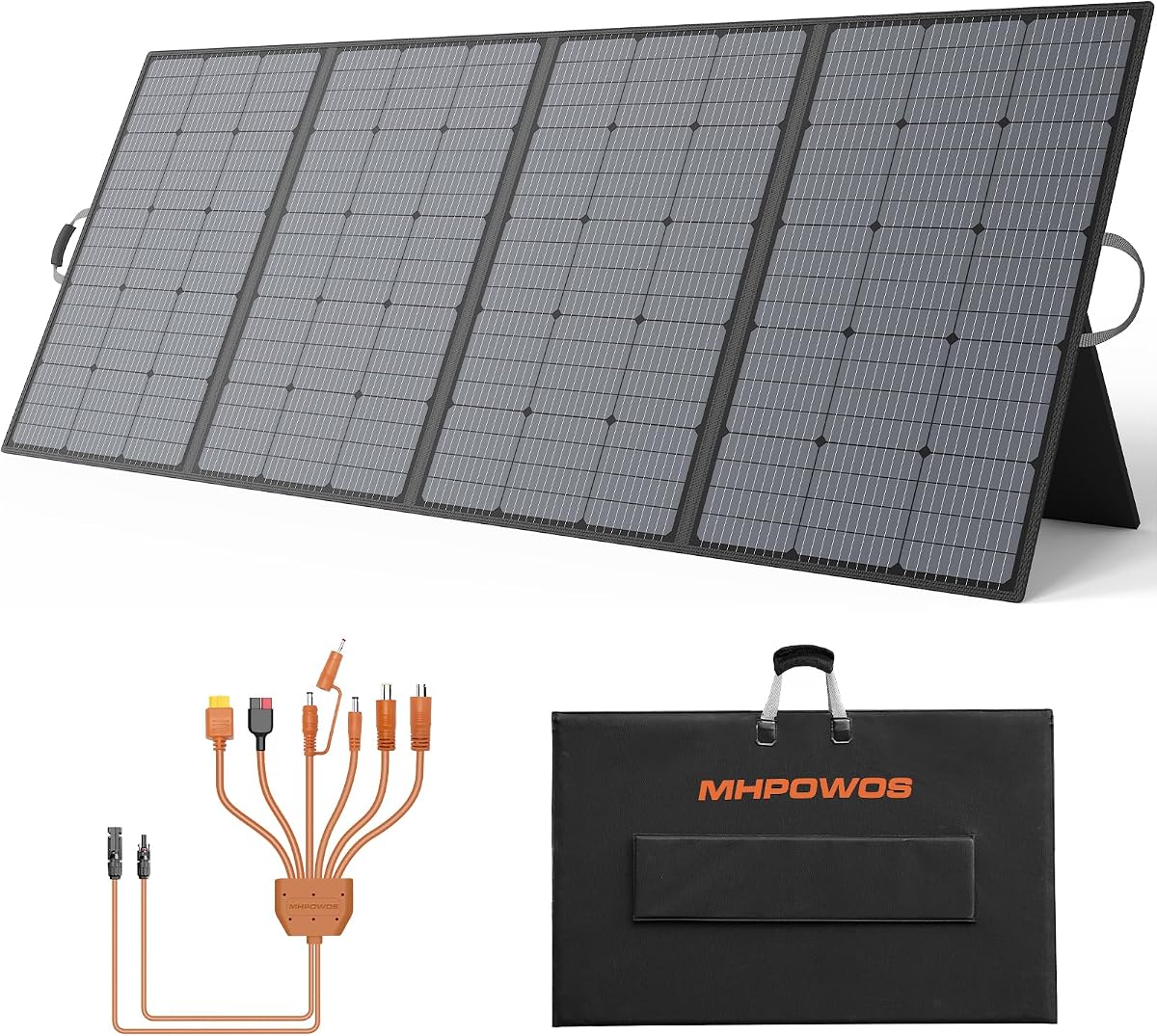
The MHPOWOS 400W Portable Solar Panel Foldable Solar Charger for Power Station sits in the middle of this guide's performance range, offering more charging capacity than the 200W models while remaining smaller than the 500W PECRON. Its 4.1 rating reflects a capable but more utilitarian design built around A+ monocrystalline cells with a 23.5% claimed conversion rate.
We may earn a commission when you buy through this link, at no additional cost to you.
A major strength is the connector package. Anderson, XT60, DC7909, DC5521, DC8020, DC5525, and DC35135 options cover a broad selection of portable power stations. The panel's plug-and-play approach and adjustable positioning hardware should simplify setup for RV owners and campers who already own compatible equipment.
Four integrated kickstands support positioning on a flat surface, and the multifold construction stores in a zippered accessory pouch. An IP67 rating for dust and water resistance supports outdoor use, while the higher 400W rating can shorten the charging cycle for compatible high-capacity stations compared with 100W, 200W, or 300W alternatives.
The important limitation is that a power station's maximum solar input may be lower than 400W. Even under excellent conditions, the station cannot accept more than its rated input limit, so the panel may operate below its maximum capability. Buyers should also account for the larger footprint and additional handling created by a four-panel-style portable design.
This model suits buyers who want substantial output and already own a power station with a matching input. It is less attractive for casual hikers who will rarely carry or deploy a panel this large. Those who value the highest cell efficiency or a bifacial design may prefer the 500W PECRON or 400W bifacial alternative.
At 400W, the panel is better matched to medium and large portable power stations than the compact models in this guide. It can still be used with smaller stations, but their input ceilings may prevent the panel from delivering its full rated potential.
Seven supported plug formats cover many popular battery ecosystems. Reviewing the socket and electrical requirements of the intended power station before ordering is still essential, since physical compatibility alone does not guarantee supported input voltage or current.
We may earn a commission when you buy through this link, at no additional cost to you.
The PECRON 500W Portable Solar Panel is the highest-output conventional monocrystalline model in this roundup. Its 4.5 rating, 500W maximum power, and claimed 25.1% conversion efficiency make it a compelling premium choice for RV systems, large power stations, and users who want to minimize deployment time.
We may earn a commission when you buy through this link, at no additional cost to you.
Despite its four-panel construction, the listed weight is 22.5 pounds. A thick integrated handle helps with transport, and adjustable kickstands allow the panels to be tilted vertically toward the sun when needed. The listed electrical details include a 42.5V maximum-power voltage and a 49.3V open-circuit voltage, useful information for advanced battery-system matching.
Outdoor durability is another strength. An IP67 rating provides dust and water protection, while the stated operating range of approximately -10 to +70 degrees Celsius covers demanding cold and hot conditions. The corrosion-resistant surface is also intended to preserve performance over extended outdoor use.
Compatibility is more standardized than that of the MHPOWOS and E-POWO models because the package includes an MC4 extension cable and an MC4-to-XT60 adapter. Owners using another connector format may need an additional suitable lead. The panel also lacks the broad direct USB charging features found on the Renogy 200W and VEVOR 100W models.
This is the premium pick for users with a large power station, an RV battery system, or an immediate need for high solar input. It is less suitable for backpack-based trips because its unfolded area is substantial. Buyers should verify the receiving device's solar input specifications, especially its voltage window and maximum accepted wattage.
The 500W rating provides a high ceiling for compatible power stations and battery systems. Actual charging speed still depends on sunlight, alignment, temperature, cable losses, and the receiving device's input limit.
Vertical sun-angle adjustment can help users obtain better results during winter mornings and summer noon. The ability to change the panel orientation is especially valuable for portable systems installed away from a permanently fixed RV position.
We may earn a commission when you buy through this link, at no additional cost to you.
The VEVOR 300W Foldable Monocrystalline Solar Panel offers a middle ground between the 200W models and the larger 400W to 500W choices. With a 4.2 rating and a claimed 22–23% efficiency range, it is a practical choice for users who want more charging capability than a compact panel without carrying the largest setup.
We may earn a commission when you buy through this link, at no additional cost to you.
The panel includes a built-in MC4 cable, a four-in-one MC4 connector cable, and a ten-in-one DC adapter set. This extensive accessory coverage should accommodate many common power stations. Its monocrystalline cells, tempered glass surface, and IP67 rating provide a solid outdoor foundation for RV travel, camping, fishing, and emergency use.
A stated operating range of -4 to 149 degrees Fahrenheit allows use across a wide range of climates. The foldable design and relatively modest 300W rating make it easier to integrate into an RV storage plan than the 400W and 500W alternatives, although the exact carried weight is not specified in the supplied information.
Compared with the top efficiency claims in this guide, 22–23% conversion is slightly lower. That does not make the panel weak; it remains capable of generating useful energy, especially for compatible medium-capacity stations. It also lacks direct USB outputs, so users who want to charge phones directly should look to the Renogy 200W, ZOUPW 200W, or VEVOR 100W models.
This panel best serves RV owners and campers who want a balance of capacity, portability, and adapter availability. It is a sensible middle option when 200W feels too modest and 400W or 500W would be cumbersome. Verify the intended power station's input rating and ensure the appropriate connector is included before buying.
The 300W rating is large enough for many portable power-station charging routines but easier to manage than the highest-output panels. It can serve as the central renewable input for a medium-sized station during a weekend trip.
Tempered glass and IP67 protection add outdoor resilience, while the stated temperature range covers common camping environments. The panel remains vulnerable to severe impacts and should be fully retracted before transport.
We may earn a commission when you buy through this link, at no additional cost to you.
The VEVOR 200W Foldable Solar Panel with Frame stands apart through its included 30A PWM controller and alligator clips. Its 4.0 rating reflects a straightforward 200W option designed for users who want to connect solar generation to batteries as well as compatible MC4 equipment.
We may earn a commission when you buy through this link, at no additional cost to you.
The controller provides a more familiar path for charging 12V battery setups and can simplify connection for RV or camping projects. A built-in MC4 cable preserves compatibility with many portable power stations, while the monocrystalline cells offer a claimed efficiency of at least 23% and a rated output of 200W.
The framed construction should appeal to buyers who want extra structural support around the folding sections. An IP67 rating and a stated 14-to-149-degree Fahrenheit operating range support use across varied weather conditions. The folding design also allows the panel to be stored away when it is not being used for charging.
Its limitations are the absence of direct USB charging and a more limited connector ecosystem than products bundled with multi-format adapter sets. Alligator clips and a PWM controller may be unnecessary for users who already own a modern power station with optimized solar input. Buyers should select a charge controller appropriate for their battery type and voltage rather than assuming every battery is directly compatible.
This panel is a good candidate for DIY battery users, van builders, and RV owners who want a controller in the box. It is less suitable for campers who primarily need direct phone charging or effortless connection to a proprietary station. For those priorities, the Renogy 200W or ZOUPW 200W models offer more integrated charging choices.
The 30A PWM controller and alligator clips create a more complete connection kit for basic battery charging. This reduces the number of separate accessories required when the destination is a battery rather than a power station.
A straightforward 200W monocrystalline design is easier for new solar users to understand than some multi-port or highly specialized alternatives. Correct battery chemistry, voltage, and charge limits remain the buyer's responsibility.
We may earn a commission when you buy through this link, at no additional cost to you.
The Renogy 300W Portable Solar Panel combines 25% N-type efficiency with a 300W rating, placing it between the 200W and 400W products in this guide. Its 4.2 rating and 18.74-pound weight make it a serious option for RV owners who want efficient output without moving to the largest panel class.
We may earn a commission when you buy through this link, at no additional cost to you.
The panel uses 16BB N-type cells and parallel wiring designed to reduce the effect of partial shading. This can be particularly useful near trees or where passing clouds interrupt direct sun. Its IP67 waterproof construction, hail-resistant ETFE coating, and listed extreme-temperature range add further confidence for outdoor deployment.
Setup is refreshingly simple: unfold the panel, extend the rust-proof kickstands, and position it toward the sun. The stated one-minute setup estimate applies to the physical deployment rather than electrical connection. IP68 connectors and broad compatibility with portable power stations and batteries make it broadly usable with appropriate equipment.
The product information cites up to 960Wh of daily output, but actual generation depends on sunlight and other environmental conditions. Its folded dimensions of 23.2 by 29.3 by 3.2 inches also make it larger than some 200W alternatives. In exchange, it offers more rated capacity and high cell efficiency without moving into the 400W or 500W size class.
This is an excellent choice for RV users, campers with medium-sized stations, and anyone who values efficient production under variable conditions. It lacks direct USB ports, so travelers should plan to charge small devices through a power station or separate charging arrangement. Verify the receiving system's input specifications before connecting it.
Parallel wiring is intended to keep individual shadows from reducing the output of the interconnected panel as dramatically as they might in a simple series arrangement. It cannot eliminate shading losses, but it can improve real-world consistency.
The folding body and integrated kickstands make it possible to deploy the panel quickly as light conditions change. This convenience is useful when a campsite offers only brief periods of direct sunlight.
We may earn a commission when you buy through this link, at no additional cost to you.
The E-POWO 400W Portable Solar Panel is designed for buyers who want substantial output and several ways to orient the panel in the field. Its 4.2 rating, claimed 23.5% efficiency, and IP67 protection support its positioning as a rugged option for camping, hiking, RV travel, and emergency outages.
We may earn a commission when you buy through this link, at no additional cost to you.
The most immediately noticeable characteristic is weight. At 15.57 kilograms, approximately 34.3 pounds, it is one of the heavier products in the guide. That makes it more appropriate for a vehicle, boat, or basecamp than for a hiker carrying a full portable power system over distance.
Its fold dimensions are 37.76 by 24.96 by 1.3 inches, and the panel includes an accessory pouch and adjustable supports. The supplied information describes three angle options at 40, 50, and 60 degrees. Reinforced grommets also provide mounting points for an RV or tent, expanding its use beyond freestanding placement.
The panel uses ETFE-laminated monocrystalline cells, waterproof Oxford fabric casing, and a fiberglass structure intended to provide corrosion resistance and thermal stability. A seven-in-one cable supports Anderson, XT60, DC7909, DC5521, DC8020, DC5525, and DC35135 connections, covering many common power stations.
E-POWO is best for stationary vehicle-based deployments where weight is manageable and higher output is valuable. The included adapter selection and flexible mounting options reduce installation barriers. As with every panel, clouds, obstacles, poor orientation, and receiver limits can reduce actual charging performance, so the rated wattage should not be treated as a constant.
Three angle settings help users balance incident light with stable placement. Adjusting the panel as the sun moves can improve production, particularly during shorter days when every available hour of direct sunlight matters.
Reinforced grommets make temporary attachment to an RV, tent, or other suitable support possible. This gives owners more placement options when the ground is uneven or direct sunlight is limited.
We may earn a commission when you buy through this link, at no additional cost to you.
The MHPOWOS 400W Bifacial Portable Solar Panel N-Type 16BB is the only bifacial design in this roundup. Its 4.4 rating and claimed 25% conversion efficiency make it distinctive, while the bifacial construction allows it to collect sunlight from both the front and rear surfaces.
We may earn a commission when you buy through this link, at no additional cost to you.
The product information states that two-sided generation can produce up to 20% more energy than a single-sided panel. Actual gain depends on how much reflected light reaches the rear surface, so a pale surface, reflective roof, or elevated installation can perform differently from a placement over vegetation or soil.
At 19.7 pounds, the panel is lighter than several conventional 400W options in this guide. Three reinforced brackets allow it to be secured to a flat surface after unfolding, and a rubber handle assists transport. Support brackets can be adjusted between 30 and 60 degrees to improve the angle of the active surface.
Weather resistance is strong, with an IP68 rating and an ETFE monocrystalline surface over an anti-corrosive aluminum frame. The seven-in-one cable includes DC7909, DC8020, XT60, DC5521, DC5525, DC35135, and Anderson connections. Despite these strengths, the panel does not store electricity and requires a compatible power station or battery system.
This bifacial model is a compelling premium option for buyers who can place the panel where light can reach both sides. It is less suitable for shaded campsites where the rear surface receives little reflected light. For users who understand bifacial positioning and want 400W output in a relatively manageable package, it provides a meaningful technical advantage.
Bifacial cells can collect reflected sunlight in addition to direct illumination. The potential gain is meaningful when the panel is elevated over a reflective surface, but it becomes smaller when the back is blocked or surrounded by low-reflectance terrain.
A 19.7-pound weight is encouraging for a 400W portable panel. N-type cells, ETFE protection, an aluminum frame, and IP68 protection combine high-output potential with materials intended for extended outdoor service.
We may earn a commission when you buy through this link, at no additional cost to you.
A useful purchase decision depends on more than nominal wattage. Battery capacity, connector type, transport weight, deployment area, expected weather exposure, and charging habits should guide the selection just as much as the advertised cell efficiency.
Rated wattage indicates the panel's maximum electrical output under specified test conditions, while a portable power station's battery capacity determines how much energy it can store. A larger panel is not automatically better: it may charge quickly but require more space, and a smaller panel may be perfectly adequate for phones, lights, cameras, and a modest battery bank. Match the panel's output to the receiving equipment rather than selecting solely by the largest wattage available.
Choose a 100W panel for small systems and mobility, 200W for general camping use, and 300W to 500W for larger stations or faster replenishment. Always verify the power station's maximum solar input.
Monocrystalline cells are used across all ten selections, but their claimed conversion efficiency ranges from 22% to 25.1%. Higher efficiency can translate into more usable output from the same panel area and may offer an advantage where space is constrained. Efficiency is only one part of real-world production, however; temperature, sun angle, shading, wiring, and controller losses also influence charging speed.
Prioritize efficiency when footprint matters, but do not ignore total wattage, weight, durability, or connector fit. A smaller high-efficiency panel may be ideal for an RV, while a larger standard-efficiency panel may better serve an open campsite.
Foldability reduces storage volume, but the weight still has to be moved. The lightest selections here are more suitable for hiking or carrying into a remote campsite, while models around 19 to 23 pounds are generally better suited to vehicle-based travel. One heavier product is particularly substantial, so buyers should assess who will unpack and reposition it each day.
Include the power station, battery cables, and accessories when estimating the total load. A modest panel that can be carried comfortably may be more valuable than a larger one that remains in the vehicle.
MC4 is the most common output among these products, but portable power stations use several proprietary and semi-standard sockets. Some panels include adapters for XT60, Anderson, DC7909, DC8020, DC5521, DC5525, or DC35135, while others primarily provide MC4 and a limited adapter set. Connector shape alone is not enough: input voltage, current, polarity, and the manufacturer's charging rules must also match.
Identify the exact power-station model before buying and compare its solar-input specifications with the panel's output. If the intended device supports only a lower input rate, a more powerful panel may not charge it any faster.
USB-A and USB-C outputs can be valuable for charging phones, tablets, navigation units, and cameras without routing energy through a power station. Some panels provide USB-C Power Delivery at 45W or 60W, which is more suitable for demanding electronics than a basic USB connection. Direct charging is especially helpful during emergencies when preserving communication equipment matters more than filling a large battery bank.
Check the output protocol, charging power, and supported devices before relying on direct charging. If a panel lacks USB outputs, verify that the portable power station has suitable USB ports.
IP65, IP67, and IP68 ratings indicate progressively stronger protection against dust and water under defined test conditions. They help assess outdoor resilience but do not make a panel immune to wind, hail, impact, prolonged heavy rain, or immersion. ETFE surfaces, tempered glass, corrosion-resistant frames, and reinforced grommets add further practical protection when handled outdoors.
For exposed campsites and RV travel, choose at least IP67 when available. Regardless of rating, retract the panel during severe weather and store it dry rather than treating the rating as permission to leave it deployed indefinitely.
Adjustable kickstands make it easier to obtain a favorable angle without improvising support. Options ranging from roughly 30 to 90 degrees cover different sun angles and seasons, while reinforced grommets permit mounting to an RV or tent. A bifacial panel adds another consideration because its rear cells need unobstructed access to reflected light to deliver the greatest advantage.
Choose a model with enough positioning options for the intended environment. Vertical adjustment can be valuable in winter, while stable ground placement and reinforced attachments help in windy locations.
Included cables, adapters, controllers, pouches, and manuals can determine how quickly the panel becomes useful. A complete adapter set may eliminate extra purchases, while a PWM controller and alligator clips can be valuable for direct battery projects. Warranty duration and support responsiveness also matter because portable panels face repeated folding, transport, and outdoor exposure.
Review the complete package rather than comparing the panel alone. Confirm that a separate controller is unnecessary for your chosen setup, that the correct adapter is included, and that the warranty and support terms meet your needs.
Before first use, identify the receiving battery or power station, verify its solar-input voltage and current limits, and inspect the panel, cable, and connector for damage. Confirm that the connector and any adapter are electrically and physically appropriate. Deploy the panel on a stable, unobstructed surface, unfold it carefully, and orient the active surface directly toward the sun using the available kickstands.
Connect the panel to the power station or charge controller before or after positioning it according to the equipment manufacturer's instructions. Avoid leaving the panel unattended where children, pets, traffic, or strong winds could create hazards. Recheck the angle as the sun moves, and remove or cover the panel during heavy rain, hail, or severe wind. Remember that rated wattage is a maximum rather than a constant charging rate.
When the trip or charging session ends, disconnect the cable, retract the panel fully, and remove loose adapters. Fold along the designated seams without forcing them, then place the unit in its pouch or designated storage area. Keep it dry, avoid placing heavy objects on the cells, and inspect connectors for dirt or corrosion. Periodic gentle cleaning with a soft, dry cloth helps preserve surface and connection performance.
Yes, if the panel's output, voltage, and connector match the power station's solar-input requirements. Most models use MC4 as their primary output and may include adapters for popular station brands. Check the receiving unit's maximum input wattage, because it may accept less than the panel can produce.
Wattage is the panel's maximum rated electrical output, while efficiency describes how effectively its cells convert sunlight into electricity. A higher-efficiency panel can produce more power in the same area, but total wattage remains important. Consider efficiency, physical size, weight, and the battery's input limit together.
Some models include USB-A or USB-C outputs that support direct charging of phones, tablets, GPS units, cameras, and certain laptops. The ZOUPW panel provides USB-C PD up to 60W, while the Renogy 200W model supports up to 45W. Other panels in the guide require a portable power station for device charging.
It can, provided the power station accepts that input and sunlight conditions are suitable. The station's maximum solar-input rating may limit the result, and battery charging speed slows as the battery becomes full. A larger panel is most useful when it can operate within the receiving device's electrical limits.
No. These ratings indicate resistance to dust and water under specified conditions, not unlimited exposure or complete immersion. One product in this guide specifically advises avoiding prolonged heavy rain. Retract the panel during severe storms and store it dry whenever possible.
Not always. A bifacial panel can benefit from reflected light reaching its rear surface, potentially increasing total production. The advantage is smaller when the panel is shaded on the back or placed over dark, low-reflectivity ground. Placement and available reflected light matter as much as the panel label.
Place it in direct sunlight with the active surface facing the sun and use the kickstands to reduce the angle between the panel and the light. Adjust the position throughout the day if possible. Partial shadows, clouds, dirt, and heat can all reduce output even when the panel has a high efficiency rating.
Many modern portable power stations contain their own solar input management, so a separate controller may not be required. Battery-only setups are different, and a suitable controller may be needed to manage charging safely. Follow the battery and power-station manufacturers' voltage, chemistry, and current instructions.
The Renogy 200W Portable Solar Panel is the most balanced overall choice because it combines 25% N-type efficiency, a manageable 13.89-pound weight, direct USB charging, and useful safety certification. The VEVOR 100W model stands out for compact mobility and multiple ports, while the PECRON 500W provides the highest conventional rated output and premium cell efficiency.
Prioritize the connection to your existing equipment before comparing wattage. Confirm the power-station model, its accepted input range, the required connector, and its solar-input ceiling. Then consider carrying weight, folded dimensions, weather exposure, direct charging needs, and how much space you have to deploy the panel at a favorable angle.
Product specifications and pricing can change, so review the current listing before purchasing. Also check whether an adapter, controller, or other required accessory is included. With those details confirmed, one of these ten foldable monocrystalline solar panels can provide a practical renewable charging solution for camping, RV travel, outdoor work, and emergency preparation.