
XFX Swift AMD Radeon RX 9060 XT OC
4.8Editor score
16GB GDDR6 memory
RDNA 4 graphics architecture
Dual-fan cooling solution
Boost clock up to 3320MHz
Our GPU for Elden Ring guide compares ten current graphics cards for 1080p, 1440p, and 4K gaming, including memory, cooling, power, features, and case fit.
Choosing a GPU for Elden Ring means balancing smooth performance with practical limits on power, thermals, and case clearance. The ideal card should handle the game comfortably at your target resolution while leaving enough headroom for other demanding titles, higher refresh rates, and future graphics features.
We compared ten graphics cards using their stated architectures, memory configurations, cooling designs, clock specifications, power requirements, and physical dimensions. The list covers AMD and NVIDIA models for different budgets and includes cards suited to 1080p, 1440p, and 4K displays.
Each pick highlights the product's most useful strengths and relevant compromises, with particular attention to VRAM, 16GB capacity, fan behavior, and installation needs. Product listings and prices change frequently, so confirm current specifications, dimensions, and power requirements before purchasing.
4.8Editor score

4.8Editor score
4.6Editor score
The table below compares all ten cards by architecture, memory, cooling approach, and a key practical consideration for building an Elden Ring gaming system.


The GIGABYTE Radeon RX 9070 XT Gaming OC 16G is an attractive high-end option for Elden Ring, particularly when a system is intended to handle demanding games at 1440p or 4K. It carries a 4.7 rating and combines the Radeon RX 9070 XT with 16GB of GDDR6 memory, giving it a useful combination of processing power and memory capacity.
We may earn a commission when you buy through this link, at no additional cost to you.
Its most notable listed features concern cooling and physical construction. The WINDFORCE Cooling System and Hawk Fan design indicate that the card is designed to move substantial air through its heatsink, while server-grade Thermal Conductive Gel is included to support heat transfer. RGB lighting adds visual appeal, although it has no effect on gaming performance and should be treated purely as a preference.
The principal trade-off is that the supplied information does not provide detailed power limits, connector requirements, or exact dimensions. Those omissions matter when matching a modern GPU to an existing case and power supply. A buyer should not assume that a card in this class will fit or power the same way as an entry-level model, even if its memory configuration looks familiar.
This GIGABYTE model is best for a buyer who wants the RX 9070 XT without choosing the largest possible flagship-style design. It makes particular sense for high-refresh 1440p gaming, 4K play, and a broader library beyond Elden Ring. Before ordering, verify the card's exact length, slot width, power connectors, and recommended PSU in the current listing.
The card's 16GB of GDDR6 memory provides a useful reserve for high-resolution textures, modern gaming workloads, and future titles. That capacity makes it more versatile than lower-memory alternatives when the objective extends beyond Elden Ring.
WINDFORCE cooling, Hawk fans, and thermal conductive gel form a cooling package designed to manage sustained graphics workloads. Case airflow and clean dust management remain important for preserving that performance.
We may earn a commission when you buy through this link, at no additional cost to you.
The ASUS Dual Radeon RX 9060 XT 16GB GDDR6 offers a balanced route into modern gaming and has a 4.7 rating. For Elden Ring, its 16GB memory configuration and Radeon RX 9060 XT platform make it a credible choice for 1080p and 1440p systems, especially for buyers who want more memory than a typical budget card offers.
We may earn a commission when you buy through this link, at no additional cost to you.
ASUS's cooling and acoustic features are unusually well described. Axial-tech fans use a smaller hub and longer blades, while a barrier ring increases downward air pressure. The 2.5-slot design is intended to improve build compatibility without sacrificing cooling, and 0dB technology allows the fans to remain inactive under lighter loads when conditions permit.
A dual BIOS switch offers Quiet and Performance profiles, which allows the owner to choose between a quieter everyday configuration and a more performance-oriented mode. Dual ball fan bearings are stated to last up to twice as long as sleeve-bearing designs. The listed OC mode reaches up to 3250MHz boost and 2640MHz game clock, while default mode reaches up to 3230MHz and 2620MHz respectively.
This is a strong recommendation for players who want a capable AMD card, useful memory capacity, and straightforward acoustic controls. It may be less attractive for a compact build because the exact dimensions are not provided in the supplied data, nor for a buyer seeking the absolute maximum performance. Confirm case clearance, power requirements, and current availability before buying.
The dual BIOS switch makes it easy to favor quieter operation during lighter games or switch to the Performance profile when frame consistency matters. This flexibility is useful for a single PC used for gaming, work, and media.
Sixteen gigabytes of GDDR6 is the defining specification here. It gives this otherwise conventional midrange card more room for textures and wider gaming use than models equipped with smaller memory configurations.
We may earn a commission when you buy through this link, at no additional cost to you.
The ASUS Dual GeForce RTX 5060 Ti 16GB GDDR7 OC Edition combines a 4.7 rating with NVIDIA's Blackwell architecture and DLSS 4. It is a logical option for a new Elden Ring system built around NVIDIA features, modern upscaling, and a generous 16GB allocation of fast GDDR7 memory.
We may earn a commission when you buy through this link, at no additional cost to you.
The card's listed AI performance is 767 AI TOPS, while OC mode operates at 2632MHz and default mode at 2602MHz. Those figures describe the platform and factory clock configuration, but they are not a substitute for real-world frame-rate measurements. For actual gaming results, display mode, resolution, ray-tracing settings, and enabled features all have a major effect.
As with the ASUS Dual RX 9060 XT, the physical design emphasizes practical installation. Axial-tech fans feature longer blades and a barrier ring for downward airflow, while the 2.5-slot form is intended to aid compatibility in smaller cases. 0dB technology and dual BIOS profiles let the owner balance silence and performance, and dual ball bearings support long-term durability.
This model is best for buyers who prioritize current NVIDIA ecosystem features over flagship-level power. It should be considered for 1080p and 1440p gaming, while 4K performance will depend on settings and the advantage provided by DLSS. Check the current product page for connector requirements, dimensions, and system compatibility before completing a purchase.
DLSS 4 support is the headline feature for an NVIDIA-focused build. It can expand the practical resolution options available to the GPU, although image-quality preferences and frame generation behavior should be evaluated in the games you play.
Sixteen gigabytes of GDDR7 gives the card a useful combination of capacity and bandwidth. That makes it a solid foundation not only for Elden Ring but also for newer releases with larger texture and rendering demands.
We may earn a commission when you buy through this link, at no additional cost to you.
The GIGABYTE Radeon RX 7600 XT Gaming OC 16G is a practical 1440p-focused option for Elden Ring, particularly for buyers who prioritize memory capacity over having the newest architecture. Its 4.5 rating is slightly below the leading products in this list, but the 16GB configuration and triple-fan cooler form a compelling foundation for a gaming PC.
We may earn a commission when you buy through this link, at no additional cost to you.
The card uses a Radeon RX 7600 XT with 16GB of GDDR6 connected through a 128-bit memory interface. That bus width is narrower than some premium alternatives, but the large memory capacity still makes the card relevant for texture-heavy games. It supports PCI Express 4.0 and offers two HDMI 2.1a and two DisplayPort 2.1 outputs for flexible multi-monitor arrangements.
Thermal and structural features include a WINDFORCE cooling system, three fans, RGB Fusion lighting, and a protective metal backplate. Those are useful for sustained gaming and general build quality, though the supplied details do not list exact dimensions or power requirements, so installation planning is still necessary.
This pick makes sense for a player who wants to play at 1440p, retain 16GB for future titles, and avoid a flagship-sized upgrade. It is not the first choice for a new high-end 4K system or for buyers who require the newest generation's media and upscaling features. Verify the latest specifications and power requirements before ordering.
A 16GB pool is particularly welcome in a 1440p card because modern games can become constrained by texture memory. Elden Ring benefits from having additional headroom, even if the game does not always require it.
Two HDMI 2.1a and two DisplayPort 2.1 outputs provide useful flexibility for high-refresh displays, ultrawide monitors, and additional screens. The included output selection also helps simplify a fresh installation.
We may earn a commission when you buy through this link, at no additional cost to you.
The ASRock Radeon RX 9070 Challenger 16GB OC stands out as a well-rounded high-end card for Elden Ring. It has the highest listed rating in this roundup at 4.8, uses the RDNA 4-based Radeon RX 9070, and pairs that GPU with 16GB of GDDR6 across a 256-bit memory interface.
We may earn a commission when you buy through this link, at no additional cost to you.
Its processing configuration includes 56 compute units and 3,584 stream processors, along with third-generation ray-tracing and second-generation AI accelerators. The factory overclock sets a boost clock of up to 2520MHz and a game clock of 2070MHz. The card is described as built for 1440p and 4K gaming, making it appropriate for users who want more than comfortable 1080p performance.
A 256-bit memory bus and 20Gbps memory speed provide a stronger foundation for demanding textures than many midrange designs. Triple fans and 0dB silent operation are intended to control noise and maintain cooling. The card's physical requirements are clearly stated at 2.5 slots, 290 by 123 by 51mm, and two 8-pin power connectors, with a recommended 700W PSU.
Those installation details are a major strength because they make planning straightforward. This is our Editors' Choice for buyers who want a current-generation Radeon card, substantial VRAM, and strong 1440p or 4K capability without moving into the very largest premium designs. Confirm case clearance and PSU suitability before purchase, and use the stated 700W recommendation as a baseline.
The Radeon RX 9070 is built on RDNA 4 and includes updated ray-tracing and AI hardware. These features provide a modern foundation for Elden Ring and make the card more future-oriented than older-generation alternatives.
The disclosed dimensions, slot thickness, connector arrangement, and recommended power supply are unusually helpful. They allow buyers to assess compatibility before the card arrives and reduce the likelihood of an inconvenient upgrade.
We may earn a commission when you buy through this link, at no additional cost to you.
The ASUS Prime Radeon RX 9070 XT 16GB GDDR6 OC Edition is a high-performance option for players aiming at 1440p or 4K. Its 4.6 rating reflects a capable card built around the Radeon RX 9070 XT, 16GB of GDDR6 memory, and ASUS's restrained Prime-series cooling design.
We may earn a commission when you buy through this link, at no additional cost to you.
The card's stated OC mode reaches up to a 3030MHz boost clock and 2480MHz game clock. Default mode is listed at up to 3010MHz boost and 2460MHz game clock. These are factory configuration figures, not guaranteed game-to-game performance, but they show the emphasis placed on clock speed within ASUS's product design.
Thermal management includes a phase-change GPU thermal pad intended to improve heat transfer and support sustained performance. Axial-tech fans improve downward airflow, dual ball bearings are rated for greater longevity than conventional sleeve bearings, and 0dB technology keeps the fans quiet during lighter workloads. The dual BIOS switch provides Quiet and Performance modes without requiring a separate utility launch.
This model is a good fit for buyers who want an RX 9070 XT in a relatively restrained 2.5-slot design and value flexible acoustic modes. The absence of exact length and power information in the supplied listing is the main caveat, so check the latest product page and your case specifications before buying. GPU Tweak III also provides performance, thermal, and monitoring controls for owners who want deeper control.
A phase-change GPU thermal pad is designed to maintain effective heat transfer over extended workloads. It complements the Prime card's cooling package and can be valuable in systems that regularly run demanding games.
The Quiet BIOS and 0dB fan behavior let users reduce noise during lighter tasks. Switching to the Performance profile provides a more aggressive alternative when maximum activity is preferred.
We may earn a commission when you buy through this link, at no additional cost to you.
The GIGABYTE GeForce RTX 5080 Gaming OC 16G is aimed at buyers who want flagship capability for Elden Ring and a broader 4K gaming library. It carries a 4.6 rating and uses NVIDIA's Blackwell architecture with DLSS 4, providing a modern feature set alongside 16GB of high-speed GDDR7 memory.
We may earn a commission when you buy through this link, at no additional cost to you.
Its 256-bit GDDR7 memory interface is designed for high-bandwidth workloads, while PCIe 5.0 support helps prepare the system for newer platform standards. These specifications indicate ample headroom for high-resolution gaming, but they do not guarantee a specific frame rate in Elden Ring because settings, CPU performance, and display mode remain important variables.
The WINDFORCE cooling system is the principal physical feature listed. As with other large high-end cards, good case airflow and careful planning are necessary, but the supplied data does not state exact dimensions, power connectors, or PSU recommendations. Those details should be taken directly from the current listing and the graphics card manufacturer's specifications.
The RTX 5080 is most appropriate for a high-end system whose owner values maximum gaming headroom, current NVIDIA technologies, and 4K readiness. It may be excessive for a dedicated Elden Ring PC that only targets 1080p or 1440p, but it offers more visible benefit in demanding 4K titles. Check physical and power requirements before purchase.
The RTX 5080's Blackwell architecture and DLSS 4 support provide modern tools for high-resolution play. That makes it relevant for a premium PC expected to serve demanding games for several years.
The 16GB 256-bit GDDR7 configuration supplies ample memory for high-detail textures and advanced rendering. Its bandwidth also helps the GPU remain competitive when texture and geometry complexity rises.
We may earn a commission when you buy through this link, at no additional cost to you.
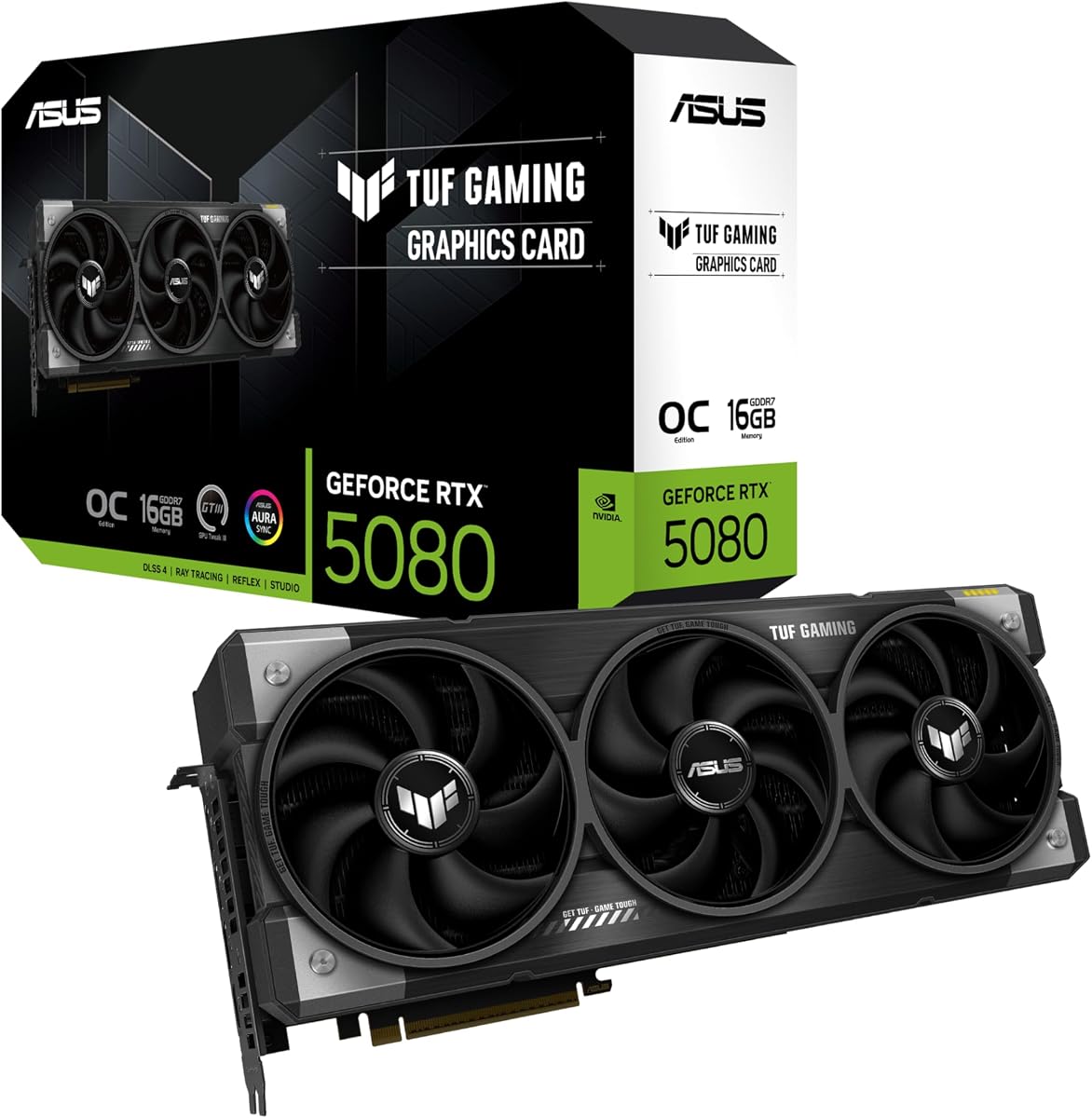
The ASUS TUF Gaming GeForce RTX 5080 16GB GDDR7 OC Edition is the premium choice in this guide, combining flagship NVIDIA hardware with an extensive cooling and component package. Its 4.6 rating is backed by a 16GB GDDR7 configuration, Blackwell architecture, and DLSS 4 support.
We may earn a commission when you buy through this link, at no additional cost to you.
Three Axial-tech fans feed a massive fin array in a 3.6-slot design. A phase-change GPU thermal pad is intended to support thermal performance and longevity, while military-grade components and protective PCB coating add durability. Auto-Extreme manufacturing is also listed, emphasizing consistent assembly, and GPU Tweak III provides accessible performance, thermal, and monitoring controls.
The practical requirements are substantial. The card measures 348mm in length, weighs 4.3 pounds, and needs a minimum 850W PSU with a 16-pin 12V-2×6 connector. A GPU bracket is included, which can be valuable when a large card causes sag, but case clearance and neighboring slot spacing must also be checked.
This is the recommendation for a high-end workstation-style gaming build where cooling, component quality, and flagship performance justify a large footprint. The OC mode is listed at 2730MHz and default mode at 2700MHz boost. Players with a compact case or a modest power supply should look toward smaller or less powerful alternatives rather than forcing this card into an incompatible system.
The large fin array, three axial-tech fans, and phase-change thermal pad form a substantial cooling package. These features suit long gaming sessions and repeated high-load workloads.
Military-grade components, PCB coating, and automated precision manufacturing focus on long-term reliability. The included bracket also helps address the physical sag risk associated with a card of this size.
We may earn a commission when you buy through this link, at no additional cost to you.
The ASUS Dual GeForce RTX 3050 6GB GDDR6 OC Edition is the most approachable entry in the roundup for an Elden Ring PC. Its 4.7 rating, two-slot design, and stated improvements in power efficiency make it relevant for budget-conscious builders and systems with limited physical space.
We may earn a commission when you buy through this link, at no additional cost to you.
NVIDIA's Ampere platform includes second-generation RT cores, third-generation Tensor cores, and support for AI-assisted technologies such as DLSS. In OC mode, the listed boost clock is 1500MHz, compared with 1470MHz in default mode. These features can broaden the card's usefulness beyond the older architecture it represents.
The two-slot design maximizes compatibility and cooling efficiency in smaller cases. Axial-tech fans use a smaller hub and longer blades, a stainless steel bracket adds corrosion resistance, and IP5X dust resistance is stated to help protect against particle ingress. Those practical details make the card easier to live with day to day.
Its main limitation is the 6GB memory pool, which is modest by modern standards. Elden Ring can run well within that allocation, but texture-heavy future titles and high-resolution texture packs may require more. It is best for 1080p gaming and modest 1440p use, especially when low cost and compact installation matter more than maximum settings.
For a dedicated 1080p gaming build, the RTX 3050 provides a straightforward path into Elden Ring and other modern titles. Its compact format also makes it useful when the available case space is limited.
The stainless steel bracket and IP5X dust resistance add practical durability. Although no card is maintenance-free, a clean environment can support quieter and more consistent cooling over time.
We may earn a commission when you buy through this link, at no additional cost to you.
The XFX Swift AMD Radeon RX 9060 XT OC Gaming Edition is our Best Budget pick because it combines 16GB of GDDR6 memory, RDNA 4 architecture, and a 4.8 listed rating without moving to a flagship graphics card. For Elden Ring, it offers a modern and potentially well-balanced option at 1080p or 1440p.
We may earn a commission when you buy through this link, at no additional cost to you.
The card's main specification is 16GB of GDDR6, a capacity that is unusually useful in this segment. It gives the GPU room for detailed textures and provides more flexibility across a modern game library. The stated boost clock reaches up to 3320MHz, making it appealing for owners who want a factory-overclocked configuration from an established board partner.
Cooling is handled by the XFX SWFT dual-fan solution. Compared with the triple-fan designs used by several larger cards, a two-fan cooler may be easier to accommodate in a compact chassis, although the exact dimensions and slot thickness are not provided. Its suitability for smaller cases therefore still depends on the actual measurements in the current listing.
This GPU is best for a value-conscious builder who wants 16GB rather than a smaller memory allocation, especially if the PC will run more than Elden Ring. It is less suitable for buyers who require a specific premium cooler, numerous display outputs, or the newest NVIDIA-specific features. Confirm physical fit, power needs, and current specifications before ordering.
The standout budget advantage is 16GB of GDDR6. It creates a useful bridge between entry-level cards with limited memory and premium models whose additional cost may be unnecessary for the target resolution.
Using the RDNA 4 Radeon RX 9060 XT platform means this is a current-generation card rather than an older design. That makes it better positioned for newer games and upcoming operating-system and driver support.
We may earn a commission when you buy through this link, at no additional cost to you.
The right graphics card depends on your display resolution, frame-rate target, case, power supply, and tolerance for a large upgrade. Use the specifications below to narrow the list before making a purchase.
A GPU that runs comfortably at 1080p may not deliver the same experience at 1440p or 4K, where the game must render substantially more pixels. Start with your monitor's native resolution and decide whether your priority is a smooth average frame rate, higher refresh rates, or simply a stable image at moderate settings. The RX 9060 XT and RTX 5060 Ti models are positioned as versatile midrange choices, while the RX 9070, RX 9070 XT, and RTX 5080 products provide more headroom for high resolutions.
Video memory stores textures, frame buffers, and other data that cannot fit in the GPU's faster on-chip cache. Every 16GB card in this guide offers a substantial reserve, which can help with texture-heavy games and provides useful longevity beyond Elden Ring. The 6GB ASUS RTX 3050 is the exception and should be considered primarily for 1080p gaming or a budget build where memory-intensive future releases are not the main concern.
The NVIDIA cards in this list use newer-generation features such as DLSS 4 on the RTX 5060 Ti, RTX 5080, and ASUS TUF RTX 5080. The AMD cards use RDNA 4 in the RX 9060 XT, RX 9070, and RX 9070 XT models, offering a modern alternative with 16GB options. Upscaling can improve performance at higher resolutions or lower internal rendering scales, but visual quality and input latency preferences vary, so it is best treated as an additional option rather than a substitute for adequate native performance.
Triple-fan cards generally provide more cooling surface and airflow than two-fan designs, while 0dB modes can keep fans stopped during lighter workloads. ASUS Dual cards in this list explicitly mention quiet and performance BIOS profiles, and the ASRock Challenger lists 0dB silent operation. GIGABYTE's WINDFORCE designs likewise focus on sustained thermal management. Cooling quality also depends on case airflow, room temperature, fan curves, and regular dust removal.
A fast GPU can overwhelm an aging power supply even when the case has enough physical room. The ASRock RX 9070 explicitly recommends a 700W PSU and two 8-pin connectors, while the ASUS TUF RTX 5080 requires a minimum 850W PSU with a 16-pin 12V-2×6 connection. Check the current manufacturer guidance for every model, confirm the connector type, and use separate power cables where instructed rather than relying on questionable adapters.
Length, height, and slot thickness can determine whether a card fits at all. The ASRock RX 9070 is listed at 290 by 123 by 51mm and occupies 2.5 slots, while the ASUS TUF RTX 5080 is much larger at 348mm long and 3.6 slots thick. Large cards can also block neighboring slots or sag without adequate support. Measure the available case space, review the full bracket, and account for power-cable clearance rather than comparing only GPU length.
The number and type of outputs can determine whether a card suits your monitor arrangement. The GIGABYTE RX 7600 XT specifically lists two HDMI 2.1a and two DisplayPort 2.1 connections, while the XFX RX 9060 XT lists HDMI and two DisplayPort connections. For a single high-refresh display, make sure the selected output and adapter support the intended resolution and refresh rate. Multi-monitor users should also check the graphics card's supported output configuration.
A card that feels sufficient today may be less comfortable when a demanding game arrives, particularly with only 6GB of memory. Sixteen gigabytes is the more future-oriented choice in this list, while flagship cards also add the newest architecture, upscaling tools, and performance headroom. Consider the rest of your library, any content creation, and how long you expect to keep the system before choosing how much performance to buy.
Before installing a new graphics card, switch off and unplug the computer, open the case, and confirm that the power supply has the correct capacity and connectors. Remove the appropriate rear expansion covers, align the card with the PCIe slot, and secure the card with the supplied bracket or screws. Connect the required power cables only after both ends are fully seated, then boot the system and install the current graphics drivers from the card manufacturer's website.
Launch Elden Ring and select your desired resolution and display mode. Use the in-game graphics menu to set the desired quality level, enable or disable ray tracing as appropriate, and adjust features such as shadow quality, ambient occlusion, reflections, and anti-aliasing. For DLSS-capable NVIDIA cards, compare native rendering with the available DLSS modes. It is also wise to change one setting at a time so you can identify which changes provide the best visual and performance balance.
Keep the card cool by maintaining case airflow, cleaning dust from filters and heatsinks, and avoiding long periods of blocked intake or exhaust. Monitor temperatures and frame behavior during sustained play, and use the included tuning utilities only conservatively. If performance is unstable, reduce settings or revisit the power limit, fan curve, and driver configuration. Never ignore unusual noise, heat, visual corruption, or shutdowns.
Six gigabytes is generally sufficient for Elden Ring itself, particularly at 1080p. However, 16GB provides more headroom for texture packs, high-resolution settings, newer games, and future software. It is a more useful longevity consideration than simply matching the minimum requirement of one older title.
Both AMD and NVIDIA options in this guide can run the game and provide a strong foundation for modern gaming. AMD Radeon models offer several 16GB configurations and RDNA 4 options, while NVIDIA models provide current features such as DLSS 4 on the RTX 5060 Ti and RTX 5080. Your choice should also reflect case size, PSU capacity, desired features, and the rest of your game library.
The higher-end Radeon RX 9070, RX 9070 XT, and GeForce RTX 5080 options are the most appropriate choices for 4K. Achievable frame rates depend on the selected model, quality settings, upscaling mode, CPU, and display refresh rate. The 1080p-focused and lower-tier models remain usable at 4K, but visual settings may need adjustment.
It depends on the graphics card and the age and quality of your existing power supply. The ASRock RX 9070 lists a 700W PSU recommendation, while the ASUS TUF RTX 5080 requires at least 850W and a 16-pin 12V-2×6 connector. Check the card's current specifications and ensure your PSU has enough capacity and the correct native connectors.
Not automatically. Length, height, slot thickness, bracket position, and power-cable clearance all matter. The listed ASRock RX 9070 is 290mm long and 2.5 slots, while the ASUS TUF RTX 5080 is 348mm long and 3.6 slots. Measure the case and compare the complete dimensions before ordering.
It depends on your resolution, settings, and display. A suitably powerful card can perform well at native resolution, while DLSS can provide additional headroom on supported NVIDIA models. AMD users may also benefit from supported upscaling modes in modern drivers and games. Test different modes because sharpness, frame pacing, and image stability can differ by display and title.
The game itself requires substantially less space than many recent large releases, but system and shader compilation needs should also be considered. A modern SSD is still recommended for faster loading and a smoother overall PC experience. Expansion cards do not add game-storage capacity, so check your drive space separately before installing a new GPU.
The best choice depends on the GPU and your quality preferences. Ray tracing can improve certain lighting and reflection effects, but it adds a performance cost that varies by model. If frame rate is the priority, begin with ray tracing off and compare the visual difference before deciding whether the tradeoff suits your system.
The ASRock Radeon RX 9070 Challenger 16GB OC is the strongest overall pick because it combines RDNA 4, 16GB of 256-bit GDDR6, a 4.8 rating, and clearly disclosed installation requirements. The XFX Swift Radeon RX 9060 XT OC stands out as the Best Budget option with 16GB memory, while the ASUS TUF GeForce RTX 5080 is the premium choice for buyers who want flagship performance, extensive cooling, and DLSS 4 support.
Prioritize your monitor's resolution, desired frame rate, case dimensions, and PSU capability before choosing a model. The compact ASUS RTX 3050 makes sense for basic 1080p use, while the RX 9060 XT and RTX 5060 Ti provide a more balanced path to 1440p. Larger Radeon and RTX 5080 cards deliver more headroom but demand greater attention to thermals, connectors, and physical clearance.
Ratings, inventory, and prices can change, and product revisions may also alter what is available. Review the current listing for exact dimensions, connector requirements, memory configuration, and system compatibility before purchasing. Comparing the final card against your display, power supply, and case is the most reliable way to select a GPU for Elden Ring that will work well now and remain useful later.