
5-in-1 Presence Sensor LWR02
4.3Editor score
PIR and mmWave dual sensing
Tracks five room conditions
Two-year battery estimate
Matter over Thread support
Our Mmwave Human Presence Sensor guide compares 10 radar sensors for range, connectivity, power, accuracy, light sensing, and smart home integration.
Mmwave human presence sensors use radar to determine whether a room is occupied, even when the person inside is sitting, reading, or sleeping. Unlike conventional motion sensors, they can distinguish ongoing human presence from simple movement, making them especially useful for lighting, climate, security, and energy-saving automations.
We compared all ten products by examining radar frequency, static-presence capability, detection range, environmental sensing, power options, wireless protocols, hub requirements, and Home Assistant compatibility. The guide covers Wi-Fi, Zigbee, Thread, ESPHome, Tuya, and multi-protocol options for different smart homes.
Each review explains the sensor's strongest use case, important limitations, and the ecosystem it fits best. Ratings and product details reflect the supplied information, while availability and current prices can change, so compare specifications and installation requirements before buying.
4.3Editor score

4.4Editor score

5.0Editor score
The table below compares all ten mmWave human presence sensors by radar type, connectivity, power source, and major environmental features, making it easier to identify the right model for your automation platform and room.



The Akamatis Litos v3 is a well-rounded presence sensor for Home Assistant users who want more precise occupancy control than a PIR sensor can provide. Its 4.4 rating reflects a strong feature set: 24 GHz mmWave radar, adjustable sensitivity, and an integrated VEML7700 ambient light sensor in a compact wall unit.
We may earn a commission when you buy through this link, at no additional cost to you.
The sensor can identify both moving and stationary objects up to 20 feet indoors. A Seeed XIAO ESP32-C3 controller and external antenna support more reliable 2.4 GHz Wi-Fi connectivity, while the light sensor allows automations to consider both occupancy and darkness. This makes the Litos especially useful for lighting scenes that should remain active while someone is reading, working, or resting.
Its main limitation is ecosystem dependence. The Litos works exclusively with Home Assistant and assumes that the platform is already installed and configured. It also requires continuous power, and its ESPHome-based approach may feel less accessible than a finished consumer product, even though the supplied firmware removes manual flashing.
The Litos v3 is the strongest recommendation for a Home Assistant household seeking one device to combine human presence and ambient-light data. Its refined housing, preinstalled firmware, and effective radar coverage outweigh the ecosystem requirement for the intended buyer.
The integrated VEML7700 light sensor closely reflects human-eye response, so automations can require both presence and low illumination. That reduces unnecessary lighting in bright rooms and prevents lights from switching off while an occupant remains still.
Ready-to-use ESPHome firmware eliminates the usual manual flashing step. After connecting through the device's setup process, the sensor can expose presence, light, and configuration information to Home Assistant.
We may earn a commission when you buy through this link, at no additional cost to you.
The SONOFF SNZB-06P24 is a feature-rich Zigbee presence sensor designed for people who need more control over a room's detection footprint. Its 3.8 rating is supported by seven-zone positioning, self-learning calibration, 24 GHz mmWave radar, and an integrated light sensor.
We may earn a commission when you buy through this link, at no additional cost to you.
Within a four-meter range and 110-degree field of view, users can enable or disable individual areas. This is useful when a hallway, window, or neighboring space falls within the radar's coverage but should not influence automations. Detection calibration can also learn recurring interference from appliances, pipes, or airflow to improve stability.
The sensor supports Home Assistant, SmartThings, and Alexa, with advanced third-party setup available through BLE in the eWeLink app. That flexibility is valuable, although it is not entirely plug-and-play because a compatible hub and a suitable power source are still required.
Choose the SNZB-06P24 when precise zones and environmental learning matter more than battery placement. It is particularly well suited to living rooms, bedrooms, offices, and bathrooms where boundaries can be refined and lighting should respond to real occupancy.
Seven configurable zones let you focus the sensor on sofas, desks, or other occupied areas while excluding corridors and windows. The result is a more deliberate automation boundary than a single all-or-nothing range control.
Detection calibration adapts to repeated environmental movement and interference. It cannot eliminate every source of false triggers, but it can make routine automations more stable in occupied homes and offices.
We may earn a commission when you buy through this link, at no additional cost to you.
This generic Zigbee mmWave sensor is a practical choice for builders who use Zigbee2MQTT and want detailed occupancy information in Home Assistant. Its 4.0 rating reflects solid radar performance, useful distance and lux data, and support for a range of automation functions.
We may earn a commission when you buy through this link, at no additional cost to you.
The 24 GHz radar detects moving and still people and provides faster response and distance detection than the 5.8 GHz radar referenced in the product information. When used through Zigbee2MQTT, Home Assistant can receive presence distance, illuminance, detection distance, and sensitivity entities for more granular automations.
Installation requires a constant 5-volt, 1-amp USB supply. The sensor can be mounted to a wall or ceiling, but its wired nature makes it less suitable for locations without access to power. ZHA compatibility is not emphasized, and Zigbee2MQTT is the recommended route.
This model makes sense for a hands-on smart home enthusiast who already operates a Zigbee2MQTT setup. Its detailed telemetry and broad scene-linking potential outweigh the installation demands for technically confident users.
Exposing presence distance, detection distance, and sensitivity gives automators more control than a simple occupied or vacant signal. These values can help distinguish useful activity from events occurring beyond the intended room area.
The sensor is suited to entry halls, living rooms, and similar spaces where arrival should trigger lighting or broader scenes. Its static-presence capability helps keep routines active when a person stops moving.
We may earn a commission when you buy through this link, at no additional cost to you.
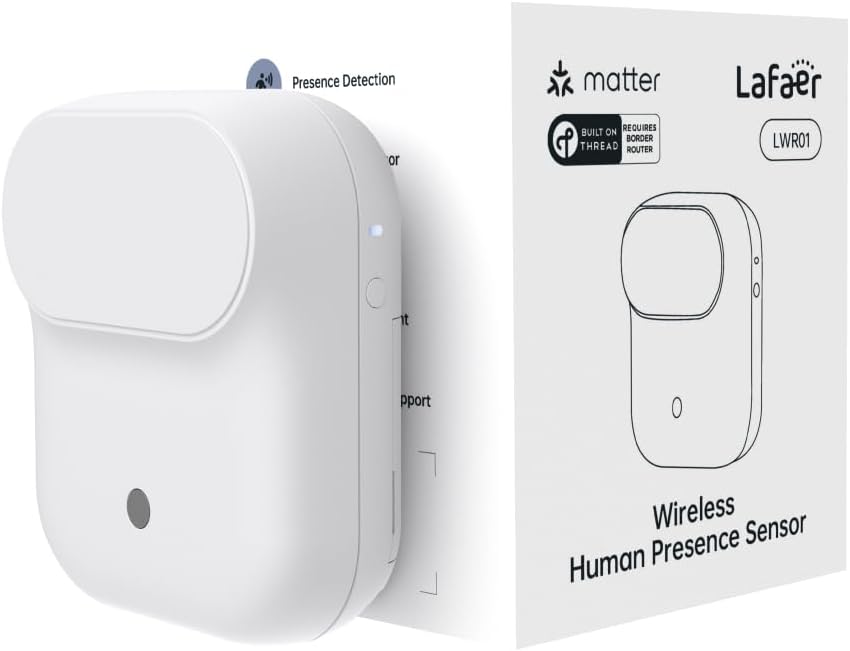
The Wireless Presence Sensor LWR01 is aimed at users who want battery convenience without giving up the option of continuous power. Its 3.3 rating is the second-lowest in this group, but the specification set includes mmWave presence detection, Matter over Thread, ambient light sensing, and IPX3 water resistance.
We may earn a commission when you buy through this link, at no additional cost to you.
The radar can detect stationary people within 3.5 meters and moving people within six meters. Battery operation can last more than one year according to the supplied information, while a Type-C connection offers continuous use for high-performance setups. Matter over Thread compatibility spans Apple Home, Alexa, Google Home, SmartThings, Home Assistant, and other supported platforms.
Despite the wireless convenience, Thread infrastructure is not optional. The product requires a compatible hub or router and specific mobile operating system versions, which makes it less convenient for someone beginning a smart home from scratch. The IPX3 rating also supports damp locations but should not be interpreted as full submersion protection.
Pick the LWR01 when avoiding power wiring in a bathroom, hallway, or other room is a priority and your home already has a Thread border router. Its flexible power and broad Matter support make it a good option despite its more demanding setup requirements.
The sensor can run on batteries for a low-maintenance installation or accept Type-C power when uninterrupted readings are preferred. This makes it adaptable to both permanent and temporary placements.
An IPX3-rated body is suitable for everyday splashes in bathrooms and other moisture-prone areas. Placement near water still requires sensible positioning and adherence to the manufacturer's installation guidance.
We may earn a commission when you buy through this link, at no additional cost to you.
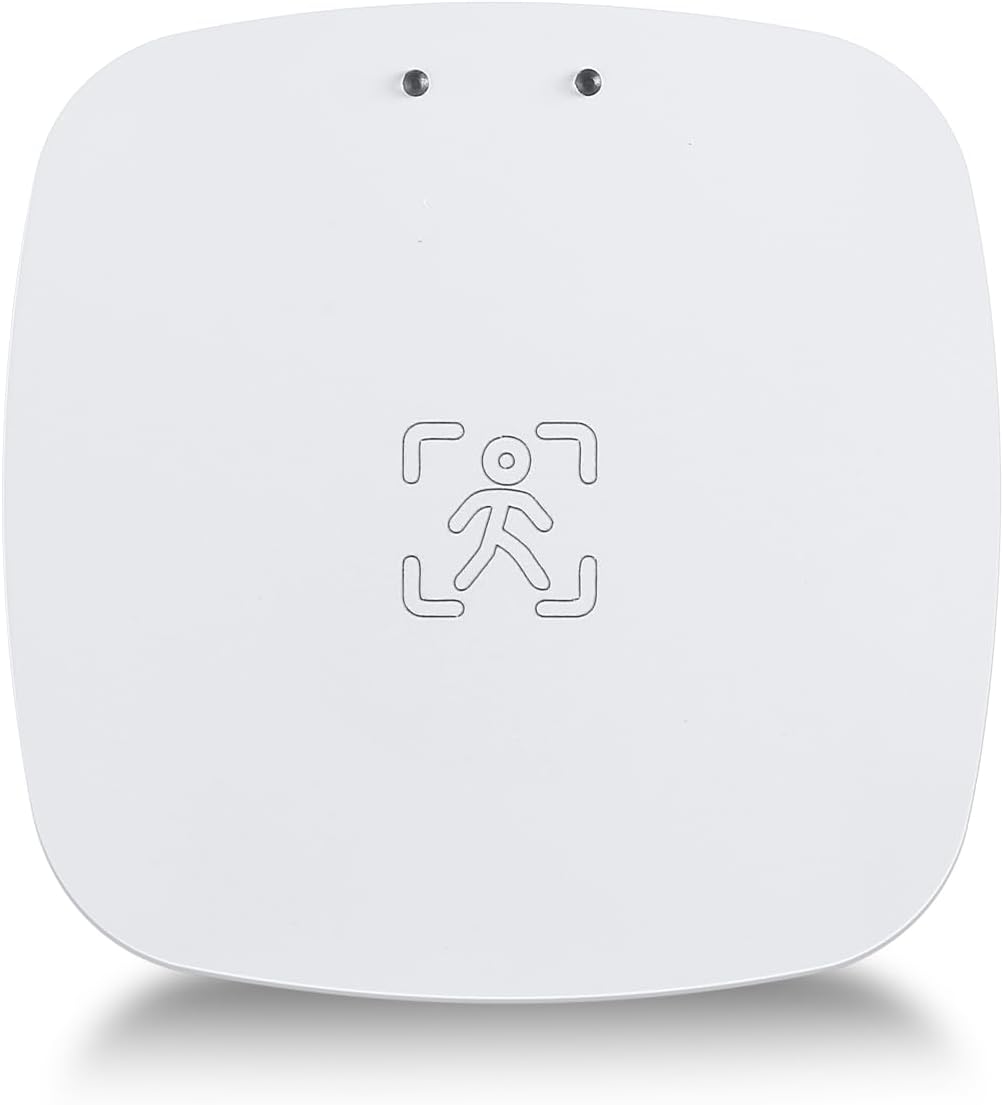
The LWR02 is the most comprehensive environmental sensor in the list, combining occupancy, motion, temperature, humidity, and ambient light in one device. Its 4.3 rating reflects a capable dual-sensor design, flexible installation, Matter over Thread support, and a stated battery life of up to two years.
We may earn a commission when you buy through this link, at no additional cost to you.
The 24 GHz mmWave radar handles static presence and small movements, while PIR responds to larger activity such as walking or waving. Combining them can maintain an occupied state when someone sits still while helping reduce false triggers from fans, curtains, and small pets. The sensor also offers a four-meter presence range and an eight-meter motion range across roughly 120 degrees.
It is powered by two included AAA batteries and also supports rechargeable cells. A hemispherical magnetic base, adhesive mounting, and shelf placement offer several installation methods. Matter over Thread works with major ecosystems through an existing border router, while the local-first design is intended to keep in-home occupancy data away from unnecessary third-party cloud processing.
The LWR02 is the premium pick for buyers who want one adaptable device instead of separate temperature, humidity, light, motion, and presence sensors. Its local-first approach and dual sensing are especially attractive, provided your home already has suitable Thread infrastructure.
mmWave radar recognizes subtle stationary activity, while PIR provides a complementary response to larger movement. The combination is useful in rooms where occupancy must remain clear but environmental movement can otherwise confuse a single detection method.
Temperature, humidity, and ambient light readings expand the sensor beyond occupancy. These measurements can support comfort automations, environmental displays, and conditions that trigger heating, cooling, or lighting changes.
We may earn a commission when you buy through this link, at no additional cost to you.
The THIRDREALITY Presence Sensor R2 combines battery placement with adjustable 24 GHz radar detection. Its 3.5 rating reflects dependable core sensing and broad Zigbee compatibility, although it depends on an existing hub or supported Zigbee bridge.
We may earn a commission when you buy through this link, at no additional cost to you.
AI-enhanced environment learning adapts the sensor to airflow and subtle curtain movement, helping it focus on meaningful human activity. Five sensitivity levels give users more control: a high setting can catch posture changes and small gestures, while a lower setting is useful in hallways where large motion is preferable.
Three AA batteries remove the need for a nearby outlet, making the R2 convenient for cabinets, bathrooms, storage rooms, and hallways. It works with Home Assistant through ZHA or Zigbee2MQTT, SmartThings, Homey Bridge, Homey Pro, and listed Echo models that include a Zigbee hub.
The R2 is a good match for an established Zigbee home that wants flexible placement and manual sensitivity control. It should not be treated as completely immune to false triggers, however, because the product information specifically notes that strong repetitive movement such as a fan can still trigger it.
Five levels make it possible to prioritize small changes in quiet rooms and larger movements in busy passages. This manual control offers a practical balance when the same sensor must serve spaces with different activity patterns.
AA battery power makes the R2 easy to position where wiring would be inconvenient. It is particularly useful for enclosed or retrofit installations where adding a permanent outlet is inconvenient.
We may earn a commission when you buy through this link, at no additional cost to you.
The Fermion C4002 is a bare-module solution for DIY smart home builders, with a 5.0 supplied rating and the longest static-presence specification in the group. It detects motion up to 11 meters, static presence up to 10 meters, and micro-movement, making it suitable for serious ESPHome and Arduino projects.
We may earn a commission when you buy through this link, at no additional cost to you.
Verified ESPHome YAML files simplify integration through a standard UART connection. Occupancy, distance, energy, and illuminance entities can then appear in Home Assistant without requiring buyers to reverse-engineer the radar output. A 3.6-to-5.5-volt operating range also supports both 3.3-volt and 5-volt logic systems without level shifters.
This is not a plug-and-play wall sensor. It needs enclosure, mounting, wiring, power, and some technical configuration. The adaptive noise filter and configurable distance gates are powerful tools, but their value depends on correctly positioning the module and defining the room boundary.
For builders comfortable with ESPHome, UART, and basic electronics, the C4002 offers exceptional control and long reach at a budget-friendly tier. It is the top choice for custom projects, while users seeking a ready-made household device will find a packaged product easier to deploy.
Verified configuration files let Home Assistant users access occupancy, distance, energy, and illuminance data through a standard UART setup. This reduces the coding burden while preserving the flexibility of a DIY installation.
Adaptive background learning filters common interference such as ceiling fans, curtains, and plants. Configurable distance gates help contain the intended monitoring area and reduce signals from adjacent spaces.
We may earn a commission when you buy through this link, at no additional cost to you.
The Akamatis Presence Sensor v2.2 is a straightforward Home Assistant device for users who want radar-based presence detection without building a custom module. It shares the Akamatis family's 4.4 rating and uses an HLK-LD2410B radar with a Seeed C3 controller.
We may earn a commission when you buy through this link, at no additional cost to you.
The sensor detects moving and stationary objects up to 20 feet indoors, with adjustable sensitivity for different room conditions. Its external Wi-Fi antenna improves connectivity, while pre-flashed ESPHome firmware removes manual flashing. Setup involves connecting to the device hotspot and entering Wi-Fi credentials.
It is limited to Home Assistant and requires an existing installation with some familiarity. Compared with the Litos v3, it lacks an integrated ambient light sensor, so users wanting occupancy-and-brightness logic should choose the newer model. It also needs continuous USB-C power.
The v2.2 remains a strong choice for Home Assistant users focused strictly on presence. It delivers useful range, polished installation, and simple firmware setup, making it easier to deploy than a bare UART radar module.
Ready-to-use ESPHome firmware means owners do not need to compile and flash code. A hotspot-based Wi-Fi setup reduces the initial configuration burden while retaining Home Assistant integration.
The radar reaches up to 20 feet indoors and can distinguish movement from stationary presence. Adjustable sensitivity provides an additional way to tune the sensor for a specific room and installation height.
We may earn a commission when you buy through this link, at no additional cost to you.
The THIRDREALITY Presence Sensor R3 combines 60 GHz mmWave radar with a useful visual status light. Its 3.3 rating is among the lower scores in the list, but the sensor brings distinctive features including RGB indication, illuminance sensing, TVOC monitoring, and Zigbee repeater functionality.
We may earn a commission when you buy through this link, at no additional cost to you.
At 60 GHz, the radar is designed to recognize subtle movements such as breathing, supporting occupancy detection in bedrooms, bathrooms, and other quiet spaces. Its simplified setup focuses primarily on setting detection distance, which can make tuning easier than models exposing numerous radar parameters.
The RGB light can display room status, automation conditions, or system information through different colors and brightness levels. Lux and TVOC data can support additional automations when the chosen platform supports them, and the indicator flashes red for dangerous air quality based on TVOC levels. A compatible Zigbee hub remains necessary.
The R3 is most compelling for users who want visible feedback and a stronger mesh signal, not just occupancy data. It also serves as a Zigbee repeater, potentially improving coverage in a larger home, while continuous USB-C power keeps its status features consistently available.
The RGB indicator turns otherwise invisible automation states into an at-a-glance room status. Different colors and brightness levels can communicate occupancy, scene selection, or device health without opening an app.
Ambient light and TVOC readings add context beyond occupancy. Their availability depends on platform support, so buyers should confirm that their chosen ecosystem exposes both measurements before relying on them in automations.
We may earn a commission when you buy through this link, at no additional cost to you.
The Zigbee Human Presence Sensor is a straightforward 24 GHz radar option for users who want stationary-presence detection in an established Zigbee network. Its 3.2 rating is the lowest supplied here, so buyers should consider its limited feature set carefully, but it remains useful for basic lighting automations.
We may earn a commission when you buy through this link, at no additional cost to you.
The sensor can detect movement up to 20 feet and recognizes a person who is sitting still, sleeping, or reading. It works with Home Assistant, SmartThings, Hubitat, Tuya, and listed Echo devices with built-in Zigbee hubs. That makes it a flexible choice across several common Zigbee ecosystems.
Two AAA batteries are stated to last up to two years in typical use, eliminating the need for a power outlet. On the other hand, the product does not advertise advanced zone positioning, ambient light measurement, wireless standards beyond Zigbee, or extensive environmental calibration.
Choose this model for a straightforward room where reliable occupied and vacant states are the priority. It is most appropriate when you already own a compatible Zigbee hub, value wireless placement, and do not need a broad set of environmental sensors.
Two AAA batteries and a stated two-year typical lifespan make the sensor easy to add without running new wiring. It is well suited to retrofitted bedrooms, bathrooms, and living rooms near an existing Zigbee network.
Support for Home Assistant, SmartThings, Hubitat, Tuya, and compatible Echo devices broadens the possible setup. A compatible Zigbee hub is still required, so existing infrastructure should influence the buying decision.
We may earn a commission when you buy through this link, at no additional cost to you.
The right mmWave presence sensor depends on your smart home protocol, available power, room conditions, and the degree of automation control you need. Consider the following factors before comparing models.
Begin with the ecosystem you already operate because protocol support can determine the sensor's usefulness more than any other feature. Wi-Fi models are convenient for standalone Home Assistant installations, while Zigbee sensors are efficient within a mesh network and often work with several platforms. Matter over Thread offers broad compatibility but requires a functioning Thread border router and compatible hub. ESPHome modules provide deeper control for technical users, whereas a finished consumer device is easier for general household installation.
Static presence is the defining advantage of mmWave radar over ordinary PIR motion detection. It lets a light remain on when someone is reading, working at a desk, or sleeping instead of repeatedly waving to reset the timer. Look for explicit support for stationary or still-person detection, and verify the distinction between motion range and static-presence range, as these figures can differ substantially among products.
Maximum range is useful only when it matches the room. A long-range sensor may see through walls or pick up activity in adjacent spaces if its boundary is poorly defined. Models with configurable distance gates or multiple zones provide finer control, which is valuable in open-plan homes, hallways, offices, and rooms with challenging reflective surfaces. A wider field of view can reduce the number of sensors required but may also increase unwanted detections.
Battery-powered sensors are ideal for retrofits and locations without nearby outlets, but battery life depends on reporting frequency, signal strength, and environmental conditions. USB or Type-C devices provide stable continuous power and are often better for rooms where a vacancy timeout would be frustrating. Consider whether you need wall, ceiling, shelf, cabinet, or magnetic mounting, and whether permanent wiring can be concealed cleanly.
An integrated ambient light sensor allows a single automation to require both presence and darkness, preventing unnecessary lighting during daylight. Temperature and humidity readings expand the device into a broader room monitor, while TVOC data can indicate changing air conditions. These additions are useful, but only if your chosen platform supports the entities. Check compatibility before treating optional readings as dependable automation inputs.
Ceiling fans, moving curtains, plants, pipes, appliances, and small pets can create unwanted radar or PIR signals. Sensitivity adjustment, environmental learning, noise filtering, and configurable distance gates can reduce these problems, although no product eliminates every false trigger. The third-reality sensors and several Zigbee models provide explicit controls, while PIR paired with radar can help distinguish human movement from some background activity.
Bathrooms, kitchens, and laundry rooms benefit from an IPX3-rated housing that can tolerate everyday splashes. Radar can generally operate through non-metallic materials, making wall or ceiling placement more flexible, but metal enclosures and reflective surfaces may affect results. For bedrooms, quiet micro-movement detection is valuable; for hallways, broader motion coverage and fewer missed arrivals may be more important.
Some products emphasize local processing, which can limit exposure of occupancy information to third-party cloud services. Pre-flashed ESPHome firmware makes Home Assistant setup accessible, while a bare UART module offers greater control for experienced builders. Assess the installation effort honestly: hub setup, YAML configuration, wiring, enclosure design, and calibration can offset the benefits of a technically capable module if you are not comfortable with those tasks.
Begin by identifying the automation you want to improve, then select a sensor with the necessary protocol, power source, and environmental readings. Mount it where it can observe the occupied area without looking through large metal surfaces, and keep the radar field clear of close obstructions where possible. For wall-mounted models, follow the stated range and angle limits rather than assuming the maximum specification applies at every height.
Connect the sensor to its required hub, router, or Home Assistant instance, then configure presence, distance, sensitivity, and timeout settings based on the room. Add a delay for vacancy so brief exits do not switch off lights, and use an occupancy timeout to avoid immediately canceling a scene when a person becomes still. If ambient light data is available, require both presence and a suitable lux reading before activating artificial lighting.
Test the installation under real conditions by sitting, reading, walking, and leaving the room. Adjust sensitivity or exclusion zones in response to fans, curtains, pets, and neighboring activity, and allow the sensor to learn the environment where that feature is supported. Clean the sensing face gently, keep moisture and dust away from it, and replace batteries on a consistent schedule to keep occupancy reporting reliable.
A PIR sensor primarily reacts to changes in infrared energy caused by movement. An mmWave radar sensor can use fine radar variations to recognize a stationary person, including subtle movement such as breathing. That makes mmWave sensors better suited to lighting that should remain on while someone is reading, working, or sleeping.
Radar signals can pass through some non-metallic materials, so a sensor may detect activity beyond the intended room or neighboring space. It does not reliably see through every wall, and metal can block or reflect the signal. Distance gates, zone settings, careful placement, and environmental calibration help reduce cross-room triggers.
The easiest option depends on the equipment you already own. A Matter over Thread model suits a household with an established Thread border router, while a Wi-Fi model can be simpler for Home Assistant. Zigbee remains efficient and flexible but requires a compatible hub or coordinator. Choose the protocol already supported by your preferred platform rather than adding a second ecosystem unnecessarily.
Yes, but their suitability depends on the enclosure's water-resistance rating and the location of electrical power. The LWR01 and LWR02 carry an IPX3 rating for everyday splashes. Even then, follow local electrical safety requirements, avoid direct jets of water, and position wired or powered equipment where it cannot be exposed to moisture.
No, not for every model. The Akamatis Litos v3 and v2.2 require Home Assistant, while the LWR01 and LWR02 use Matter over Thread and can work with supported Apple Home, Alexa, Google Home, SmartThings, Home Assistant, or Homey setups. Zigbee products require a compatible hub, and the Fermion C4002 is primarily a DIY UART module for builders.
Moving air, ceiling fans, curtains, plants, pets, pipes, appliances, and reflective surfaces can affect radar readings. Products with environmental learning, adjustable sensitivity, zone controls, or PIR plus radar are designed to mitigate these effects. No sensor is entirely immune to every source of interference, so placement and periodic retuning remain important.
Battery power is more convenient for retrofits because it removes the need for a nearby outlet or concealed cable. It is less suitable when you want continuous high-frequency operation, predictable status updates, or uninterrupted power. Wired models are often preferable in central rooms where the automation must react immediately and remain available at all times.
Measure the area that genuinely needs monitoring rather than selecting the largest advertised range. Consider where people sit or sleep, whether hallways or neighboring rooms fall within the radar field, and whether furniture can block reflections. Adjustable distance gates and zones are especially helpful in open plans, while sensitivity should be tuned after testing real household activity.
The Akamatis Litos v3 is the best overall option for Home Assistant users because it combines reliable static-presence radar, adjustable sensitivity, Wi-Fi, and an integrated light sensor in a ready-to-flash package. The LWR02 is the feature-rich premium choice, adding PIR, temperature, humidity, light, local processing, and flexible wireless power, while the Fermion C4002 is the best budget pick for technically confident DIY builders.
Prioritize protocol and hub compatibility first, then confirm that static presence works in the intended room. Pay attention to environmental learning, zone controls, sensitivity, and light sensing if fans, curtains, pets, or daylight regularly complicate your routines. Battery versus wired power and the effort required for installation are equally important for long-term satisfaction.
Product ratings, availability, and current prices can change over time, so review the latest listing and compatibility information before purchasing. Comparing the sensor's protocol, power requirements, detection behavior, and automation data against your own home setup will lead to the most reliable choice.