
CIGMAN Laser Level Self Leveling 3×360° for Picture Hanging & Construction
4.6Editor score
Twelve full-room laser lines
Rechargeable 4000mAh battery
Multiple mounting accessories
Discover the best laser level for DIY, comparing accuracy, visibility, mounting options, self-leveling features, accessories, and ideal project applications.
A laser level for DIY replaces improvised measurements with a consistent projected reference, helping you hang pictures, align cabinets, install tile, place trim, and frame walls with greater confidence. The most useful model combines clear green lines, dependable self-leveling, simple controls, and mounting options suited to your workspace.
The ten products in this guide were compared using the supplied specifications and customer ratings. We considered working range, stated accuracy, self-leveling range, line configuration, manual and pulse modes, durability, power options, included accessories, and how conveniently each tool supports common household projects.
Each review explains the strongest reasons to choose a particular laser level, along with its limitations. The list ranges from compact cross-line tools for quick indoor jobs to three-dimensional models for complex layouts, while current availability and product details may change after publication.
4.6Editor score

4.5Editor score
4.4Editor score
This side-by-side comparison highlights each laser's projection system, stated accuracy, power configuration, and most useful mounting or accessory features for DIY work.




The Motovera 100ft Green Cross Line combines a green self-leveling laser, an adjustable tripod, batteries, and a carry bag in a package aimed directly at DIY users. Its 4.2 rating reflects a useful combination of visibility, accessories, and straightforward operation, especially for picture hanging, shelving, tiling, and general household alignment.
We may earn a commission when you buy through this link, at no additional cost to you.
Its most attractive feature is the breadth of the kit. The stated ±1/9-inch accuracy at 33 feet is suitable for common home-improvement layouts, while the 110-degree projection angle helps the cross line cover a useful portion of a wall or work area. Four brightness levels and pulse mode provide additional control in changing indoor conditions, and IP54 protection adds confidence around ordinary dust and moisture.
The pendulum supports both self-leveling and manual operation. In self-leveling mode, the unit levels within ±4 degrees and flashes if it is beyond that range. Manual mode is useful for angled layouts such as stairs or decorative patterns, but the line then serves as an angle reference rather than a guaranteed level. Outdoor visibility can also be limited without a compatible receiver.
This is an attractive choice for someone who wants a ready-to-use kit rather than a bare laser. The included tripod reduces setup work, while the carry bag helps protect the tool between jobs. For DIY users who value complete accessories and green-line visibility over specialized three-dimensional projection, it is a practical all-around recommendation.
The green beam is specified to remain visible indoors up to 100 feet and to appear four times brighter than a standard red laser under comparable light. A 110-degree field also makes the cross useful for establishing horizontal and vertical references across larger wall areas.
The adjustable tripod, two AA batteries, manual, and carry bag provide the basic equipment needed for immediate alignment work. The soft-grip body is compact enough to move between a workbench, wall, and floor without becoming cumbersome.
We may earn a commission when you buy through this link, at no additional cost to you.
The Huepar BOX-1G is a self-leveling green cross-line laser offered with a portable 40-inch tripod. Its 4.4 rating and flexible line selection make it a well-rounded choice for homeowners who may need a single horizontal reference for shelving, a vertical line for cabinets, or a cross for transferring points around a room.
We may earn a commission when you buy through this link, at no additional cost to you.
The stated accuracy of ±1/13 inch at 33 feet is among the more precise specifications in this guide, while the 130-degree horizontal and 150-degree vertical projection create broad coverage. Users can choose between a single line and a cross line, and single-line operation conserves power. The supplied tripod has a 1/4-20 mount and a three-way pan head for changing height, tilt, and orientation.
The included tripod is best treated as an indoor support. Its instructions specify flat ground and windless conditions, while the product data recommends a larger tripod for demanding outdoor work. In bright sunlight, pulse mode improves compatibility with a Huepar receiver, but that receiver must be purchased separately. Self-leveling operates within four degrees, with flashing indicating that the tool is outside that range.
Choose the BOX-1G when you want a capable cross-line tool, a useful tripod, and the flexibility to reduce power use in single-line mode. It is less convincing as an all-weather outdoor system out of the box, but for indoor DIY and controlled work areas, it balances precision, visibility, and accessories effectively.
Single-line mode is useful when horizontal or vertical guidance is all the task requires, while cross-line mode speeds up square layouts and point transfer. This flexibility also helps conserve battery life during longer, less demanding projects.
The 1/4-20 tripod interface and stable pan head allow the laser to be raised to working height and aimed without changing the core layout. The aluminum tripod folds for storage, although its limited height makes it best suited to flat indoor surfaces.
We may earn a commission when you buy through this link, at no additional cost to you.
The BOSCH GLL50-20G is a compact green-beam self-leveling cross-line laser built around simple, dependable positioning. Its 4.5 rating, thin bright lines, and stated 5/16-inch accuracy at 30 feet make it a strong option for everyday wall, trim, cabinet, shelf, and picture-hanging work.
We may earn a commission when you buy through this link, at no additional cost to you.
Durability is a major strength. The IP55 rating is intended to withstand dust and rain, and the integrated magnetic mount makes it easy to attach to suitable metal surfaces. The ergonomic, lightweight body is easier to carry than a large three-dimensional laser, while two included AA batteries offer a familiar power source.
The model supports BOSCH's 3.7-volt Lithium-Ion 1.0 amp-hour battery, sold separately, allowing users to choose between disposable cells and a rechargeable system. Its Smart Pendulum System self-levels and blinks when out of level, while locking the pendulum provides transport security. The 50-foot range is shorter than many competitors, and no tripod is supplied.
This laser is best for DIY users who value a recognizable brand, robust enclosure, simple cross-line layout, and flexible power options. It may not suit someone needing full-room 360-degree planes, but for focused household alignment in normal indoor or jobsite conditions, it offers a refined and highly practical package.
The IP55 enclosure is one of the stronger protections listed among the compact cross-line models. It helps the tool cope with dust and rain encountered during installation work, although it should still be handled carefully and stored dry.
The green laser is specified as up to four times brighter than standard red beams, improving visibility in bright indoor areas. Two AA batteries are included, while compatibility with BOSCH's separate Lithium-Ion pack provides an optional rechargeable workflow.
We may earn a commission when you buy through this link, at no additional cost to you.
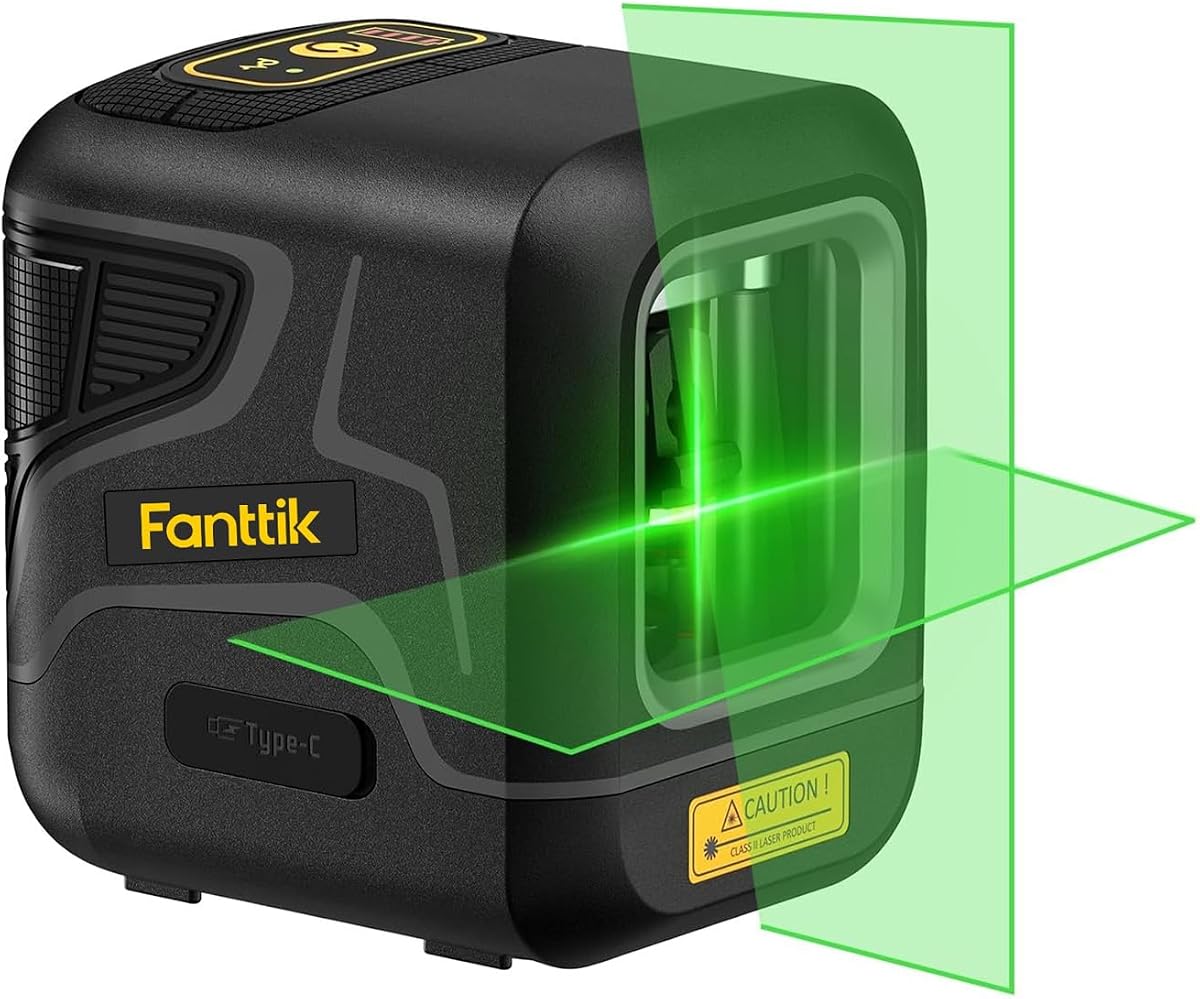
The Fanttik D2 is designed for quick household alignment in a pocket-sized green cross-line format. Its 4.5 rating and emphasis on picture hanging and home DIY make it particularly appealing for users who want a straightforward tool that can be deployed immediately.
We may earn a commission when you buy through this link, at no additional cost to you.
A 2200mAh rechargeable battery is specified to provide up to 10 hours of continuous operation, and the battery is said to be rechargeable more than 500 times. That removes the need to carry spare cells. The 1/8-inch accuracy at 30 feet is well suited to shelving, photographs, trim, and similar projects, while the green beam is described as four times brighter than red under the same light.
The magnetic bracket supports 360-degree rotation, giving the small body more placement flexibility than a simple flat-based design. Self-leveling operates within four degrees and flashes when the tilt exceeds that limit. Locking the pendulum enables manual projection at non-horizontal angles. Pulse mode can extend the working range to 164 feet when used with a receiver, but no receiver is included.
At 0.56 pound, the D2 is especially easy to carry and store, and the drawstring pouch suits a small toolbox. It is the strongest recommendation for someone who prioritizes rechargeable convenience and compact size over three-dimensional coverage or an included tripod.
The integrated battery is specified for up to 10 hours of continuous use, making it possible to complete a large installation without pausing to replace cells. USB-C charging also offers convenient options for topping up from compatible power sources.
The magnetic bracket can be attached to a suitable metal surface and rotated through 360 degrees. This allows the laser to be raised, lowered, or turned as the project develops without requiring a separate full-size support.
We may earn a commission when you buy through this link, at no additional cost to you.
The Huepar HM03CG projects one full 360-degree horizontal line and two 360-degree vertical lines, creating a three-plane reference that can cover an entire room. Its 4.6 rating reflects a strong combination of projection coverage, rechargeable operation, and flexible installation hardware for ambitious DIY work.
We may earn a commission when you buy through this link, at no additional cost to you.
The listed green working range is 98 feet at 100 lux, with accuracy of ±1/9 inch at 33 feet. Individual horizontal and vertical lines can be switched on or off, allowing the user to select only the references needed for a task. The self-leveling pendulum operates within three degrees, while manual mode supports angled lines for stairs and nonstandard layouts.
A rechargeable battery provides a stated eight hours of continuous operation, and four indicators display the remaining charge status. Charging protection is included, as is a Type-C port compatible with a laptop, power bank, or car charger. The magnetic bracket provides 1/4-20 and 5/8-11 interfaces, plus two nail holes for a more permanent wall installation.
The HM03CG is a strong choice for installers working across floors, walls, and ceilings who need the laser planes to remain visible around a room. It is bulkier and more complex than a pocket cross-line model, and outdoor use in bright light benefits from a compatible receiver. Even so, its three-plane coverage makes it one of the most capable options here.
The horizontal plane can remain projected around the room while the two vertical planes establish perpendicular references. This is particularly useful when aligning wall coverings, ceiling elements, cabinetry, or multiple points in an open-plan interior.
The magnetic bracket supports standard tripod threads and includes wall-fixing holes. A hard carry case protects the larger tool during transport, while the rechargeable battery removes the need to plan projects around disposable-cell changes.
We may earn a commission when you buy through this link, at no additional cost to you.
The Huepar 9011G with Tripod packages a 100-foot green cross-line laser with a magnetic bracket, picture-hanging strips, batteries, a manual, and a carry bag. Its 4.3 rating and broad accessory selection make it a convenient starting point for new DIY users.
We may earn a commission when you buy through this link, at no additional cost to you.
The laser projects a cross line over a 110-degree field and has a stated accuracy of ±1/9 inch at 33 feet. It self-levels within ±4 degrees when the pendulum is unlocked, and the supplied data notes that self-leveling activates in under three seconds. Manual mode supports angled patterns such as stairs, but those lines should not be treated as true level references.
The aluminum tripod has a 1/4-20 mount, a three-way pan head, and a listed extension from 11.4 to 25.6 inches despite the product title referencing 40 inches. It is recommended for indoor use on a flat surface in windless conditions, and furniture may be used to increase its height. The magnetic bracket gives another placement route for steel surfaces.
Choose this package if you want a cross-line laser, a basic tripod, and picture-hanging accessories in one box. It provides enough capability for wall tiling, shelves, photos, and decoration while remaining much simpler than a 3×360-degree laser. The main limitation is that the compact tripod is less suitable for exposed outdoor conditions.
The included picture-hanging strips complement the laser's horizontal and vertical references, making the package particularly relevant for decorating tasks. The carry bag and compact body make the full set easier to store between projects.
The two-position approach is easy to understand: unlock the pendulum for automatic leveling and lock it for angled manual projection. A flashing line in self-leveling mode warns that the surface is tilted beyond the supported range.
We may earn a commission when you buy through this link, at no additional cost to you.
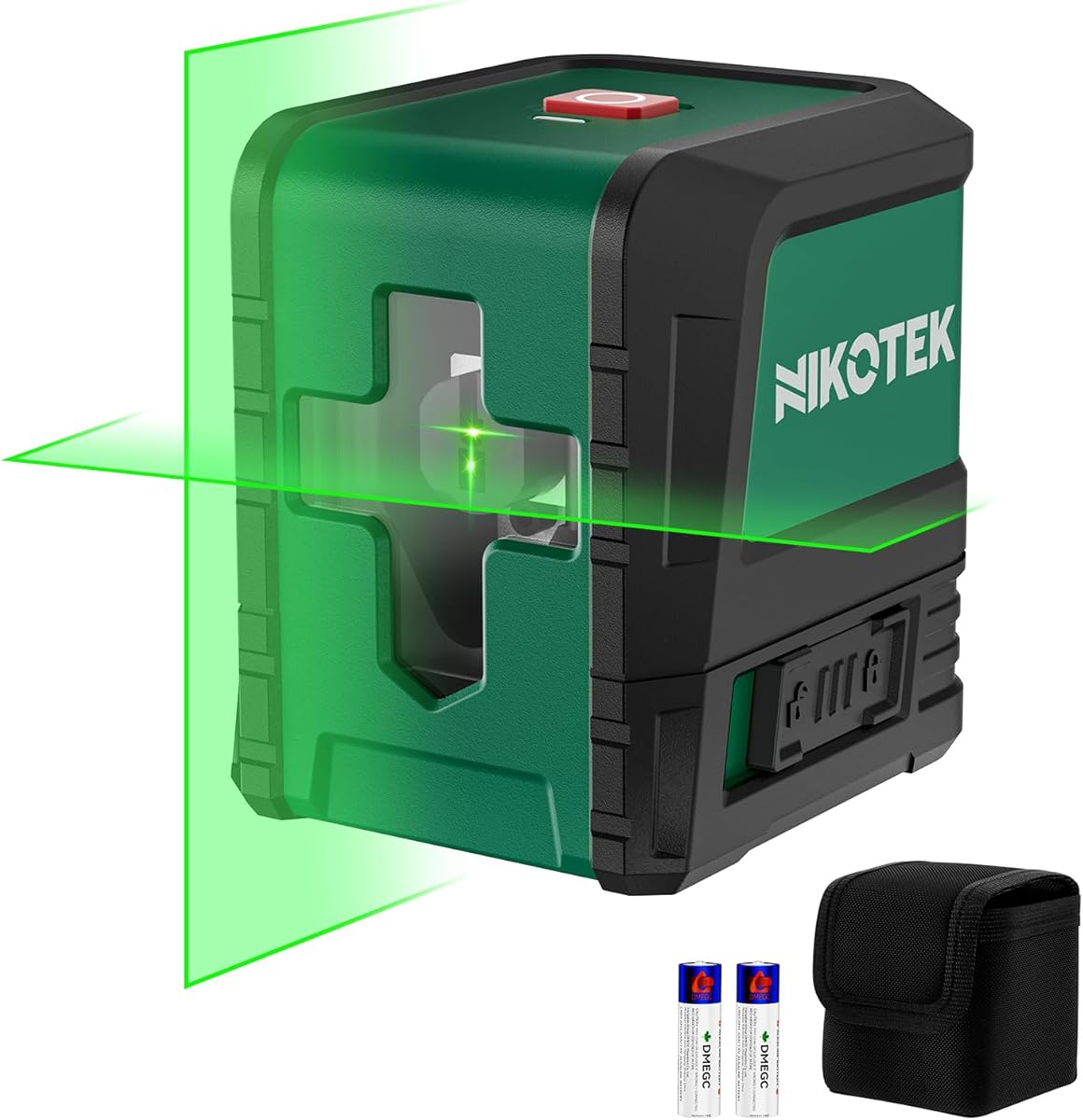
The Nikotek 100ft Green Cross Line is a simple laser level aimed at home decoration and basic alignment. Its 4.4 rating reflects a focused design that gives DIY users a bright horizontal and vertical cross without adding a complicated control panel or three-dimensional projection system.
We may earn a commission when you buy through this link, at no additional cost to you.
The most prominent specification is a 110-degree projection angle, intended to make the cross visible across a useful portion of a wall or work surface. When the pendulum is unlocked, the unit self-levels within a 3.5-degree range. If the surface is tilted beyond that limit, the line flashes continuously to signal that the tool cannot provide a level reference.
The supplied information is less extensive than for several competing products. It does not provide a detailed accuracy figure, battery runtime, durability rating, pulse-mode capability, or a full mounting specification, so buyers should consider those omissions when comparing the tool with more extensively documented alternatives.
This model makes sense for someone seeking a compact green cross-line tool for pictures, shelves, decoration, and straightforward household layout work. The included battery and carrying pouch provide the essentials, while the lack of a bundled tripod keeps the package simple. It is best for indoor tasks and users who value ease of use over extensive accessory options.
One horizontal and one vertical line are enough for many household jobs, including centering a picture, aligning shelves, checking trim, and transferring points on a wall. The wide projection angle helps the cross cover more of the intended surface.
The 3.5-degree self-leveling range is narrower than the four-degree range common among several rivals, but the flashing alert is easy to interpret. If the line flashes, the surface should be checked before a measurement is trusted.
We may earn a commission when you buy through this link, at no additional cost to you.
The Huepar 9011G is a palm-sized green cross-line laser with a 4.3 rating and a straightforward feature set. It is aimed at indoor picture hanging, wall tiling, and general DIY alignment, while its self-leveling behavior and troubleshooting guidance make it approachable for first-time users.
We may earn a commission when you buy through this link, at no additional cost to you.
The stated accuracy is ±1/16 inch at 16.4 feet, and the 110-degree field provides a broad cross-line spread. The green beam is described as up to twice as bright as a traditional red laser. With the pendulum unlocked, the tool self-levels within four degrees and activates in under three seconds; locking the pendulum enables manual projection at arbitrary angles.
A major strength is the unusually clear explanation of flashing. The product data notes that holding the tool in hand, placing it on an uneven surface, or using an unlevel tripod head can all cause the line to flash. It recommends checking the surface, adjusting the position, stabilizing the head, or using another mounting option.
The magnetic bracket, two AA batteries, manual, and carry bag cover the basic needs, and the soft-grip body is easy to handle. The absence of a tripod means users will need another stable support for projects performed at height. Even so, this is a capable compact cross-line tool for indoor alignment and decorating.
A flashing line is often a setup issue rather than a product failure. Checking the tripod head, placing the tool on a flat surface, and confirming that the pendulum is properly positioned can quickly restore a stable reference.
The stated ±1/16-inch accuracy at 16.4 feet is well suited to shelves, wall art, cabinet references, and tile alignment. Manual mode expands creative layout options, though angled lines are not true level references.
We may earn a commission when you buy through this link, at no additional cost to you.
The CIGMAN CM-701 is the most feature-rich three-dimensional laser in this guide, with 12 bright lines, full 360-degree coverage, a remote control, and several mounting bases. Its 4.6 rating makes it a compelling premium option for complex layouts that extend beyond a single wall or cross.
We may earn a commission when you buy through this link, at no additional cost to you.
The three-plane system can cover the floor, walls, and ceiling around a room, which is valuable for interior design, tiling, framing, shelving, and larger construction tasks. Users can select auto-leveling, manual, and pulse modes. Self-leveling works within ±4 degrees, while pulse mode can extend the working distance from 30 to 50 meters when paired with a receiver.
Power comes from a built-in 4000mAh rechargeable battery, with Type-C charging from compatible power banks, laptops, or wall adapters. The package includes a magnetic L-base, mini tripod base, laser target plate, remote control, portable bag, and cable. Its 1/4-inch thread supports conventional tripods and rotating bases.
The CM-701 is designed for users who regularly need complete spatial coverage and are willing to carry a more capable tool. A basic cross-line laser is simpler and lighter, but few options in this list can place visible references around an entire room with the same combination of planes, controls, and mounting hardware.
A horizontal plane and two vertical planes create references on multiple surfaces at once. This reduces the need to reposition the laser repeatedly when marking cabinetry, framing, wall coverings, ceiling details, or floor tile.
The magnetic L-base, mini tripod base, full tripod compatibility, and target plate support several working methods. The remote control also makes line visibility and brightness easier to manage when the laser is positioned beyond easy reach.
We may earn a commission when you buy through this link, at no additional cost to you.
The RockSeed Cross Line stands out for its robust 40-inch iron tripod and construction-focused accessory set. Its 4.4 rating and ±1/8-inch accuracy at 30 feet make it a practical choice for home projects where a stable elevated support is as important as the laser itself.
We may earn a commission when you buy through this link, at no additional cost to you.
The tool projects a red horizontal and vertical cross over a 110-degree angle. Self-leveling mode automatically establishes the horizontal and vertical references, while manual mode locks the cross so it can be used at any angle. The stated self-leveling and compensation range is four degrees, with flashing used to indicate an out-of-level condition.
The included iron tripod extends to 40 inches and folds to 16 inches. It has a dual bubble level, a center-column knob, anti-slip feet, quick-release clamps, a height lock, and suspension hooks. Those stability features distinguish it from lightweight plastic tripods and can be useful when the laser needs a firm working position.
IP54 protection and a stated four-foot collision-protection enclosure add confidence for normal worksite use. The canvas case, batteries, and instruction manual complete the package. The red beam may be less visible than green in bright conditions, and pulse mode is not listed, but this is still a well-equipped choice for builders who prioritize a substantial tripod and rugged simple cross-line design.
The iron tripod, dual bubble levels, anti-slip feet, and quick-release clamps create a stable base for the laser. Its height adjustment helps place the reference at a comfortable working height for tile, trim, pictures, or carpentry.
The enclosure carries an IP54 protection rating and a stated four-foot collision-protection specification. These features make the tool better suited to dusty or damp installation environments than an unprotected household gadget.
We may earn a commission when you buy through this link, at no additional cost to you.
The right laser level depends on the size of your projects, the surfaces involved, and the degree of spatial coverage you need. Comparing projection type, accuracy, mounting options, power, and visibility will help avoid paying for features that do not improve your work.
A cross-line laser projects one horizontal and one vertical reference, making it ideal for pictures, shelves, trim, cabinet installation, and simple tile layouts. It is smaller, lighter, and usually easier to set up than a three-dimensional model. If your work frequently spans a whole room, involves ceilings and floors, or requires alignment around multiple walls, a 3×360-degree tool with one horizontal and two vertical planes will save repeated repositioning.
In short, choose a cross-line for focused wall work and a 3D model for comprehensive room layouts.
Stated accuracy tells you how closely the projected line should meet the manufacturer's reference under defined conditions. The products in this guide range from ±1/13 inch at 33 feet to ±1/8 inch at 30 feet, with one product specifying accuracy at 16.4 feet. Self-leveling range matters because the pendulum can only compensate for a limited degree of tilt; if the tool is tilted beyond that range, the line should flash as a warning.
Compare accuracy at the same distance and pay attention to whether the surface or support is actually stable. Select a tool with a stated accuracy appropriate to the precision your project requires.
Green beams are generally more visible to many users than red beams, particularly in bright rooms, and several green models in this guide claim two to four times the brightness of standard red lasers. Red can still be entirely adequate for controlled indoor work and may suit users who find green lines less comfortable. Outdoor visibility is a separate issue because ambient sunlight can overwhelm either color without a pulse mode and compatible receiver.
For mostly indoor decorating, choose the color you can see most easily. For bright work areas, prioritize pulse-mode receiver compatibility.
The listed working range is most useful as a general indication of potential coverage, not a guarantee that a line will be clearly visible in every environment. Some models cite a nominal indoor range, while receiver-assisted pulse range can be much greater outdoors. If your projects extend across a large room, garage, or outdoor site, full 360-degree planes and receiver compatibility may be more valuable than a longer nominal indoor specification.
Match the range to the actual space, and confirm whether outdoor use requires an additional receiver.
A laser level is only as useful as its support system. The 1/4-20 thread is common across these products and allows compatibility with many tripods, while magnetic brackets work on suitable steel surfaces. Some kits include a compact indoor tripod, while others provide magnetic L-bases, mini tripod bases, wall-fixing holes, or target plates. Consider working height, portability, and whether the bracket can hold the tool securely without marking finished surfaces.
Look for at least one reliable positioning method, and make sure any included tripod is appropriate for indoor or outdoor conditions.
Disposable AA batteries are familiar and easy to replace, while rechargeable systems can reduce interruptions and avoid recurring cell purchases. The listed rechargeable options include the Fanttik D2's 2200mAh battery, the Huepar HM03CG's eight-hour runtime, and the CIGMAN CM-701's 4000mAh battery. USB-C charging is convenient because compatible power banks, laptops, and car adapters can often be used. Check battery indicators and charging protection when working on long installations.
Choose disposable cells for simplicity or rechargeability for frequent use, and compare the stated runtime with the length of a typical project.
Manual mode locks the internal pendulum so a line can be projected at a chosen angle. This is useful for staircases, diagonal designs, and nonstandard wall patterns, but the line is no longer a true level reference. A clear warning is important because users can otherwise mistake an angled line for a horizontal or vertical one. Several tools flash periodically in manual mode as a reminder.
Use manual mode for intentional angle transfer, but return to self-leveling whenever level accuracy is required.
IP54 and IP55 ratings indicate resistance to dust and water under specified test conditions, which can be reassuring in garages and active renovation areas. Portability also depends on more than the protection rating: consider body weight, storage case, tripod bulk, and battery design. A pocket model is convenient for a few pictures, while a three-plane tool may be better for a contractor moving between larger jobs.
Balance environmental protection with the size and support equipment you can realistically carry to the job.
Begin by choosing a stable location and checking the pendulum status. Unlock it for self-leveling, place the tool on a level surface or secure it to a suitable bracket, and allow the line to settle. If the laser flashes continuously in self-leveling mode, the surface is likely tilted beyond the supported range or the mount is unstable. Do not treat a flashing line as a reliable level reference.
For an ordinary cross-line job, center the horizontal beam at the desired height and use the vertical beam to mark a plumb reference. Mark along the bright line at several points rather than depending on a single bright spot. For three-dimensional tools, switch on only the planes required for the current stage, and use a compatible receiver and pulse mode when working outdoors in strong light. Keep the lens and laser window clean and avoid aiming the beam at people or reflective surfaces.
Turn the unit off before moving it, lock the pendulum for transport, and remove the batteries if the tool will be stored for an extended period. Rechargeable models should be kept away from extreme heat and moisture, while loose batteries should be protected from short circuiting. Store the tool in its case or pouch, clean the body with a soft dry cloth, and periodically inspect the tripod locks, bracket threads, battery contacts, and laser window.
A green beam is often easier for the human eye to see, especially in brightly lit rooms, which can make marking faster and reduce errors. Red levels can still work well for indoor tasks and may be more comfortable for some users. Whichever color you choose, visibility outdoors may require pulse mode and a compatible receiver.
A tripod is helpful whenever the reference must be raised above a surface, held steadily, or left in position while you work around it. Compact cross-line kits often include a small indoor tripod, while other models provide only a magnetic bracket. If your projects are mainly wall decoration, a magnetic mount or low stable support may be enough.
Continuous flashing usually means the tool is tilted beyond its self-leveling range or is not sitting on a stable surface. An uneven tripod head, a loose bracket, or holding the unit in your hand can produce the same alert. Level the support, reposition the tool, and check that the pendulum is correctly unlocked before continuing.
Yes, but direct sunlight can make a normal laser line difficult to see. A model with pulse mode can work with a compatible receiver to extend practical outdoor use, and a 3×360-degree model can cover large exterior spaces more efficiently. The receiver is not included with every laser reviewed, so check compatibility before starting.
Self-leveling mode uses the internal pendulum to establish a horizontal or vertical reference automatically, although only within a limited tilt range. Manual mode locks the pendulum so the line can be held at an intentional angle. Manual projection is useful for stairs and decorative layouts, but it should not be treated as a true level reference.
A basic cross-line laser is usually sufficient for one or several pictures because it projects both horizontal and vertical references on the wall. A 360-degree tool becomes more useful when you need references on multiple walls, floors, or ceilings at the same time. For routine decorating, a compact cross-line model is simpler and easier to carry.
Accuracy requirements depend on the tile size, wall dimensions, and how visible the joints will be. Even a cross-line model with stated accuracy around 1/8 to 1/9 inch can help keep layouts consistent, but large-format tile or highly visible alignment grids may justify a higher-precision tool. Verify the floor or wall separately and use a conventional level when confirming critical surfaces.
Turn it off, lock the pendulum, and place it in its protective case or pouch. Avoid leaving loose batteries inside a long-term stored tool unless the manufacturer permits it, and keep rechargeable batteries away from extreme heat. Clean the lens with a soft dry cloth and check the tripod clamps, mounting threads, and bracket for looseness before the next project.
The CIGMAN CM-701 is the strongest choice for comprehensive 3×360-degree layouts, while the BOSCH GLL50-20G offers a compact, durable, and trusted option for everyday cross-line work. The Fanttik D2 stands out for pocketability and rechargeable convenience, and the Motovera and Huepar bundles provide useful tripods and accessories for new users.
Most DIY projects will be handled well by a green cross-line laser with dependable self-leveling and a stable mounting option. Choose a three-dimensional model only when the work regularly spans several walls, floors, or ceilings, and remember that receiver-assisted pulse mode can materially improve outdoor usability.
Before purchasing, compare the stated accuracy at the same distance, verify the mounting hardware needed for your space, and check whether a receiver is required. Product specifications, included accessories, ratings, and availability can change, so confirm the current listing details before making a final decision.