
DIGITEN 0-99999 LCD Counter
4.6Editor score
Five-digit LCD display
Proximity and magnetic sensing
Twenty-counting frequency
Panel reset and pause
Explore the best LCD digital counter options for machinery, crafts, laps, inventory, and production, with feature comparisons and practical selection guidance.
An LCD digital counter can turn repetitive manual tallying into a quick, organized task, but the right model depends heavily on where and how you will use it. Panel counters suit industrial equipment, handheld clickers serve craftspeople, and lap counters focus on simple manual counting with highly visible displays.
The products in this guide were compared by display type, counting capacity, sensor support, power source, mounting method, controls, and intended application. The list includes both panel-mounted industrial totalizers and battery-powered counters for knitting, sports, workshops, production lines, and general inventory work.
Each review identifies the standout capabilities and practical limitations of one model, helping you choose according to your workflow rather than display size alone. Product availability and pricing can change, so confirm the specifications, connection type, and mounting requirements before purchasing.
4.6Editor score

4.8Editor score

The comparison below highlights the major differences among panel counters, sensor-equipped totalizers, handheld tally counters, and sports-focused units. Display type alone does not determine suitability, so input compatibility, mounting, power, and counting method deserve equal attention.


The DIGITEN LCD Digital 0-99999 Counter combines a five-digit display with both proximity-switch and magnetic detection, giving it more flexibility than a basic manual tally counter. Its 4.6 rating reflects a generally favorable balance of useful sensing options, straightforward installation, and a counting range large enough for many workshop and production tasks.
We may earn a commission when you buy through this link, at no additional cost to you.
The included proximity switch can register moving or passing items, while magnetic detection offers another route for triggering counts. A counting frequency of 20 Hz accommodates many moderate-speed workflows without turning the unit into a high-frequency industrial totalizer. The on-panel reset and pause functions are particularly helpful when you need to stop a run, inspect the result, and continue without losing your place.
Its single AA battery simplifies power management, although the relatively compact five-digit screen means that a count exceeding 99,999 will roll over rather than continue into a sixth position. The included sensor also needs careful positioning, and the product data does not specify a broad sensing distance, so it is not a substitute for a production line with substantial space between the sensor and target.
This is a compelling choice for makers, small fabricators, and equipment operators who want automatic counting without sophisticated wiring. It also works well as an entry-level display when a magnet or proximity target is easy to position. Choose it for practical sensor support and battery convenience; look to a six- or eight-digit model when capacity and larger totals matter more.
The combination of a proximity switch and magnetic sensing gives you options when the material passing a machine is not consistent. A magnet can be attached to a moving part, while the proximity switch can be aligned with a target that enters its detection area.
Reset and pause controls are placed on the panel, making routine count management more convenient than reaching for separate controls. The five-digit screen and AA power source also keep the installation relatively approachable for DIY machine builders.
We may earn a commission when you buy through this link, at no additional cost to you.
The LA8N-BN Totalizer is the most technically specified panel counter in the group, offering an eight-digit seven-segment display, battery power, and selectable up, down, or combined counting modes. It is designed for DIN 48×24 mm panel applications where reliable input wiring, front protection, and adjustable counting behavior are more important than a simple plug-and-play format.
We may earn a commission when you buy through this link, at no additional cost to you.
The no-voltage NPN input is a key feature for compatible equipment, while a separate no-voltage reset input supports integration into a broader control process. Selectable maximum counting speeds of 1 cps, 30 cps, or 1 kcps allow the counter to match slower machine cycles or faster pulse sources, and the 20 ms minimum signal width provides a clear basis for signal compatibility.
It is not a universal replacement for every counter, however. The terminal arrangement must be checked against the original device or equipment manual, and the unit should not be used with voltage-input or AC/DC free-voltage systems. Its IP66 front protection applies only when the mounting bracket, waterproof ring, terminal cover, and sealing parts are correctly installed, so fitment deserves verification before ordering.
The LA8N-BN is best for technicians replacing a compatible industrial counter, upgrading a panel with a larger display, or building a new control enclosure around no-voltage NPN signals. It is less suitable for craft counting or installations that require a supplied photoelectric sensor. If your wiring and panel dimensions match, its eight digits and configurable counting modes make it a strong technical choice.
The three selectable counting speeds make the unit adaptable to both slow cycles and fast pulse sources. Matching the counter setting to the equipment helps avoid missed signals, accidental increments, or a setup that cannot keep pace with the process.
Terminal blocks support organized wiring, while the sealed front can help protect the display when it is correctly mounted. Check cutout dimensions, depth, terminal clearance, and sealing components before modifying a control panel.
We may earn a commission when you buy through this link, at no additional cost to you.
The Six-Digit Knitting Counter is tailored to repetitive craft and textile workflows, using magnetic induction to track a knitting machine or another suitable moving setup. Its 4.4 rating indicates a generally useful combination of a clear display, simple battery power, and a counting rate appropriate for many textile applications.
We may earn a commission when you buy through this link, at no additional cost to you.
The six-digit capacity extends to 999,999, which is useful when recording many rounds or repeated operations. Magnetic sensing removes the need to press a button for every cycle, and the indicator appears when the magnet is detected, giving feedback that the count registered. A maximum rate of 20 times per second, or 1,200 times per minute, is more than sufficient for typical hand-operated and small knitting-machine use.
Operating the unit requires learning its multi-function button. Pressing and holding the pause or power switch for one second pauses the count, saves the data, and enters shutdown, while a longer press turns the display back on and resumes counting. Ordinary AA batteries are used but not included, and a six-digit screen is still more limited than the industrial eight-digit panel models in this list.
This counter is a good fit for knitters, crocheters using compatible magnetic setups, and hobbyists who want to automate repetitive row counts. It is less useful as a general push-button tally device or a wired industrial totalizer. Buy it when magnetic sensing and a large LCD are central to the task, and follow the button procedure carefully to avoid unintentionally clearing or suspending a session.
Magnetic induction allows the count to advance as a magnet passes the sensor, which is useful when attention must remain on the work rather than a manual button. The visible indicator also confirms that each detected event has been registered.
The six-digit LCD provides a larger reading than a basic five-digit tally counter while maintaining low power consumption. This makes the display easier to check across a craft table or during a longer project session.
We may earn a commission when you buy through this link, at no additional cost to you.
The Push-Button Lap Counter is a straightforward manual counter built around a 2.3-inch LED screen, large responsive buttons, and one-touch reset. Its 4.6 rating makes it a strong option for walking laps, workouts, classroom activities, or any task where a person should record events with a simple press.
We may earn a commission when you buy through this link, at no additional cost to you.
The large display remains easy to read from a distance and offers more visual impact than a compact five-digit LCD. The power-off memory is the standout feature, preserving the last count so the number does not need to be reconstructed after changing batteries or turning the unit off. Its metal housing is also more substantial than that of many lightweight plastic tally counters.
This model does not include an automatic sensor, so every counted event depends on someone pressing the button. It also uses an LED display rather than an LCD, which means it falls outside the strictest interpretation of the keyword even though it serves the same core counting function. A wall-mounted setup may require suitable fixing hardware or a surface that can support it.
Choose this counter for sports practice, group activities, home inventory, or workbench tallying where fast manual entry and a highly visible screen matter. It is particularly appealing for users who repeatedly lose track of a running total. For unattended machine counting, select a model with a proximity, magnetic, or photoelectric sensor instead.
The 2.3-inch LED display is large enough to check quickly while moving between tasks. Large controls also reduce the chance of entering the wrong count when an operator is focused on a lap, workout, or busy workstation.
Power-off memory protects the current total when the unit is switched off. That is particularly useful for long sessions, intermittent use, and shared counters that need to retain a value between activities.
We may earn a commission when you buy through this link, at no additional cost to you.
The LE8N Series Counter is a panel-mounted hour meter with an eight-digit LCD, built-in battery, and a rectangular face designed for equipment integration. Unlike the general-purpose totalizers in this list, its stated display units focus on hours, minutes, and seconds or hours and minutes, making it more relevant to elapsed-time and operating-hour applications.
We may earn a commission when you buy through this link, at no additional cost to you.
The display can show hours, minutes, and seconds, as well as hours and minutes, giving it useful flexibility for different timing needs. Its small panel dimensions and bracket mounting suit compact control cabinets, while battery operation avoids tying the display directly to the machine's electrical supply. The manual reset provides a straightforward way to return the reading to zero.
The supplied specifications are less complete than those of several other panel counters in this guide. They do not clearly describe signal voltage, input configuration, counting speed, or sensor compatibility, so the unit should not be selected as a drop-in replacement without checking the original documentation. The stated cutout terminology also deserves confirmation against the actual panel and required mounting depth.
The LE8N Series is best for equipment builders and maintenance teams seeking a dedicated panel-mounted time totalizer with an LCD. It may suit replacement work where an equivalent LE8N-style hour meter is already established. Choose it for time display rather than general event counting, and verify all electrical and dimensional details before installation.
Multiple time formats make the display useful for monitoring service intervals, machine runtime, or process duration. An eight-digit screen can present substantially more information than a basic five-digit event counter.
The rectangular bezel and bracket mounting are intended for a control panel rather than a handheld setting. Its built-in battery can simplify display power, but the counter still needs an appropriate signal source and a verified panel opening.
We may earn a commission when you buy through this link, at no additional cost to you.
The LED Lap Counter is designed for scorekeeping, laps, and other scenarios where the display may be farther away from the person entering values. It has a three-inch-high LED presentation, three front buttons, and remote control, earning a 4.6 rating for its flexible operation and clearly defined up, down, and reset functions.
We may earn a commission when you buy through this link, at no additional cost to you.
You can create a starting number and then increase, decrease, or reset the count with either the remote or the three panel buttons. The remote is particularly useful when the counter is mounted in a visible location but the operator is moving around a sports area. An audible beep provides feedback when the value changes, and that alarm can be turned off through the remote.
This is primarily a manual display rather than an automatic sensor counter, and its LED screen differs from a conventional LCD. The remote also introduces a separate control and potential pairing or operating consideration, although it expands usability when the unit is mounted out of reach. The high display format may not fit every control panel or confined workspace.
The counter is well suited to golf, lap tracking, event scoring, and other situations where a visible running value is important. It can also be used for general upward or downward totals when remote access is valuable. Choose it for manual bidirectional control and distance operation, not for counting moving products on a conveyor.
Remote operation allows an instructor, coach, or scorekeeper to change the count without touching the mounted display. Front buttons provide a useful alternative when the remote is unavailable or when local adjustment is more convenient.
Bidirectional counting is valuable for scores, timed events, and tasks where a value may need to move in either direction. The audible change alert provides immediate confirmation, while remote muting offers control over distracting sounds.
We may earn a commission when you buy through this link, at no additional cost to you.
The DIGITEN Photoelectric Counter is built for automatic totals based on a supplied photoelectric switch and reflector. Its 4.1 rating reflects a useful production-oriented package, while the six-digit display can record outputs, flows, repetitions, and other events without requiring a person to press a button for every item.
We may earn a commission when you buy through this link, at no additional cost to you.
The included sensor and reflector provide the basic components needed to detect an object interrupting an optical path. This arrangement is more specialized than magnetic sensing and may suit conveyor belts, packaging lines, and repetitive work cells. A six-digit display offers substantially more capacity than a standard hand tally counter, and the unit accepts a broad 100-240V AC input for fixed installations.
Because it requires mains power, this model is less convenient for mobile or battery-powered work. It also uses an LED display rather than an LCD, placing it outside the strictest technical meaning of the search term. Photoelectric detection can be affected by how objects present themselves to the beam, and the product data provides less detail about sensing distance and response speed than some competing industrial models.
This counter is best for a workshop or production line where parts repeatedly pass a fixed point and an automatic count is more valuable than portability. Verify the sensor's fit with the objects being counted and provide safe, appropriate mains power. For a battery-powered craft counter or a more detailed industrial input specification, choose one of the models with clearly stated low-voltage sensing.
A photoelectric beam can register each item that crosses a defined point, reducing the chance of a missed manual tally. The approach is especially useful when products move consistently and the sensor can be positioned away from operators.
The package includes both the photoelectric switch and reflector, providing the core components for a basic through-beam setup. Installation still requires careful alignment and testing with the actual materials and spacing used in your process.
We may earn a commission when you buy through this link, at no additional cost to you.
The Infrared Tally Counter is an automatic production counter with a 1.5-inch red LED, an infrared photoelectric beam, and a maximum total of 999,999. Its 4.0 rating reflects a capable design for workflows where regular opaque items pass through a defined detection zone, with the main limitations centered on object material and power requirements.
We may earn a commission when you buy through this link, at no additional cost to you.
The listed sensing range extends up to 27 inches, offering flexibility in positioning the sensor and target. Each interruption of the invisible infrared beam adds one count automatically, and the bright red display is designed to remain readable indoors. Power-off memory preserves the final value after an outage or restart, which is valuable when interruptions would otherwise create reconciliation work.
The standard photoelectric arrangement is not equally effective for every material. The product information specifically notes that black, transparent, and metallic objects may not be detected reliably, so production testing is essential. A 100-240V AC input also makes this a fixed-installation unit. Adjustable counting speed can help when fast-moving items cause drift, but correct setup remains necessary for accuracy.
The counter is best for packaging, sorting, inventory, piece counting, and production lines with regularly sized opaque products. The included hooks and stickable backing support quick wall or conveyor-side mounting, and a manual reset clears the total when needed. Choose it for a long-range automatic count and outage memory, but verify material detection and line speed before relying on it for critical totals.
An infrared photoelectric sensor provides a non-contact way to count moving objects without mechanical contact. The stated 27-inch maximum range gives more placement freedom than a compact short-range sensor.
Power-off memory restores the previous count after a restart, reducing the risk of beginning again from zero. This is particularly useful in production environments where a temporary power interruption would otherwise interrupt reconciliation.
We may earn a commission when you buy through this link, at no additional cost to you.
The H7EC BLM Counter combines a six-digit LCD with a no-voltage input and a maximum counting speed of 200 times per second, earning the highest listed rating in this guide at 4.8. It is especially appealing for equipment integration where a clear panel display, electronic counting, and rapid pulse response are all important.
We may earn a commission when you buy through this link, at no additional cost to you.
Its electronic operation avoids the mechanical wear associated with older electromagnetic counters, supporting a longer service life in a working system. The standard 48×24 panel size makes installation more predictable for control-panel builders, and the panel can set count locking to help prevent accidental changes. Manual panel reset provides direct control over clearing a total.
The six-digit range reaches 999,999, which is ample for many totals but smaller than the LA8N-BN's eight-digit capacity. Because the input is described as without voltage, it should be matched to a compatible signal source rather than assumed to accept every machine output. The minimum count specification also indicates that counting behavior is tied to pulse duration and timing rather than merely object presence.
The H7EC BLM is a strong all-around panel counter for technicians, industrial equipment builders, and maintenance teams seeking a fast, clear, and comparatively compact totalizer. It is less convenient for handheld use and does not include a stated external sensor in the supplied information. Confirm the electrical input, pulse requirements, panel cutout, and reset configuration before installation.
A maximum rate of 200 counts per second is well suited to fast machine cycles and electronically generated pulses. Electronic counting avoids the mechanical wear that can limit longevity in an electromagnetic design.
The 48×24 standard panel format simplifies integration into compatible control cabinets. Count locking can also reduce accidental changes, while manual reset keeps routine administration on the device.
We may earn a commission when you buy through this link, at no additional cost to you.
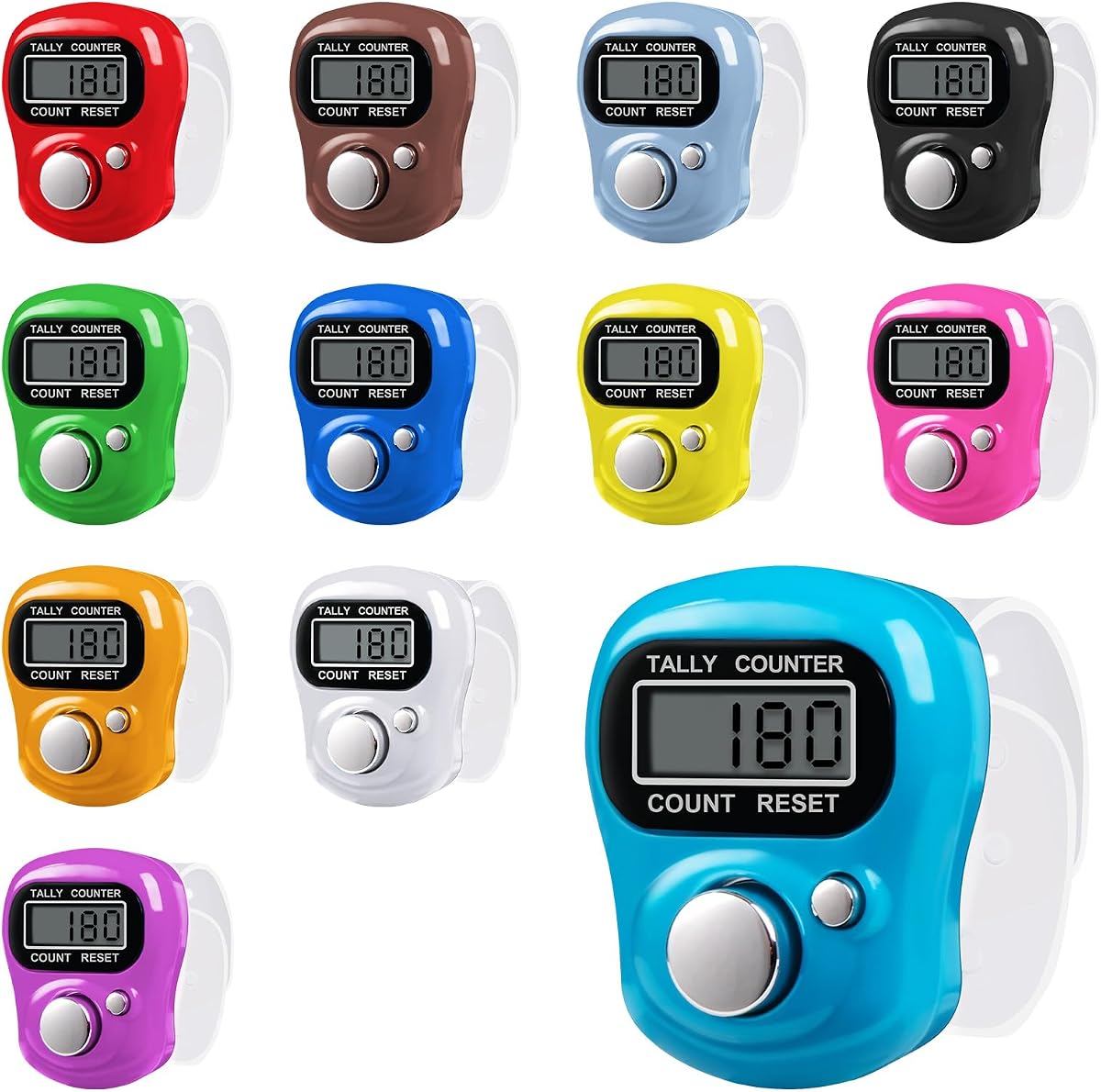
The Amble Finger Counter is a portable five-digit tally device offered in a twelve-pack, giving a group access to individual counters for crafts, events, education, sports, or inventory work. Its 4.6 rating reflects a user-friendly design with an adjustable finger strap, straightforward controls, and an automatic screen-off function.
We may earn a commission when you buy through this link, at no additional cost to you.
The soft, skin-friendly strap is designed to fit most fingers and can also slide over small cylindrical objects. Two buttons handle the essential actions: one records a count and the other resets the display to zero. The five-digit screen supports totals up to 99,999, while automatic screen shutoff conserves power after a period of inactivity and wakes when another count is recorded.
This is a manual counter rather than an automatic sensor model, and it cannot be mounted permanently in a control panel. The multipack format may be unnecessary for a single user, while the five-digit range is modest for very large inventories. The stated capacity should also be treated as a practical limit rather than a reason to defer resetting between batches.
The twelve-counter set is ideal for schools, workshop teams, clubs, knitting groups, and event organizers that need a reliable way to divide a larger task among several people. Individual users can wear a counter comfortably and tally independently. Choose it for portable manual counting and broad access; select a sensor-equipped panel totalizer when events should be registered automatically.
The adjustable, skin-friendly strap makes the counter easy to wear during repeated tasks. It can also sit over a small cylindrical object, offering a different way to position it when needed.
Automatic screen shutoff reduces unnecessary power use when a counter is left between rounds or tasks. Pressing the count button again wakes the screen with the final digit retained, supporting quick resumption.
We may earn a commission when you buy through this link, at no additional cost to you.
Start with the counting method, then narrow the field by display, capacity, power, sensor compatibility, and installation requirements. A counter that looks suitable but cannot receive the correct signal or fit the available space may be less useful than a simpler model designed for the actual task.
Manual counters use a button and suit sports, classroom exercises, knitting rounds, and situations where a person is present to record each event. Automatic counters use magnetic, proximity, or photoelectric sensing to register passing items. Manual operation is simple and flexible, while automatic sensing is usually better for production lines, machinery, and repeated objects. A counter can also support multiple input methods, such as the DIGITEN model that includes proximity and magnetic detection.
Choose manual counting for active, low-speed tasks and automatic counting for repeated machine events. Confirm that the sensor style suits the material, distance, and movement of the items.
LCDs are commonly associated with panel meters and often suit control-panel applications, while bright LED displays can be easier to read at a distance. The relevant factors are digit count, character size, viewing angle, backlighting, and whether the display must remain visible in bright or dim environments. A large panel number may be ideal for an operator standing nearby, whereas a sports score may benefit from a tall display visible across a room.
Prioritize readability over raw size. Confirm that the display technology matches your application, and check the stated dimensions before choosing a unit for a panel, wall, or handheld role.
Five-digit counters reach 99,999, six-digit counters reach 999,999, and eight-digit models offer still more capacity. Capacity matters when totals accumulate over many shifts, production runs, or events. It is also useful for avoiding a rollover that could disrupt a workflow. A larger display may be advantageous, but it should be balanced against panel space, power requirements, and ease of reading.
Estimate the largest realistic total and add room for growth. If your workflow regularly approaches the limit, choose a six- or eight-digit model and establish a regular reset routine.
Panel counters are not interchangeable without checking their electrical expectations. The LA8N-BN and H7EC BLM are described as using no-voltage input, while the LA8N-BN specifically requires a matching NPN arrangement. Do not assume a voltage-input machine can be connected directly. Photoelectric counters have their own material limitations, particularly with black, transparent, or metallic objects, and magnetic systems require suitable magnets and sensor alignment.
Compare the replacement device with the original counter's manual, especially terminal numbers, signal type, pulse width, and reset arrangement. If specifications are unclear, do not guess.
Battery-powered counters are convenient for portable and occasional use, while AC-powered units suit permanent production installations. AA or built-in battery systems simplify placement but require occasional power replacement, whereas a mains-powered panel counter needs safe fixed wiring. Panel models additionally require a suitable cutout, mounting depth, and terminal clearance. Wall-mounted units need reliable fixings and may need appropriate hardware for the surface.
Plan the power source and physical location before buying. Measure the panel, confirm the mounting method, and make sure you can safely access the battery, reset control, terminals, or wall attachment.
Counting speed must match the source. The LA8N-BN offers selectable maximum speeds and a stated minimum signal width, while the H7EC BLM supports up to 200 counts per second. The knitting counter and five-digit DIGITEN model are described around 20 counts per second, and the infrared tally counter includes an adjustable response setting. A high theoretical rate does not guarantee accuracy if the sensor is poorly positioned or the signal is too brief.
Use the manual to match timing and sensitivity to the process. Test with representative items, especially during a full-speed run, before treating the count as final.
Useful controls include reset, pause, up, down, remote adjustment, and count locking. Reset makes a new batch easy to begin, while pause protects a temporary interruption. Up-and-down functions help with scores and bidirectional totals. Power-off memory protects the last value, and count locking can help prevent accidental changes in a control panel. More controls are not automatically better; the best interface is the one that matches the operator's task.
List the controls your users will actually need and prioritize easy access. Make sure remote, panel, and reset functions are clear enough to prevent accidental count changes.
A large display and high digit count often come with a more substantial panel housing, while portable counters are optimized for handheld use. Finger counters are comfortable and easy to distribute, but their manual operation and five-digit capacity suit smaller tasks. Industrial panel counters offer more wiring and mounting complexity, yet they are better for permanent integration. Consider who will use the counter, where it will be placed, and how often it needs to move.
Choose portability for active, individual tasks and panel integration for machinery. Avoid paying for complexity that the application will not use, but do not sacrifice capacity when totals are genuinely large.
Begin by identifying the intended input method and installing the counter with power disconnected. For a panel unit, verify the cutout, mounting depth, terminal arrangement, and signal type before wiring. For a magnetic or proximity system, position the sensor where the moving target can pass consistently. For photoelectric counting, align the sensor and reflector, then test the beam with the actual objects that will be counted.
After installation, perform a short test run and compare the displayed total with the number of known events. Adjust sensor position, sensitivity, or counting speed if the count is missed or triggered unexpectedly. Learn the distinction between pause, reset, and power functions before beginning a count, particularly on models that use long button presses. When changing a value or restarting a batch, confirm that the previous total has been recorded if it is still needed.
For care, keep panel seals, terminal covers, and gaskets properly seated, and keep wiring away from high-voltage or high-frequency noise. Battery-powered models should be stored with the screen inactive during long periods of nonuse, while mains-powered equipment should be isolated safely before servicing. Clean the display and controls with a soft, dry or lightly damp cloth, avoid abrasive cleaners, and periodically retest automatic sensors against the real operating conditions.
An LCD counter is generally designed for instrument-panel integration and presents a numerical reading in a compact format. A digital LED tally counter usually emphasizes a bright, large display for manual or visible counting, such as sports laps or classroom activities. The choice depends more on mounting, controls, visibility, and input requirements than on the label alone.
Yes, but the counter must include or support an appropriate sensor. Magnetic, proximity, and photoelectric models can register movement or interrupted beams without a button press. The sensor must be matched to the object's material, distance, speed, and trigger pattern, and automatic accuracy should be verified under normal operating conditions.
Choose based on the largest total you expect to record before resetting. Five-digit units reach 99,999, while eight-digit models provide much more headroom for long production runs or cumulative totals. A larger display is useful when values approach the maximum, but it also requires more panel space and may be unnecessary for a small craft or short event.
No. A no-voltage input counter requires a compatible source, and a model specifying NPN input must be matched to the corresponding wiring arrangement. Voltage-output machines, AC or DC free-voltage descriptions, and different terminal layouts are not automatically interchangeable. Check the original equipment manual and the counter's connection diagram before installation.
Not necessarily. Standard photoelectric sensing can be unreliable with black, transparent, or metallic objects, as noted in the infrared tally counter's product information. Material, color, surface finish, angle, spacing, and speed all affect the signal. Test several real samples under the intended operating conditions before relying on the count for inventory or production records.
Power-off memory retains the last displayed value when the unit is switched off or loses power and restores it on restart. This reduces the need to reconstruct totals and can be especially valuable in production environments where interruptions are common. It does not replace a written backup if the counter is reset or its memory is intentionally cleared.
A manual finger counter is convenient for recording each completed row or stitch sequence and is often easier to use than a machine-mounted model. The six-digit knitting counter in this guide also supports magnetic induction, which can automate row counting when the setup is compatible. Choose based on whether you want to press a button or have a sensor detect each repetition.
Disconnect equipment power before wiring or servicing, verify the panel cutout and mounting depth, and use the correct input type. Tighten terminals securely, route wires away from high-voltage and high-frequency noise, and ensure sealing parts, covers, and brackets are properly seated. Test the count with a short run before restoring normal operation.
The H7EC BLM stands out as the most balanced technical choice, combining a six-digit LCD, fast electronic counting, a standard panel format, and a 4.8 rating. The DIGITEN 0-99999 is a more approachable option for makers who want both magnetic and proximity sensing, while the LA8N-BN offers the most advanced panel specification with an eight-digit display, configurable counting, and sealed-front construction.
Prioritize the counter that matches your trigger method, electrical environment, and physical space rather than choosing only by display size. Manual users should consider button comfort, memory, and visibility, while industrial buyers should verify input type, signal timing, cutout dimensions, and sensor performance. Craft users may benefit most from magnetic induction, and production operators should test real objects through the complete counting system.
Finally, review the current listing and technical documentation before ordering, especially for panel replacements and sensor-equipped systems. Product availability and pricing can change, but the required specifications should remain stable. A short compatibility check before installation is the most effective way to avoid delays, incorrect wiring, inaccurate totals, and returns.